



Table of Contents
You have been asked to submit a notarized copy of your diploma for an overseas job application. Or a bank requires a notarized letter for a loan. Or your immigration application asks for centralize supporting documents.
If you have never dealt with notarization before, these requests can feel confusing. What exactly is notarization? How is it different from just making a photocopy? Why do some organizations insist on it? And where do you even go to get something notarized?
This comprehensive guide explains everything about notarization, why it matters, and how to navigate the process in Canada.
WHAT IS NOTARIZATION? THE LEGAL DEFINITION
Notarization is the process where a licensed official (a notary public) witnesses the signing of a document and certifies its authenticity.
In simpler terms: A notary public is a legal professional appointed by the government to serve as an impartial witness to important documents. When you have something notarized, the notary:
- Verifies your identity (using government-issued photo ID)
- Witnesses you signing the document
- Confirms the document is genuine
- Applies their official seal and signature
- Records the event in their official notary journal
This creates an official record that a qualified professional has verified the authenticity of your document and signature.
The Legal Authority Behind Notarization
In Canada, notaries public are appointed under provincial authority. Each province (Ontario, British Columbia, Alberta, etc.) has specific rules about: – Who can become a notary public – What powers they have – What documents they can notarize – How they maintain official records
In Ontario specifically: – Notaries public are regulated under the Notaries Act – They have specific authority to certify documents – Their seals and signatures carry legal weight – They maintain official journals for accountability
The key point: a notary’s seal and signature carry legal authority because they’ve been appointed by the government and bound by professional standards.
WHY NOTARIZATION MATTERS: THE LEGAL WEIGHT BEHIND THE SEAL
Why does this need to be notarized? Can I just photocopy it
This is the most common question. The answer reveals why notarization exists:

The Problem With Regular Copies
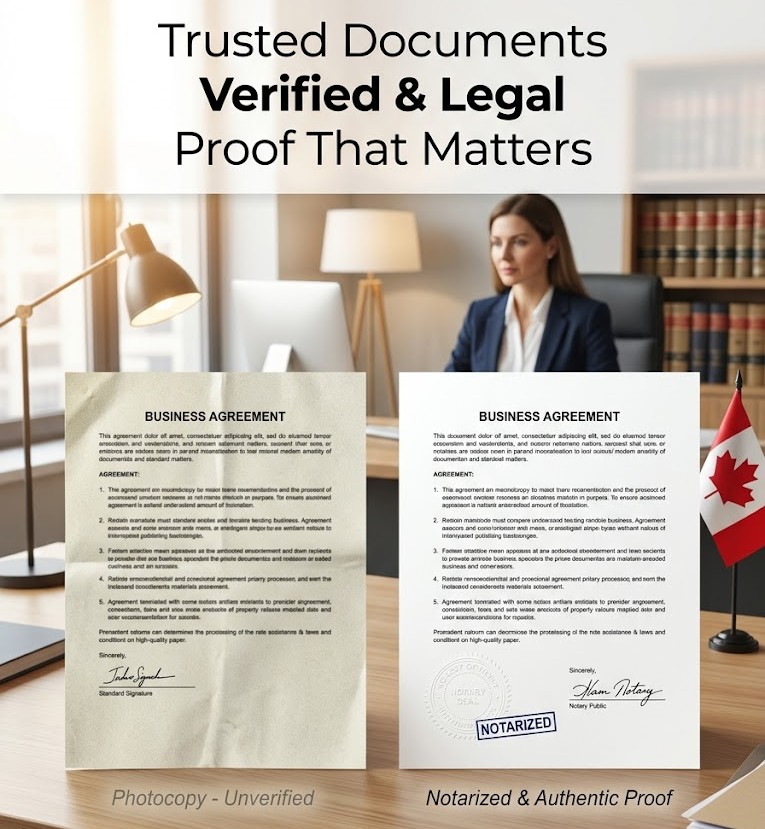
A regular photocopy of a document has zero legal weight. Here why:
- Anyone can make a photocopy
- No one knows if the copy matches the original
- No one knows if the original is genuine
- No one verified anything
- Anyone could have altered the document
Example: You photocopy your university diploma and submit it to an employer overseas. The employer has no way to know: – Is this a real diploma from a real university? – Is this photocopy accurate, or has it been altered? – Did this person actually graduate?
The employer can verify anything, so they may not trust it.
The Power of Notarization
When a document is notarized, several things change:
- A qualified official has verified it
- That official’s reputation is on the line
- An official record exists in their journal
- If it turns out to be fraudulent, the notary can be held liable
- Government and legal institutions trust notarized documents
Same example with notarization: You get your diploma notarized and submit it to the overseas employer. Now they know: – A Canadian notary public verified the document – That notary examined the original diploma – That notary confirmed it matches the copy – That notary seal guarantees authenticity – If it fraudulent, the notary bears responsibility
This transforms a worthless photocopy into a legally valuable document.

Who Trusts Notarized Documents?
Government agencies across Canada and internationally: – Immigration authorities (IRCC, USCIS) – Banks and financial institutions – Courts and legal systems – Schools and educational institutions – Insurance companies – Foreign governments (via apostille) – International organizations
When these entities request a unnotarized document, there asking for this official verification.
WHICH DOCUMENTS NEED TO BE NOTARIZED? COMPREHENSIVE LIST
Not every document needs notarization. But these do:
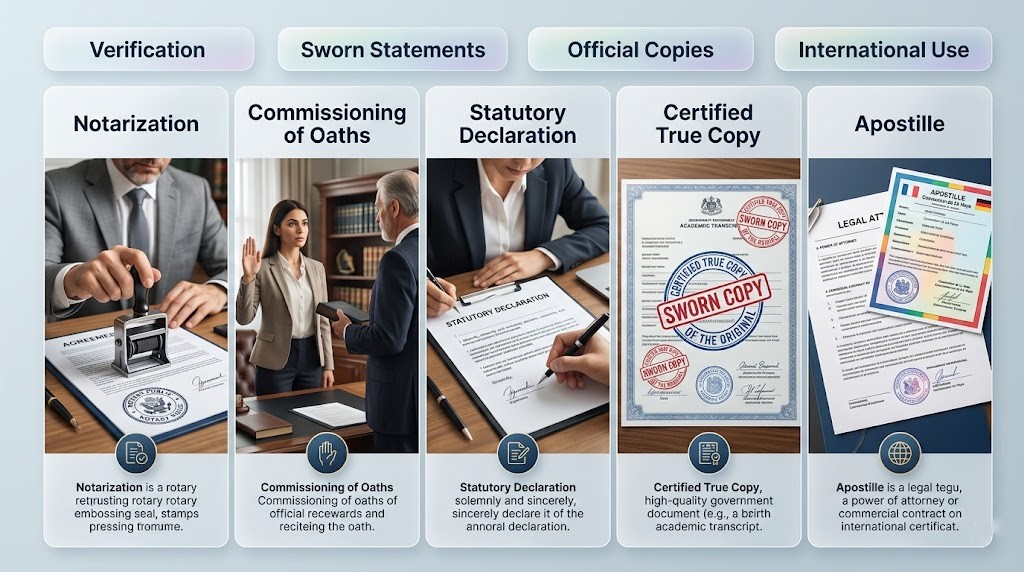
Immigration & Travel Documents
- Visa invitation letters: Inviting family/friends to visit Canada
- Passport certifications: Proving your passport copy is accurate
- Birth certificate copies: For immigration applications
- Diploma certifications: Proving educational credentials
- Sponsorship supporting documents: For family immigration
- Travel consent letters for minors: Permission to travel
Legal & Court Documents
- Powers of attorney: Legal documents granting someone authority
- Statutory declarations: Formal statements for legal proceedings
- Affidavits: Sworn statements as evidence
- Consent forms: Legal permission documents
- Declarations of common law partnership: Legal relationship documentation
Why it matters: Courts require notarized documents to verify that you genuinely agreed to and signed the document. It prevents fraud and forgery.
Financial & Banking Documents
- Statutory declarations for loans: Proving financial circumstances
- Proof of funds declarations: Demonstrating you have money
- Bank authorization letters: Permission to act on bank account
- Mortgage documentation: Real estate transaction documents
Why it matters: Financial institutions need assurance that the person claiming to have funds actually does, and that documents are authentic.
Real Estate Documents
- Property transfer declarations: Ownership transfer documentation
- Mortgage applications: Real estate financing
- Property ownership affidavits: Proving who owns property
Why it matters: Real estate transactions involve significant money and legal rights. Notarized documents prevent fraud in these high-value transactions.
Business Documents
- Corporate resolutions: Official company decisions
- Authorization letters: Permission to act on business behalf
- Business declarations: Formal business statements
Why it matters: Business partners and stakeholders need assurance that decisions are genuine and authorized.
Educational Records
- Diploma copies: For overseas employment or further education
- Transcript certifications: Academic record verification
- Certificate attestations: Proving educational achievement
Why it matters: Educational institutions and employers worldwide need assurance that degrees are real and credentials are accurate.
NOTARIZATION VS OTHER DOCUMENT SERVICES: WHAT'S THE DIFFERENCE?
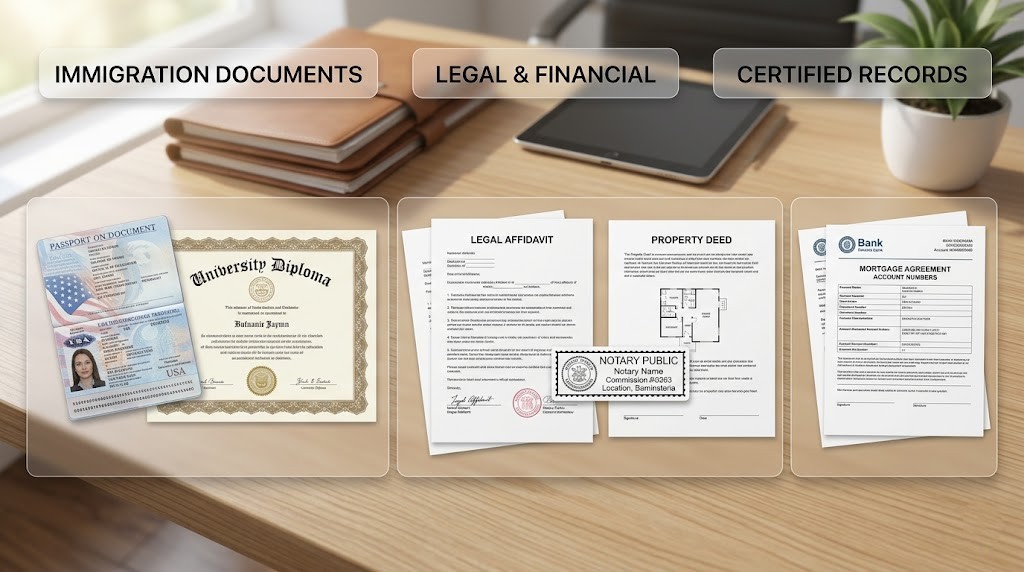
Notarization vs Commissioning of Oaths
Notarization: – Certifies that copies match originals – Verifies signature authenticity – Certifies documents are genuine
– No oath ceremony required – Used for: passport copies, diploma copies, certificates
Commissioning of Oaths: – Witnesses someone taking a solemn oath – Administers formal oath ceremony – Certifies truthfulness of a statement – Requires oath/affirmation (“I solemnly swear…â€) – Used for: affidavits, statutory declarations, character references
Key difference: Notarization is about authenticating documents. Commissioning is about witnessing sworn statements.
Notarization vs Statutory Declaration
Notarization: – You bring already-signed copies – Notary confirms they match originals – No legal statement involved – Quick process (15-30 minutes)
Statutory Declaration: – You bring an unsigned document – You make a formal statement under penalty of perjury – Legal consequences for false statements – Longer process (30-45 minutes)
Key difference: Statutory declarations have legal penalties for false statements. Notarization is just verification.
Notarization vs Certified True Copy
Certified True Copy: – Official copy that certified as accurate – Often created by government agencies – May be more authoritative than notarized copies – Longer to obtain (government processing)
Notarized Copy: – Your copy verified by notary as accurate – Faster to obtain – Widely accepted internationally – Notary’s reputation stands behind it
Key difference: Certified true copies come from official sources. Notarized copies come from private notaries.
In practice: Many organizations accept notarized copies. For government-specific needs, ask which type they require.
Notarization vs Apostille
Notarization: – Canadian authentication only – Recognized in Canada, US, some other countries – Can be done by any notary public – Minimal cost
Apostille: – International authentication (Hague Convention countries) – Recognized worldwide in 190+ countries – Requires special processing – Takes longer (5-7 business days) – Adds “Apostille certificate†to notarized document
Key difference: Notarization works for most countries. Apostille is specifically for Hague Convention countries (Australia, EU, UK, etc.).
When to use: – Notarization: US, Mexico, informal international use – Apostille: Formal international use, specific countries – Both: When unsure (notarize first, then apostille if needed)
THE NOTARIZATION PROCESS: STEP BY STEP
Understanding what happens during notarization removes the mystery:
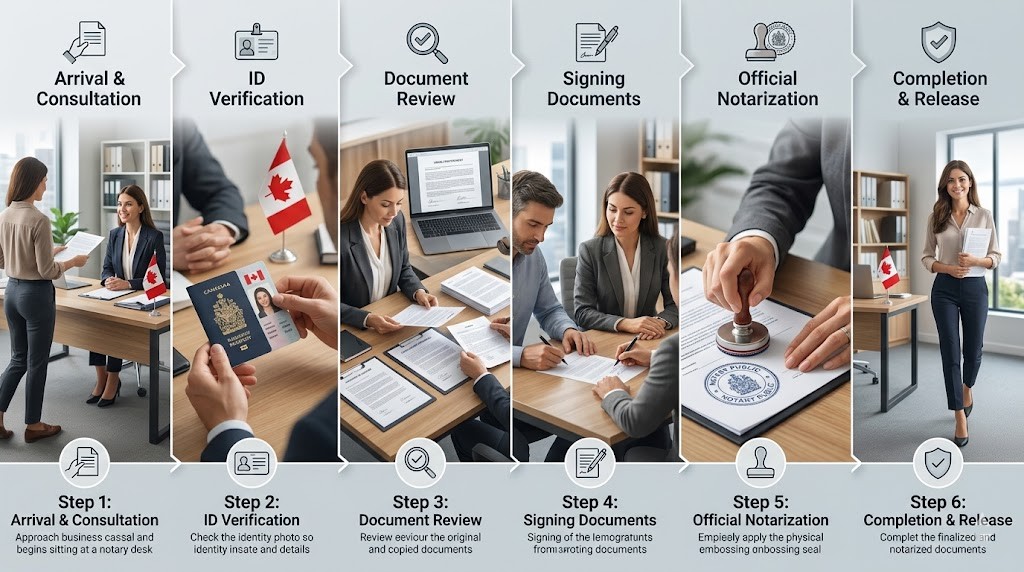
Before You Arrive
What you need to prepare: 1. Original document: You must bring the original to compare to copies 2. Copies to be notarized: Clean, complete copies (all pages, all signatures) 3. Valid government-issued photo ID: Drivering license, passport, or provincial ID 4. Understanding: Know what document says and that it accurate
What you should NOT do: – Don’t sign the copy before arriving (notary witnesses your signature) – Don’t assume every page needs notarization (ask first) – Don’t bring damaged or illegible copies (get clean copies made)
Step 1: Arrival & Registration (2 minutes)
- Check in with the notary
- Provide list of documents you want notarized
- Provide your identification
Step 2: Identity Verification (3 minutes)
- Show government-issued photo ID
- Notary examines your ID carefully
- Notary records your ID information in official journal
- Notary confirms your signature on ID matches your document signature
Step 3: Document Examination (5 minutes)
- Notary examines your original document carefully
- Notary examines your copies to notarize
- Notary confirms the copies are accurate and complete
- Notary asks: Are these copies true and accurate reproductions?
- You confirm they are
Step 4: Signing the Notarization Form (3 minutes)
- You sign the notarization form in the notary presence
- This is critical you MUST sign while the notary watches
- Don’t pre-sign before arriving
What the form says: – Your name – Description of the documents – Statement that these are true and accurate copies – Date of notarization – Your signature and witness (notary signature)
Step 5: Notarial Seal & Certificate (2 minutes)
- Notary applies their official seal/stamp to the document
- Notary signs the notarization certificate
- Notary records all details in official journal
- Document is now notarized
Step 6: You Leave With Notarized Documents
- Documents are valid immediately
- No waiting period
- Notarized copies are ready for submission
Total time: Typically 15-30 minutes for straightforward notarization
COMMON NOTARIZATION SCENARIOS: REAL-WORLD EXAMPLES
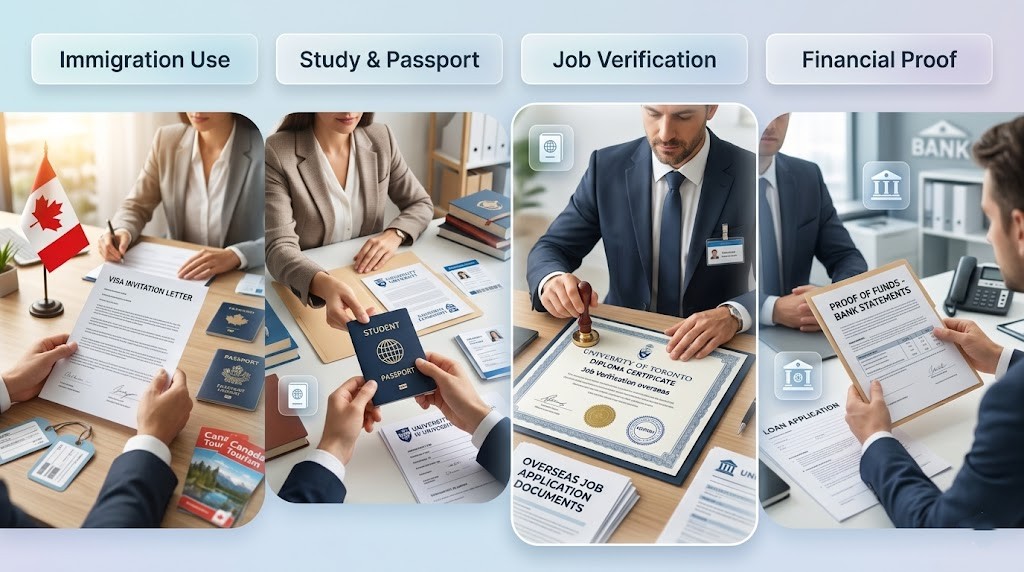
Scenario 1: Immigration Visa Invitation Letter
Your situation: i am inviting my parents from India to visit Canada. The visa officer asked for a notarized invitation letter.
What happens: – You write an invitation letter explaining who you are, your relationship to your parents, and invitation details – Notary verifies it’s your genuine letter – Notary certifies the copy is true and accurate – Your parents submit notarized letter with visa application – Indian visa officer trusts it because a Canadian notary verified it
Timeline: 20 minutes Documents needed: Original letter, copy to notarize, ID
Scenario 2: Passport Certification for Study Permit
Your situation: i am applying for a Canadian study permit. The university requires certified copies of my passport.
What happens: – You bring your original passport – Notary examines it page by page – Notary certifies that your copy matches the original exactly – You get notarized passport copies – University accepts them as official proof of your identity
Timeline: 15 minutes per set of copies Documents needed: Original passport, copies, ID
Scenario 3: Employment Overseas Diploma Certification
Your situation: I got a job offer overseas. My employer needs notarized copies of my university diploma to verify my credentials.
What happens: – You bring original diploma – Notary examines it carefully – Notary certifies that your copy is identical
– Your employer receives notarized diploma – Employer trusts it because they know a Canadian official verified it
Timeline: 15 minutes Documents needed: Original diploma, copy, ID
Scenario 4: Bank Proof of Funds Declaration
Your situation: “The bank wants a notarized declaration showing I have enough funds for a mortgage.
What happens: – You bring bank statements or proof of funds – Notary certifies that your declaration statement is true
– Bank accepts notarized declaration – Bank knows notary verified the claim, reducing fraud risk
Timeline: 20 minutes Documents needed: Bank statements, declaration form, ID
WHEN TO CHOOSE NOTARIZATION VS. LEGAL HELP
Choose Notarization For:
- Copying documents and verifying they match originals
- Passport/diploma certifications
- Invitation letters
- Travel consent letters
- Proof of funds declarations
- Documents where you just need verification
Choose a Lawyer For:
- Creating legal documents (powers of attorney, wills)
- Complex legal matters
- Documents requiring legal advice
- Court proceedings
- Contracts and agreements
Often you need BOTH: A lawyer creates/reviews your legal document, then a notary notarizes it.
PRACTICAL TIPS FOR SUCCESSFUL NOTARIZATION
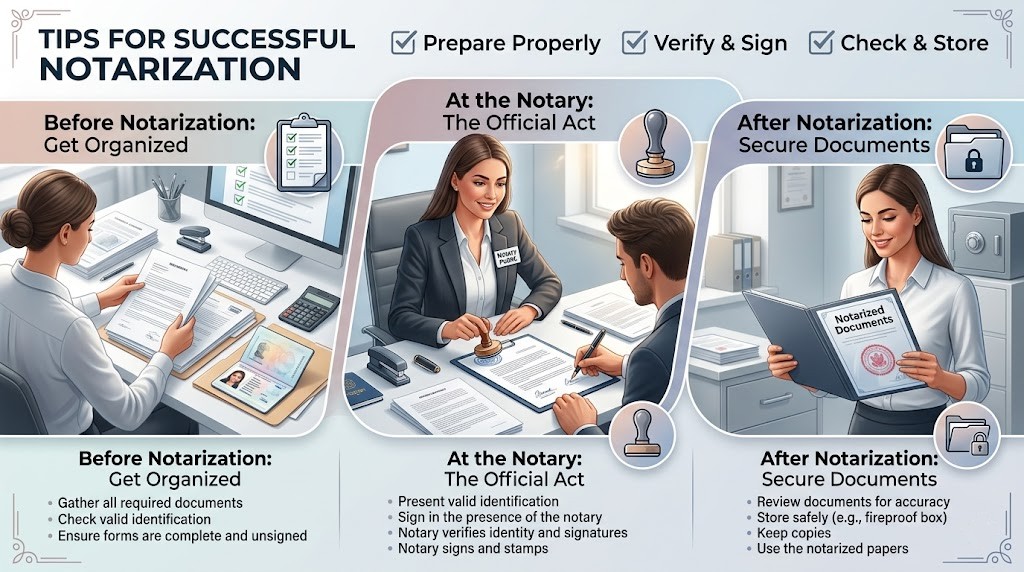
Before You Go to the Notary
- Understand what you need: Call ahead and ask which documents need notarization
- Prepare clean copies: Don’t bring blurry or damaged copies
- Bring originals: Notary must see originals to verify copies
- Bring valid ID: Must be current government-issued photo ID
- Get there early: Especially if you have multiple documents
- Understand the documents: Be able to explain what they are
At the Notary's Office
- Answer questions honestly: Notary may ask why you need notarization
- Don’t pre-sign: Wait to sign in notary’s presence
- Read carefully: Understand what you’re signing
- Get multiple copies notarized: If you need more than one
- Ask about apostille: If documents are going international
After Notarization
- Check the seal: Ensure seal is clear and legible
- Keep originals safe: Store original documents securely
- Know validity: Notarized documents are valid indefinitely unless time-specific
- Prepare backups: Have extra notarized copies made (notary can do this)
- Keep receipts: Document your notarization for records
CONCLUSION: THE VALUE OF PROPER DOCUMENTATION
In our increasingly digital world, proper documentation still matters enormously. When government agencies, banks, employers, and institutions ask for notarized documents, they’re asking for verification they can trust.
Notarization is the bridge between an informal photocopy and an official, trusted document. It’s an efficient, affordable way to add legal weight to your documentation.
Whether you’re applying for immigration benefits, securing employment overseas, handling banking matters, or managing legal affairs, notarized documents can smooth your path and speed your process.
Next time someone asks for a notarized copy, you’ll know exactly what they mean and why it matters.
FAQ: Your Questions Answered
How long is a notarized document valid?
Indefinitely. Once notarized, a document remains notarized forever (unless the notary’s seal expires). However, some organizations require notarization within a specific timeframe (3-6 months) before submission. Always check the recipient’s requirements.
Can I get a document notarized if I don't have the original?
Ideally no. Notarization requires comparing your copy to the original. However, in some cases with sufficient documentation of authenticity, a notary may notarize a copy without seeing the original. Call the notary to discuss your specific situation first.
Do I need to sign the document in front of the notary?
YES. This is critical. Documents must be signed in the notary’s presence. Don’t pre-sign before arriving. The notary is witnessing your signature.
Can you notarize a document in a language other than English?
Generally, notaries work with English documents. For non-English documents, you may need: – A certified translation first (translator creates English version) – Then notarization of the English translation – Or a specialized notary who speaks that language
What if I need documents notarized but I can't visit in person?
Some notaries offer: – Mobile notary services (notary comes to you) – Remote/online notarization via video (for certain documents) – Courier services (you send documents, they notarize and return)
How long does it take for immigrants and international applicants?
No. A notary public is different from a lawyer. You don’t need legal advice to get notarization. However, for complex legal documents, you may want to consult a lawyer about the document itself, then get it notarized separately.
What's the difference between a notary and a lawyer?
Notary: Verifies documents and signatures, doesn’t provide legal advice – Lawyer: Provides legal advice and can also notarize documents
Some lawyers are also notaries. Some notaries are not lawyers.
How much does notarization typically cost?
Costs vary by location and notary, but notarization is generally one of the most affordable document services available. It’s significantly less expensive than legal services.
Can I get multiple documents notarized at one visit?
Yes. Many notaries offer volume discounts or reduced rates per document when you notarize multiple documents at one time. Ask when you arrive.
What should I bring to get something notarized?
Original document – Copies to be notarized – Valid government-issued photo ID – Any forms that need to be filled out
- Payment (ask about cost beforehand)

Navneet Lotey
Navneet Lotey has over 5 years of experience in fingerprinting. He aims to deliver accurate, easy-to-understand fingerprinting solutions for individuals and businesses alike.