


Table of Contents
Adopting a child is one of the most significant decisions a family can make. It involves deep emotional investment, months or years of preparation, and a series of legal and administrative requirements designed to protect the best interests of the child. Among these requirements — and one that surprises many prospective adoptive parents — is the need for RCMP fingerprinting and a certified criminal record check.
Whether you are pursuing a domestic adoption within Canada or an international adoption from another country, fingerprinting is a mandatory step in the process. This guide explains why it is required, who needs it, how the process works, and how to get it done as efficiently as possible so your adoption timeline is not delayed.
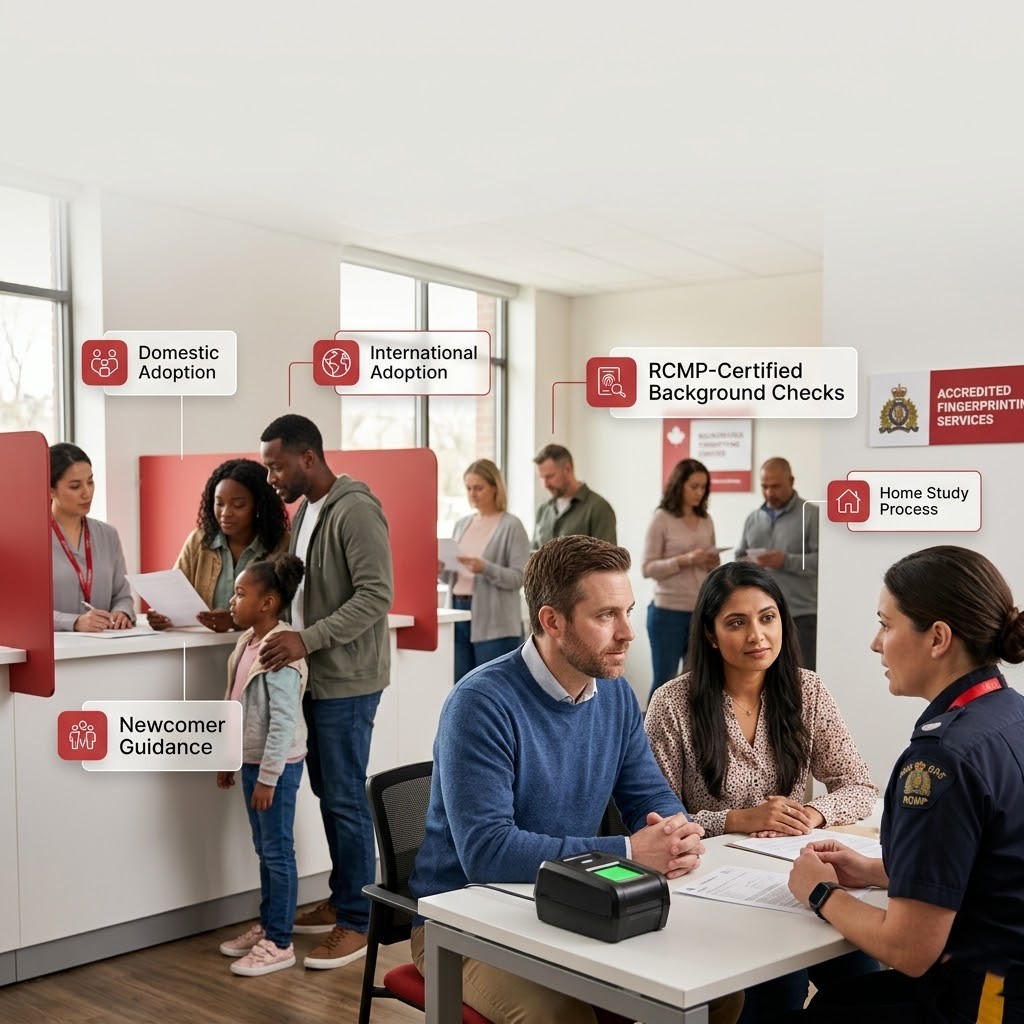
Who Is This Guide For?
- Prospective adoptive parents pursuing domestic adoption through a provincial agency or Children’s Aid Society
- Canadian citizens and permanent residents planning to adopt a child from another country
- Adults in the household who are required to submit background checks as part of a home study
- Newcomers and immigrants in Canada pursuing adoption for the first time
- Families working with private adoption agencies that require RCMP-certified background checks
- Anyone who wants to understand what fingerprinting for adoption involves before starting the process
Why Is Fingerprinting Required for Adoption in Canada?
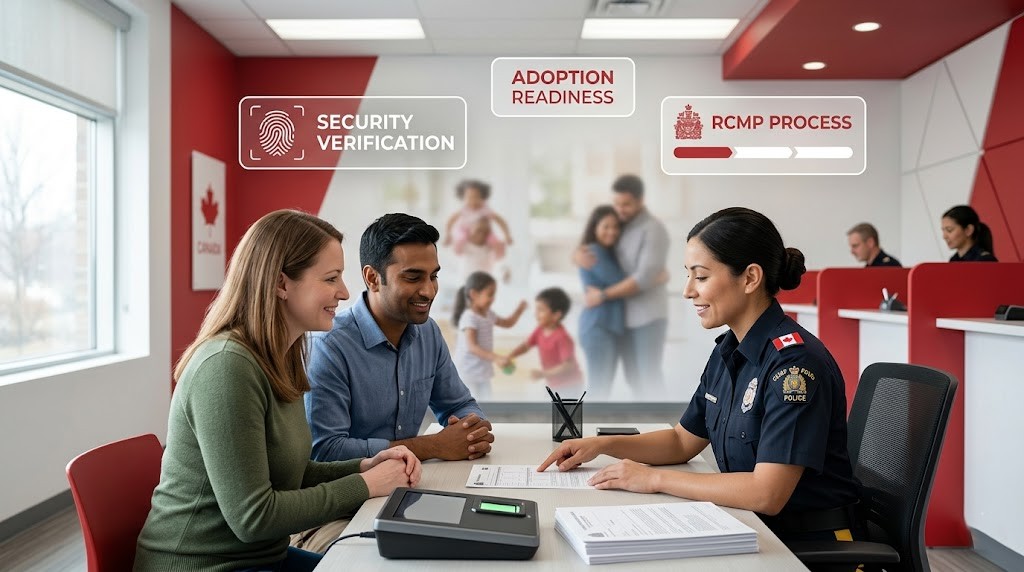
Canada’s adoption system — at both the provincial and federal level — places the child’s safety and wellbeing above everything else. Before any child can be placed in a home, every adult in that household must demonstrate they have no criminal history that would make them unsuitable as a caregiver or parent.
A name-based police check alone is not sufficient for adoption purposes. The RCMP’s fingerprint-based criminal record check searches the national database with biometric certainty, ensuring the result is accurate and cannot be confused with another person who shares your name. This is the standard required by provincial adoption agencies, Immigration, Refugees and Citizenship Canada (IRCC), and the governments of many countries from which children are adopted.
Learn how RCMP certified fingerprinting works: https://loteyfingerprinting.ca/rcmp-certified-fingerprinting-canada-2025-guide/
Domestic vs International Adoption: Fingerprinting Requirements Compared
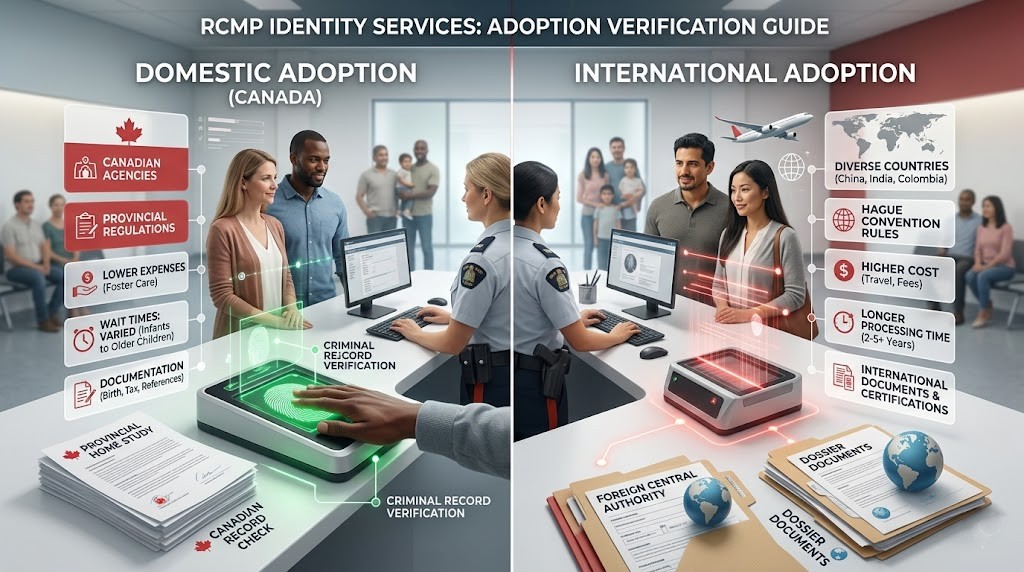
| Requirement | Domestic Adoption (Within Canada) | International Adoption (From Abroad) |
|---|---|---|
| RCMP Criminal Record Check | Required for all adult household members | Required for all adult household members |
| Fingerprinting method | Digital live scan or ink-and-roll | Digital live scan preferred; ink-and-roll for foreign submissions |
| Vulnerable Sector Check | Required in most provinces | May be required alongside criminal check |
| Foreign country check | Not required | Required by most sending countries |
| IRCC requirement | N/A (provincial process) | Required for sponsorship and immigration of child |
| Home study background check | All adult members of household | All adult members of household |
| Validity period | Varies by province — typically 6 months to 1 year | Varies by country and IRCC requirements |
| Who processes the results | Provincial agency / Children’s Aid Society | IRCC + foreign country authorities |
Fingerprinting for Domestic Adoption in Canada
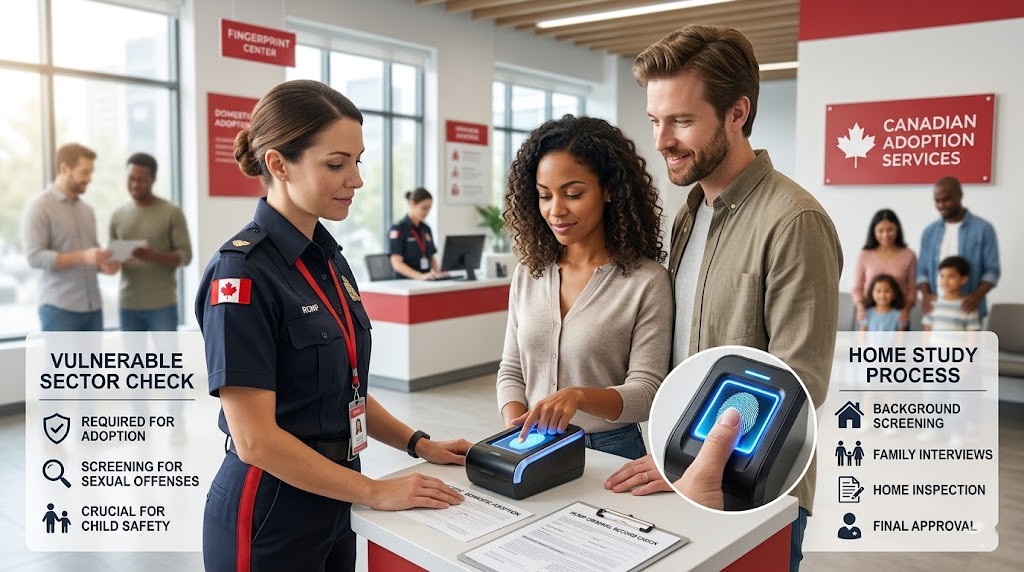
Domestic adoption in Canada is regulated at the provincial level. Each province and territory has its own process, but all require prospective adoptive parents and household adults to complete a criminal record check as part of the home study. In most provinces, this includes a Vulnerable Sector Check — the enhanced check that also searches for pardoned sexual offences.
In Ontario, for example, families adopting through the Children’s Aid Society (CAS) or a licensed private adoption agency must submit both a criminal record check and a Vulnerable Sector Check for every adult in the home. Because children are the vulnerable population being protected, the VSC requirement is standard. Read the Vulnerable Sector Check guide: https://loteyfingerprinting.ca/vulnerable-sector-check-canada-fingerprinting/
Fingerprints are typically required because of the sensitive nature of the application — a name-based check is not considered sufficient when a child’s placement is at stake. Many prospective parents are surprised to learn that even individuals with no criminal record may need to provide fingerprints to confirm their identity.
Fingerprinting for International Adoption in Canada
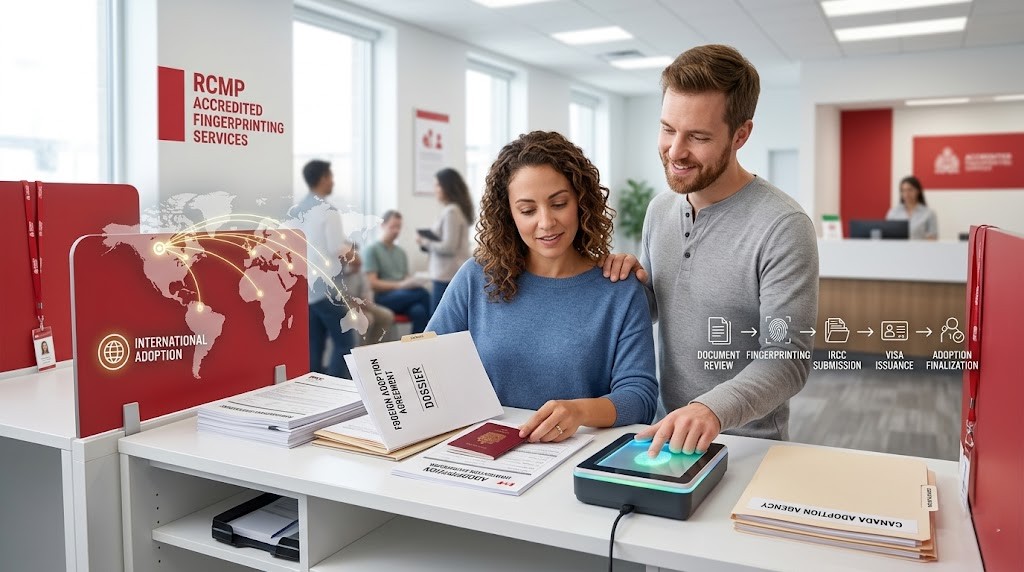
International adoption involves two parallel processes: the legal adoption in the child’s home country, and the immigration or citizenship process that allows the child to come to Canada. Both processes require fingerprint-based criminal record checks.
The Canadian Side: IRCC Requirements
Immigration, Refugees and Citizenship Canada (IRCC) requires all prospective adoptive parents to submit an RCMP-certified criminal record check as part of the sponsorship or citizenship application for the child. This is not optional — IRCC will not process the child’s immigration or citizenship without it.
Additionally, children over the age of 14 who are being adopted internationally are themselves required to provide biometrics (fingerprints and photo) for their permanent residence application.
The Foreign Country Side
Most countries that permit international adoption also require Canadian prospective parents to submit proof of a clean criminal history. Many sending countries require both a Canadian RCMP criminal record check and in some cases an FBI check or a police clearance from your country of origin. Requirements vary significantly by country, so always verify with your adoption agency and the foreign country’s central adoption authority.
Read about police clearance vs criminal record check: https://loteyfingerprinting.ca/police-clearance-vs-criminal-record-check-international-students-canada/
Who in the Household Needs to Be Fingerprinted?
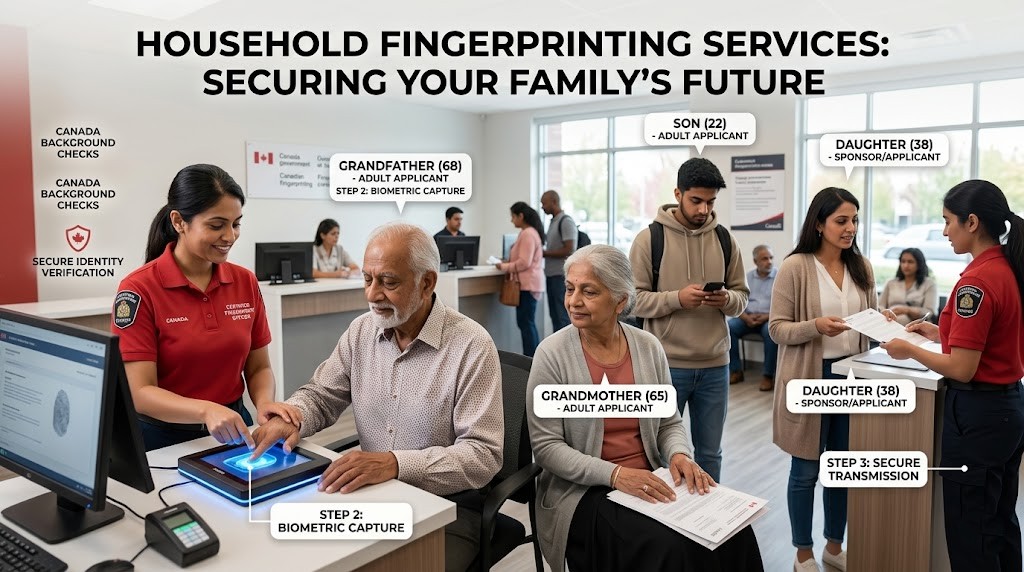
It is not just the primary adoptive parents who need fingerprinting. The home study process requires a background check on every adult member of the household — typically defined as anyone age 18 or older who resides in the home. This includes:
- Both adoptive parents (or the sole adoptive parent)
- Any other adult relatives living in the home
- Adult children or other adult occupants
- Live-in caregivers or au pairs in some cases
Missing a household member’s background check is one of the most common reasons adoption home studies are delayed. Identify all adults in the home early and schedule fingerprinting appointments together to keep your timeline on track. Lotey Fingerprinting offers mobile fingerprinting services for groups: https://loteyfingerprinting.ca/mobile-fingerprinting-services-canada/
Step-by-Step: How Fingerprinting for Adoption Works in Canada
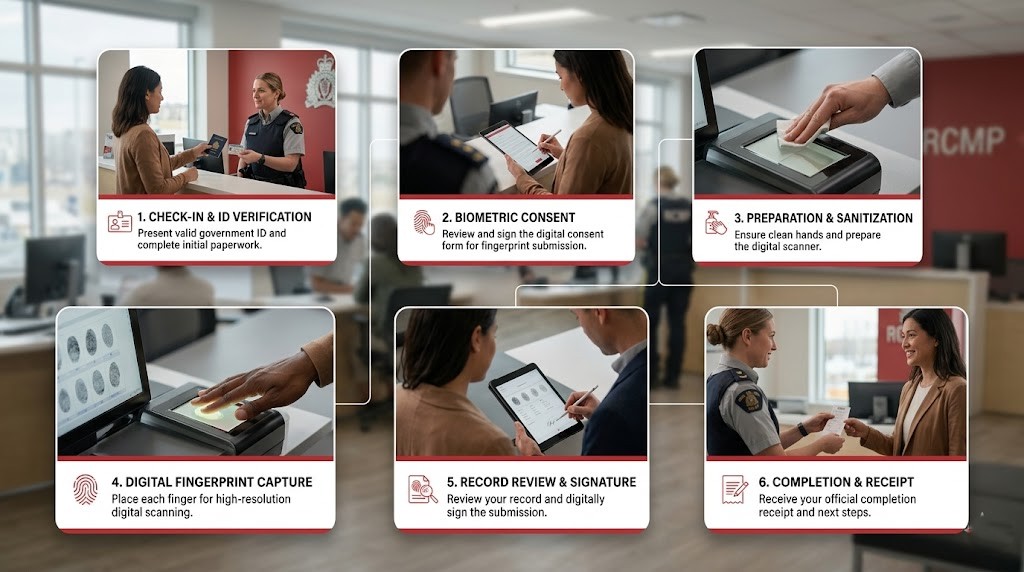
- Confirm with your adoption agency or provincial authority exactly which checks are required and for whom.
- Identify all adult members of the household who need to be fingerprinted.
- Gather the required identification: two pieces of valid government-issued ID per person, including at least one photo ID.
- Book an appointment at an RCMP-accredited fingerprinting provider. For Brampton and GTA residents, Lotey Fingerprinting handles adoption fingerprinting: https://loteyfingerprinting.ca
- Choose your fingerprint method — digital live scan is fastest and most accurate. Read the guide: https://loteyfingerprinting.ca/digital-live-scan-fingerprinting-guide-canada/
- For international adoptions, also confirm whether the sending country requires ink-and-roll fingerprint cards on specific forms. Read the ink-and-roll guide: https://loteyfingerprinting.ca/ink-roll-fingerprinting-guide-canada/
- Your fingerprints are submitted to the RCMP’s CCRTIS. Processing typically takes 3 business days for a clean record, or up to 120 days if manual review is required.
- Results are mailed via Canada Post. Read about processing timelines: https://loteyfingerprinting.ca/rcmp-criminal-record-check-processing-time-2026/
- Submit completed results to your adoption agency, provincial authority, and/or IRCC as required.
- Repeat if checks expire before placement is completed — most adoption checks have a validity window of 6 months to 1 year.
Common Mistakes Adoptive Parents Make With Fingerprinting
- Only having the primary applicant fingerprinted — forgetting other adults in the household.
- Submitting a basic name-based police information check instead of an RCMP-certified fingerprint check.
- Not confirming whether the foreign country requires additional checks (such as FBI or home-country police clearance).
- Waiting too long to start — fingerprinting early in the process prevents delays later.
- Not renewing expired checks before the adoption placement is finalised.
- Choosing a non-RCMP-accredited provider whose results may be rejected by the adoption agency or IRCC.
- Forgetting to bring the correct ID to the appointment, causing delays and rebooking.
For more on mistakes newcomers and first-timers make during the fingerprinting process, read: https://loteyfingerprinting.ca/top-5-mistakes-newcomers-canada/
How Long Are Fingerprinting Results Valid for Adoption?
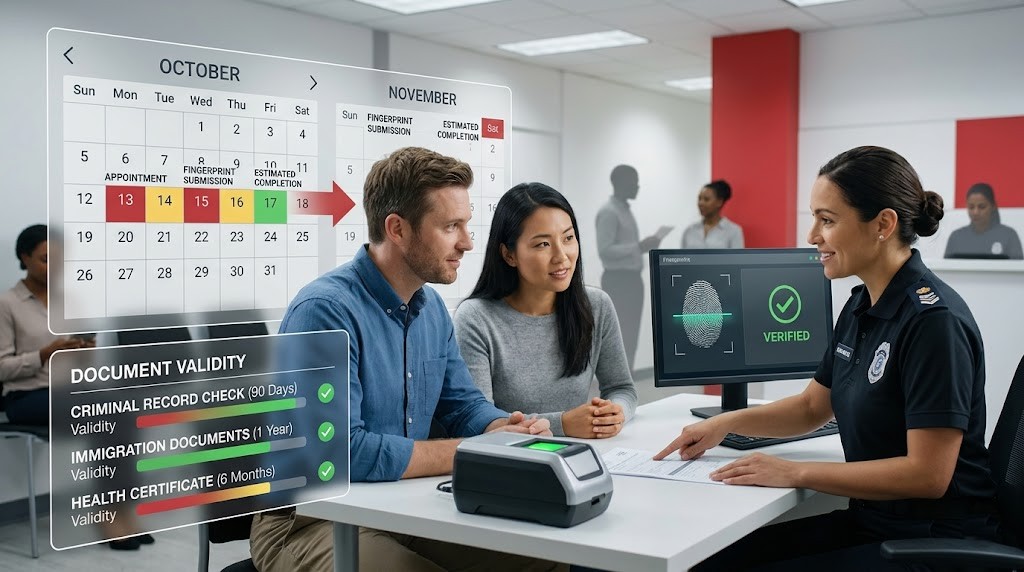
Criminal record check validity for adoption purposes varies by province and by the requirements of the international sending country. In Ontario, most adoption agencies accept results that are no more than 6 months old at the time of submission. IRCC may have its own validity window for the immigration and sponsorship process.
International adoptions in particular can take several years to complete. If your criminal record check expires during the process, you will need to be re-fingerprinted. Build renewal into your adoption timeline to avoid disruptions at critical stages.
To understand the difference between a police clearance and a criminal record check, read: https://loteyfingerprinting.ca/police-clearance-vs-criminal-record-check-international-students-canada/
How Long Does Adoption Fingerprinting Take?
The fingerprinting appointment itself takes approximately 15 minutes at Lotey Fingerprinting. RCMP processing for digital live scan submissions takes 3 business days for applicants with no criminal record, with Canada Post delivery adding approximately 3 to 7 business days on top. Most adoption applicants with clean records receive their results within 1 to 2 weeks total.
Getting Adoption Fingerprinting Done in Brampton and the GTA
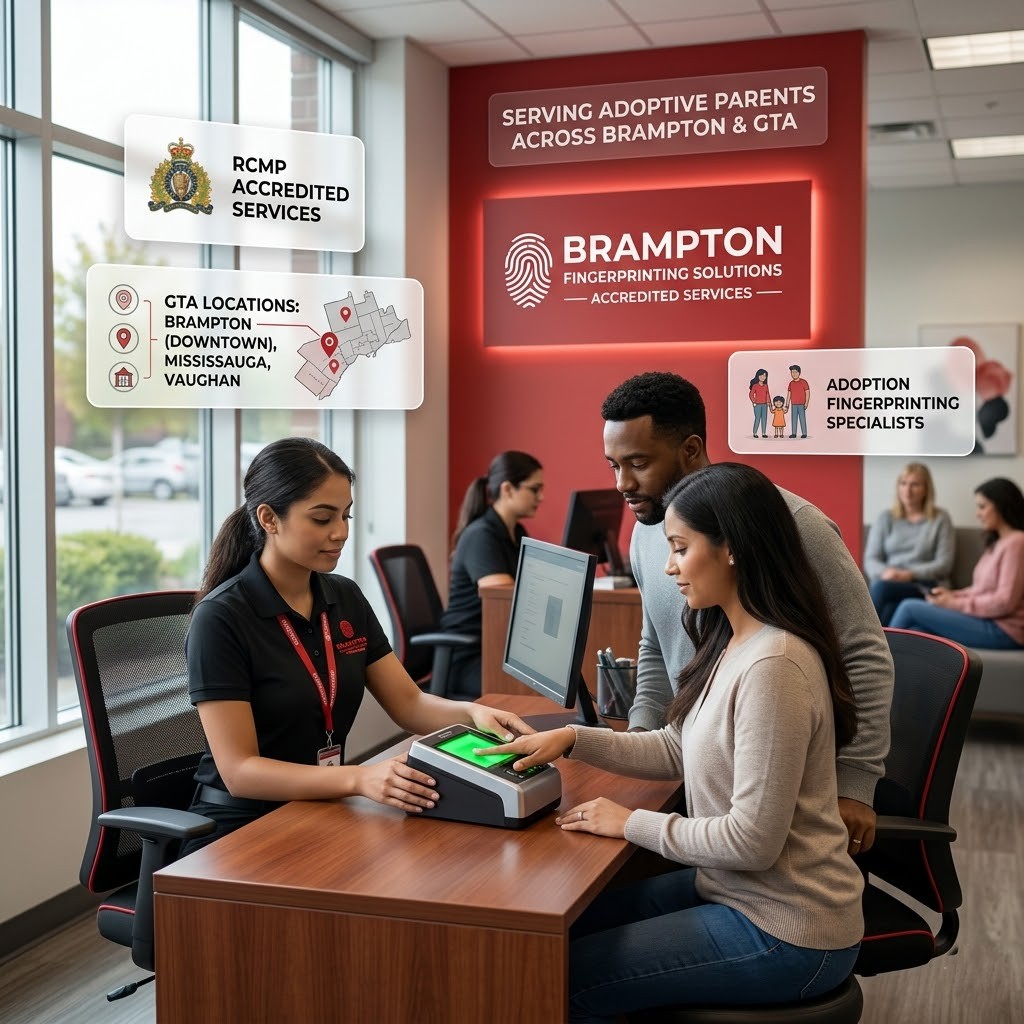
Lotey Fingerprinting in Brampton provides RCMP-accredited fingerprinting services specifically for adoption-related background checks. Our team is experienced with both domestic and international adoption requirements, including digital live scan, ink-and-roll fingerprint cards, and the specific form and ID requirements that adoption agencies and IRCC demand.
We serve families across Brampton, Mississauga, Toronto, and the GTA. For households with multiple adults who need fingerprinting, we also offer mobile fingerprinting services. Visit https://loteyfingerprinting.ca/brampton-background-check-fingerprinting/ to learn more or book your appointment at https://loteyfingerprinting.ca
Ready to Start Your Adoption Fingerprinting?
At Lotey Fingerprinting in Brampton, we understand that every day counts when you are waiting to bring a child home. Our RCMP-accredited team helps prospective adoptive parents and all household adults get their fingerprinting completed accurately and without unnecessary delays.
Whether you are adopting domestically through a provincial agency or internationally through IRCC, we are here to guide you through the fingerprinting step so your adoption process stays on track. Visit https://loteyfingerprinting.ca to book your appointment, or call us to discuss your specific adoption fingerprinting requirements.
Also explore: Immigration fingerprinting — https://loteyfingerprinting.ca/immigration-fingerprinting-services-canada/
Citizenship fingerprinting — https://loteyfingerprinting.ca/citizenship-fingerprinting-guide-canada/
Security clearance fingerprinting — https://loteyfingerprinting.ca/security-clearance-fingerprinting-canada/
FAQ: Your Questions Answered
Do I need RCMP fingerprinting for adoption in Canada?
Yes. All prospective adoptive parents and adult household members must submit an RCMP-certified criminal record check as part of the adoption home study process. For domestic adoptions involving children, a Vulnerable Sector Check is also typically required.
Does every adult in my home need to be fingerprinted for adoption?
Yes. The home study background check process requires a criminal record check for every adult member of the household, typically defined as any person age 18 or older who resides in the home. Missing a household member is one of the most common causes of adoption delays.
What type of criminal record check is needed for adoption — police information check or RCMP certified?
Adoption agencies and IRCC require an RCMP-certified fingerprint-based criminal record check — not a basic name-based police information check. The RCMP-certified version searches the national database and is the only format accepted for adoption purposes.
Do I also need a Vulnerable Sector Check for adoption?
In most Canadian provinces, yes. Because adoption involves placing a child — a vulnerable person — in a home, the Vulnerable Sector Check is standard. Read the complete VSC guide: https://loteyfingerprinting.ca/vulnerable-sector-check-canada-fingerprinting/
Do I need fingerprinting for both Canadian and foreign authorities for an international adoption?
Yes. Most international adoptions require an RCMP-certified check for Canadian authorities AND a separate check for the foreign country’s requirements. Some countries also request an FBI check or police clearance from your country of origin.
How long do adoption fingerprint results remain valid?
Most provincial adoption agencies require results no older than 6 months. IRCC has its own validity windows for immigration purposes. International sending countries may have separate requirements. Check with your adoption agency for the exact timeframe.
How long does adoption fingerprinting take to process?
The appointment takes about 15 minutes. RCMP processing takes 3 business days for a clean record, plus Canada Post delivery of 3 to 7 business days. Most applicants receive results within 1 to 2 weeks. Full guide: https://loteyfingerprinting.ca/rcmp-criminal-record-check-processing-time-2026/
Can I use digital live scan fingerprinting for adoption, or do I need ink-and-roll?
Digital live scan is accepted for Canadian domestic adoption and IRCC purposes and is the fastest method. Some foreign countries may require ink-and-roll fingerprint cards on specific forms. Confirm with your adoption agency before booking.
What if my adoption takes years — do I need to redo fingerprinting?
Yes. If your criminal record check expires before adoption placement is finalised, you will need to be re-fingerprinted. International adoptions can take several years, so plan for possible renewals. Starting the process early also helps avoid last-minute delays.
Where can I get RCMP-accredited fingerprinting for adoption in Brampton and the GTA?
Lotey Fingerprinting in Brampton provides professional RCMP-accredited fingerprinting services for adoption-related background checks, including digital live scan and ink-and-roll. Visit https://loteyfingerprinting.ca to book your appointment or enquire about mobile fingerprinting for multiple household members.

Navneet Lotey
Navneet Lotey has over 5 years of experience in fingerprinting. He aims to deliver accurate, easy-to-understand fingerprinting solutions for individuals and businesses alike.