



Table of Contents
The Business Problem: When Hiring 50 People Means Coordinating 50 Individual Appointments
Your company just won a major contract. You need to hire and clear 50 healthcare workers within three weeks. Each person requires RCMP-certified fingerprinting for vulnerable sector checks. Your HR coordinator starts calling local fingerprinting agencies to book appointments.
The reality hits immediately:
- Available appointment slots are scattered across different weeks
- Your candidates work varying shifts and can’t easily take time off
- The nearest RCMP-accredited provider is 45 minutes away
- Each appointment requires travel time, parking, waiting—easily 90 minutes of lost productivity
- Two candidates miss their appointments due to schedule conflicts
- Three submissions get rejected for quality issues and need rebooking
Total time lost: 75+ hours of employee time. Delayed start date: Two weeks beyond your target. Contract penalty: Looming.
For HR directors at healthcare organizations, operations managers at manufacturing facilities, security officers at logistics companies, and talent acquisition leads across high-volume industries, this scenario represents a fundamental operational challenge that traditional fingerprinting models weren’t designed to solve.
Mobile fingerprinting services—where RCMP-accredited providers bring professional equipment directly to your workplace—have emerged as the solution. According to industry market research, the corporate offices segment of fingerprint access control systems is growing at a CAGR of 12.85%, driven by increasing emphasis on workplace verification and individual-level identification.
Who This Guide Is For
This analysis is designed for decision-makers managing volume hiring and workforce compliance:
By Industry:
- Human Resources Directors and Managers
- Operations Directors and COOs
- Talent Acquisition Leaders
- Company Security Officers
- Healthcare Administrators
- Manufacturing Plant Managers
- Compliance and Risk Officers
By Role:
- Healthcare and Long-term Care (vulnerable sector screening at scale)
- Manufacturing and Industrial (new facility openings, seasonal hiring)
- Logistics and Warehousing (mass hiring events)
- Education (annual teacher/staff onboarding)
- Financial Services (regulatory compliance hiring)
By Company Size:
- Mid-market organizations (200-1,000 employees) with periodic volume hiring
- Enterprise companies (1,000+ employees) onboarding multiple cohorts
- High-growth startups scaling rapidly in regulated industries
Understanding the Market Shift: Why Mobile Fingerprinting Is Accelerating
The Technology Foundation
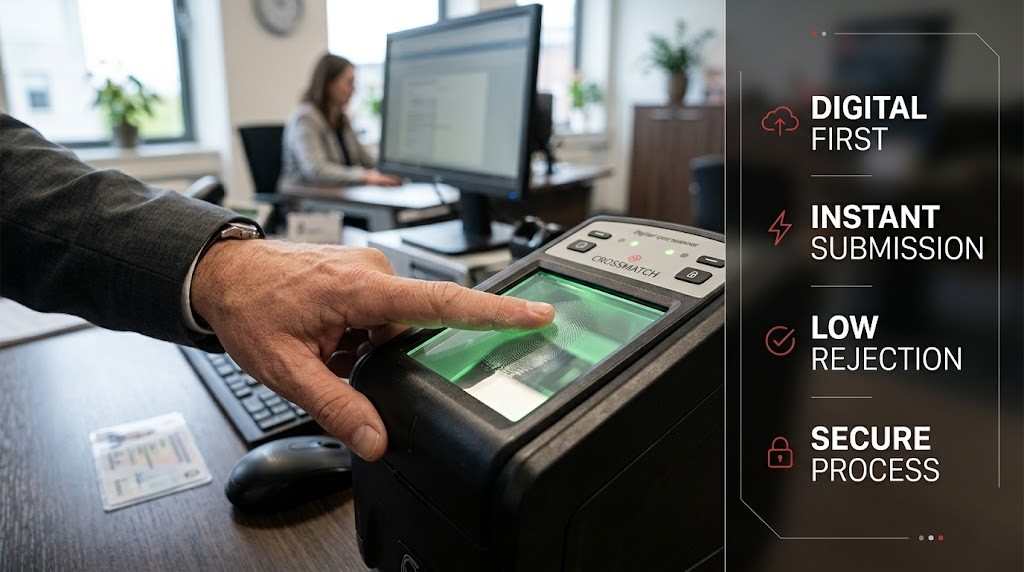
According to biometric industry resources, over 92% of all fingerprint submissions to the FBI are now processed through electronic LiveScan systems as of 2024. This technological shift—from ink-and-paper to digital capture—created the foundation for mobile services.
What Changed:
| Traditional Model (2010–2018) | Mobile Model (2019–Present) |
|---|---|
| Fixed-location offices only | Services travel to client sites |
| Ink-based submissions (mail delays) | Electronic LiveScan (instant transmission) |
| Individual appointment scheduling | Group sessions at employer location |
| Standard business hours | Flexible scheduling (early morning, weekends, shifts) |
| Employee travel required | Zero employee travel time |
The enabling factors:
- Portable LiveScan equipment became lighter and more reliable
- Secure internet connectivity is ubiquitous
- RCMP-accredited providers invested in mobile capabilities
- Employers increasingly value employee time optimization
Market Growth Indicators
While comprehensive statistics on mobile fingerprinting specifically aren’t centrally tracked, related market segments demonstrate robust growth:
Corporate Biometric Adoption:
According to fingerprint access control market analysis, corporate offices are implementing fingerprint systems at unprecedented rates:
- Corporate offices segment growing at 12.85% CAGR
- Cloud-based fingerprint access control solutions enabling multi-location management
- Enterprise demand for centralized, scalable deployment
Workforce Screening Drivers:
According to industry resources, companies prefer mobile fingerprinting because it allows them to screen large numbers of employees or volunteers on-site, ensuring compliance with legal and regulatory requirements without disrupting operations.
For context on broader fingerprinting demand trends in the Greater Toronto Area, see our analysis: Brampton’s Background Check Boom: How Local Employment Trends Are Driving Fingerprinting Demand in 2025.
The Five Business Cases Driving Mobile Fingerprinting Adoption
Case #1: Healthcare New Facility Openings
The Challenge:
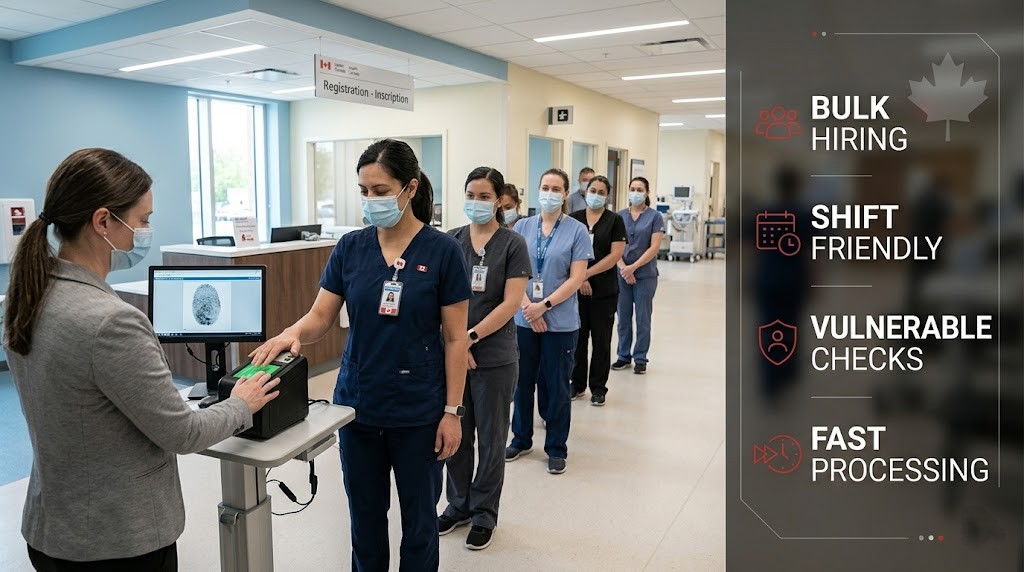
A long-term care facility opening in Brampton needs to hire 120 staff members (nurses, PSWs, administrative staff) within 60 days. Every single person requires a vulnerable sector check with fingerprinting.
Traditional Approach Problems:
- 120 individual appointments impossible to schedule within timeline
- Staff working 12-hour shifts can’t easily travel to fingerprinting offices
- Multiple appointment no-shows delay the entire hiring process
- Quality control issues mean some employees need re-fingerprinting
Mobile Solution:
Set up on-site fingerprinting stations for 2-3 days. Process 40-50 employees per day in scheduled blocks aligned with shift changes.
Business Impact Table:
| Metric | Traditional Method | Mobile On-Site |
|---|---|---|
| Total employee time lost | ~180 hours (1.5 hrs × 120) | ~30 hours (15 min × 120) |
| Scheduling complexity | 120 individual appointments | 3 group sessions |
| Quality rejection rate | ~15% (ink-based typical) | ~3% (digital LiveScan) |
| Time to complete all fingerprinting | 6–8 weeks | 3–5 days |
Case #2: Manufacturing Seasonal Workforce Scaling
The Challenge:
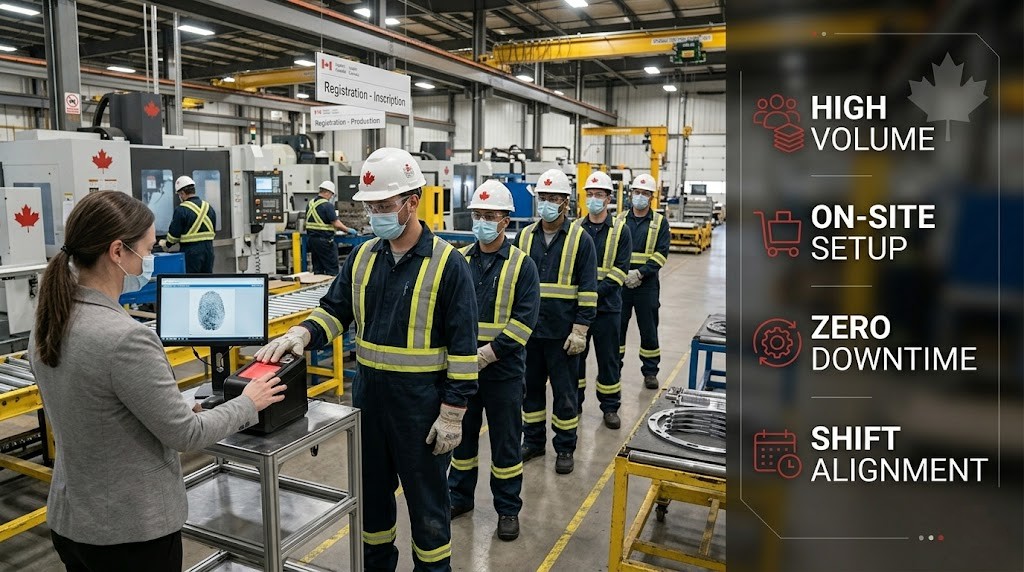
A food processing facility needs to onboard 200 seasonal workers for peak production season. Criminal record checks are mandatory for food safety compliance.
Traditional Approach Problems:
- Production can’t afford to pull workers mid-shift for appointments
- Multiple shifts (6am, 2pm, 10pm) make scheduling nearly impossible
- Language barriers complicate appointment coordination
- Transportation challenges for workers without vehicles
Mobile Solution:
Deploy fingerprinting services directly to the facility, offering sessions that accommodate all three shift schedules including early morning and evening slots.
Operational Advantage:
- Zero production interruption
- Higher completion rates (no transportation barriers)
- Multilingual technicians available
- Supervisors can ensure 100% compliance
Case #3: Government Contractor Security Clearance Requirements
The Challenge:
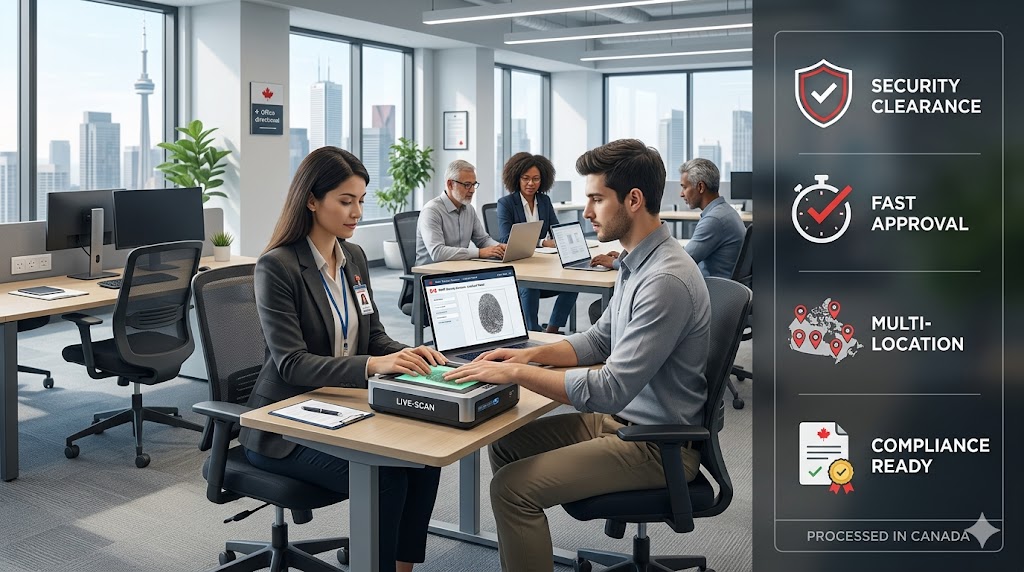
A technology consulting firm wins a federal government contract requiring Secret clearances for 30 developers and analysts distributed across Toronto, Brampton, and Mississauga offices.
Traditional Approach Problems:
- Developers working on billable projects can’t afford half-day absences
- Three office locations mean complex coordination
- Some team members are remote/hybrid and rarely come to office
- Security clearance delays directly impact contract start dates
Mobile Solution:
Schedule mobile fingerprinting at each office location on designated “clearance days” plus offer remote worker appointments at their preferred locations.
For more context on security clearance fingerprinting requirements, see: Security Clearance Statistics: How Many Canadians Are Getting Fingerprinted for Government Jobs?
Case #4: Education Annual Hiring Cycles
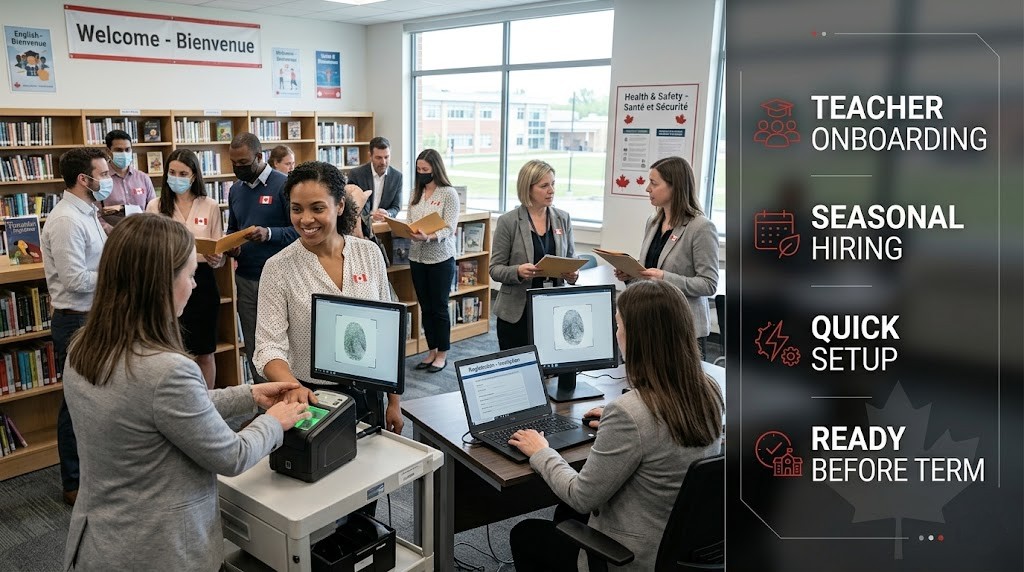
The Challenge:
A school board hires 80 new teachers and educational assistants each September. All require vulnerable sector checks before the school year starts.
Traditional Approach Problems:
- August rush overwhelms fingerprinting providers
- Teachers on summer vacation may be traveling
- Same-day appointment availability virtually impossible during peak season
- Late-arriving fingerprint results delay classroom assignments
Mobile Solution:
Coordinate with the school board’s HR team to schedule on-site fingerprinting sessions at the board office during August orientation week, when all new hires are already on-site for professional development.
Case #5: Corporate Office Expansion and Compliance Renewals
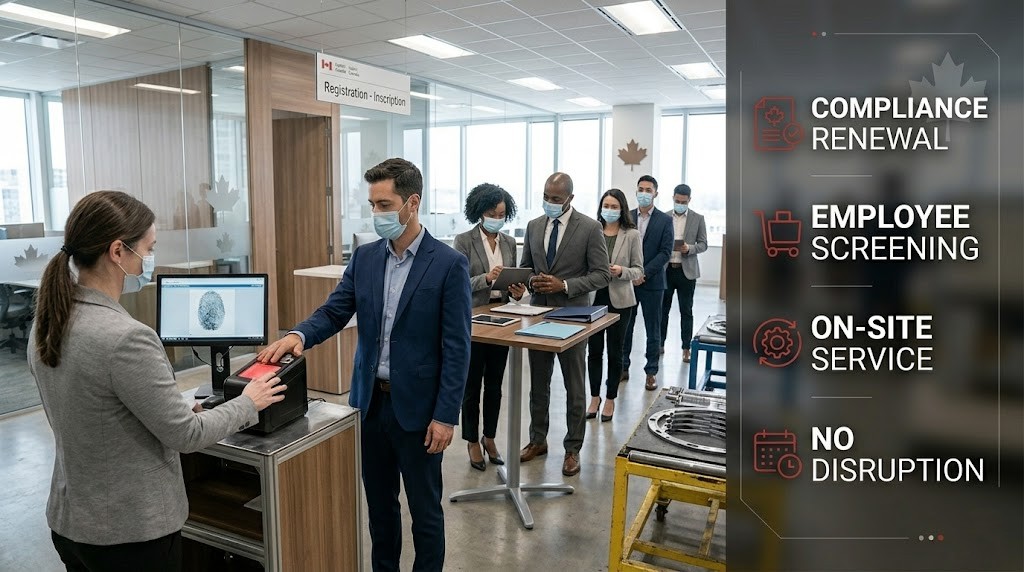
The Challenge:
A financial services firm with 500 employees needs to conduct background check renewals for 100 employees whose clearances are expiring, plus onboard 25 new hires for a new Brampton office.
Traditional Approach Problems:
- Employees view fingerprinting appointments as inconvenient “compliance overhead”
- Scheduling 125 appointments across different employee calendars is administrative nightmare
- Some employees procrastinate until after expiration, creating compliance gaps
- Inconsistent experiences from different fingerprinting providers
Mobile Solution:
Deploy mobile fingerprinting to the Brampton office for one week, offering convenient time slots integrated with employees’ work schedules.
Industry-Specific Operational Advantages
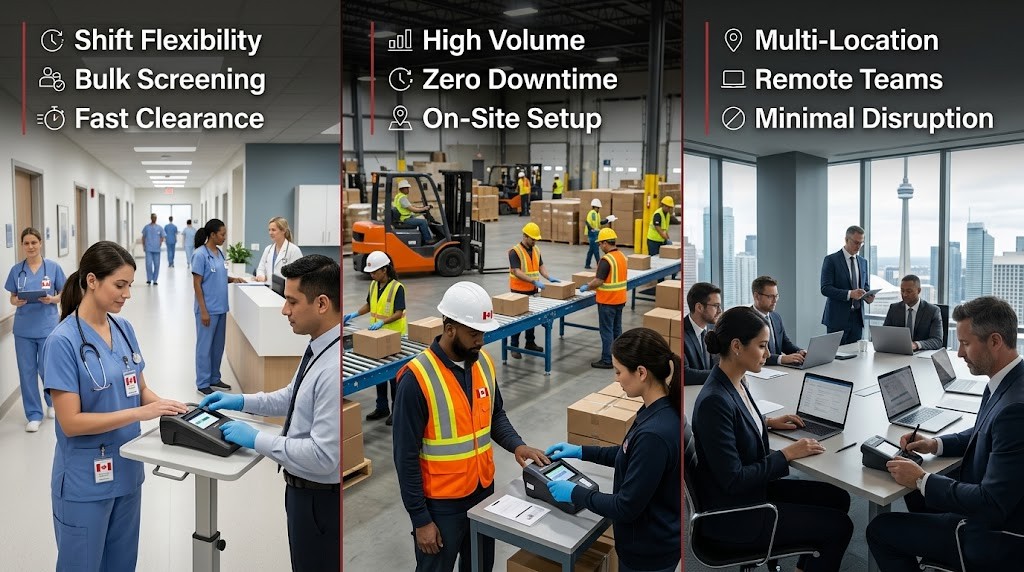
Healthcare: Vulnerable Sector Check at Scale
Your Unique Needs:
Healthcare organizations face the most stringent background check requirements combined with high-volume hiring and retention challenges.
Mobile Fingerprinting Advantages:
| Operational Challenge | Mobile Solution |
|---|---|
| 24/7 shift work schedules | Flexible session times (early morning, late evening) |
| Multiple facility locations | Rotate through facilities on scheduled cycle |
| Urgent replacement hiring | Emergency on-site sessions within 24–48 hours |
| Student placement compliance | Coordinate with academic calendars |
| Multilingual workforce | Technicians with language capabilities |
Real-world efficiency: Instead of 80 nurses each losing 90 minutes for individual appointments (120 total hours), mobile fingerprinting processes everyone on-site in approximately 20 minutes each (27 total hours)—saving 93 hours of nursing time.
Manufacturing and Logistics: Volume Hiring Events
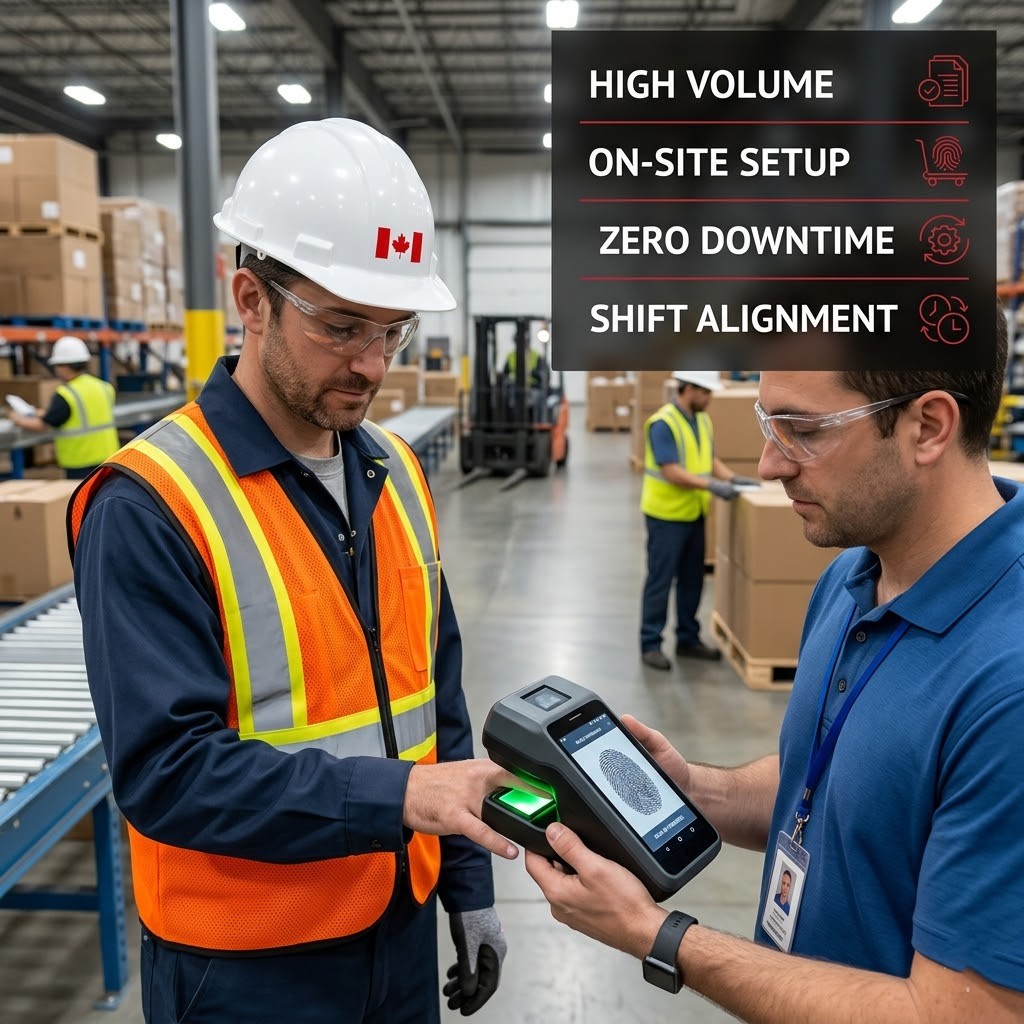
Your Unique Needs:
Manufacturing and warehousing sectors experience high turnover, seasonal hiring surges, and operational constraints that make individual appointments impractical.
Mobile Fingerprinting Advantages:
- Production continuity: No need to release employees from production lines
- Shift alignment: Schedule sessions during shift changes to minimize disruption
- Quality control: Digital LiveScan reduces rejections that delay onboarding
- Supervisor oversight: Plant managers can ensure completion rates
- Compliance documentation: Centralized recordkeeping for audits
Case study context: A distribution center hiring 150 warehouse workers can complete all fingerprinting in two 8-hour sessions rather than coordinating 150 individual appointments over multiple weeks.
Professional Services: Distributed Workforce Management
Your Unique Needs:
Consulting, engineering, and professional services firms often have employees distributed across multiple offices or working remotely, making centralized fingerprinting challenging.
Mobile Fingerprinting Advantages:
- Multi-location flexibility: Rotate services through Toronto, Mississauga, Brampton offices
- Remote worker support: Accommodate home office locations
- Minimal billable time impact: Reduce opportunity cost of compliance
- White-glove service: Professional experience that reflects firm’s brand
- Scalable model: Easily accommodate growth without fixed infrastructure
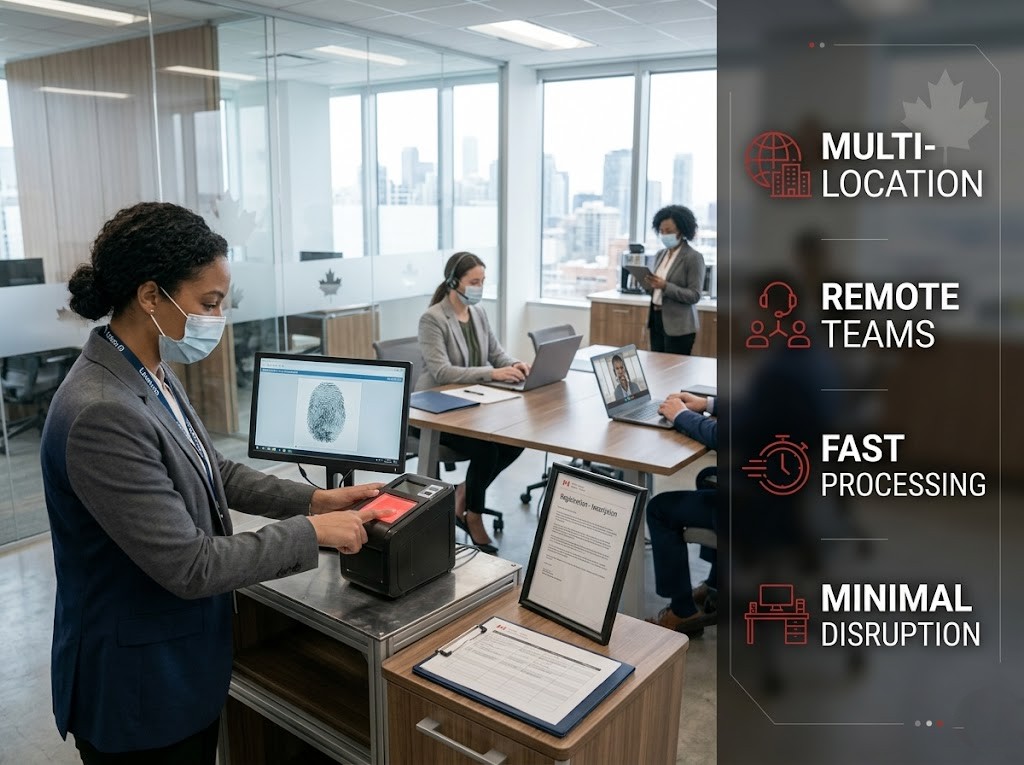
Best Practices: Implementing Mobile Fingerprinting Successfully
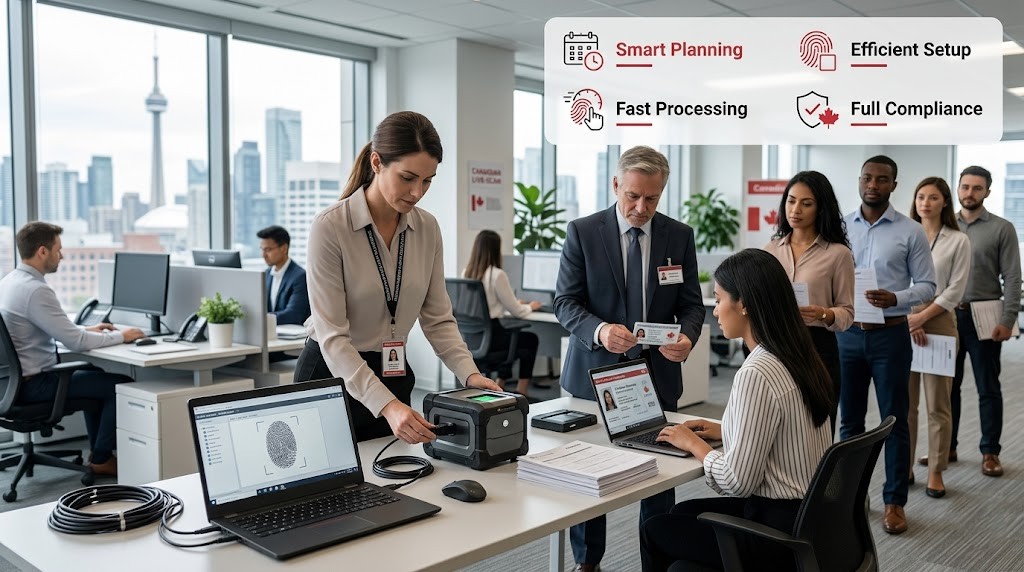
1. Strategic Session Planning
Pre-Event Coordination:
- Work with your mobile fingerprinting provider to determine optimal session duration
- Align fingerprinting schedule with existing employee events (orientations, training sessions, all-hands meetings)
- Create appointment slots that accommodate different work schedules
Logistics Setup:
- Designate a quiet, private space with electrical outlets and table
- Ensure reliable internet connectivity
- Arrange for HR personnel to verify employee identity documents
- Have employee roster prepared with full legal names
2. Volume Optimization
Efficient Processing Framework:
| Group Size | Session Structure | Typical Duration |
|---|---|---|
| 1–10 employees | Rolling appointments every 15 minutes | Half day |
| 11–30 employees | Block scheduling every 30 minutes | Full day |
| 31–75 employees | Two-day event with scheduled cohorts | 2 days |
| 76–150 employees | Multi-day with shift-aligned sessions | 3–5 days |
3. Quality Assurance Integration
Pre-Fingerprinting Verification:
- Confirm each employee has correct identification documents
- Verify legal names match HR records exactly (fingerprint records use legal names)
- Ensure employees understand the purpose (employment, vulnerable sector, security clearance)
- Collect required authorization forms in advance
Post-Fingerprinting Follow-Up:
- Obtain electronic confirmation codes immediately
- Track submission status for each employee
- Monitor for any quality issues or rejections
- Coordinate re-fingerprinting if needed (rare with digital LiveScan)
4. Compliance Documentation
Audit-Ready Recordkeeping:
- Maintain roster of all employees fingerprinted with dates
- Store electronic confirmation receipts
- Document session attendance
- Track pending results and final clearances
- Create audit trail for compliance reviews
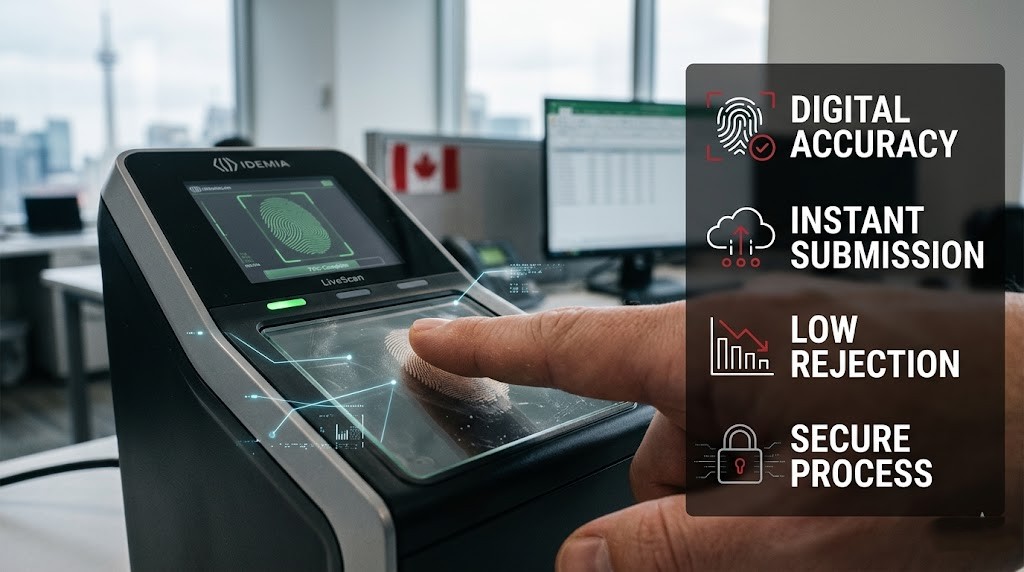
Technology Advantages: Why Digital LiveScan Matters
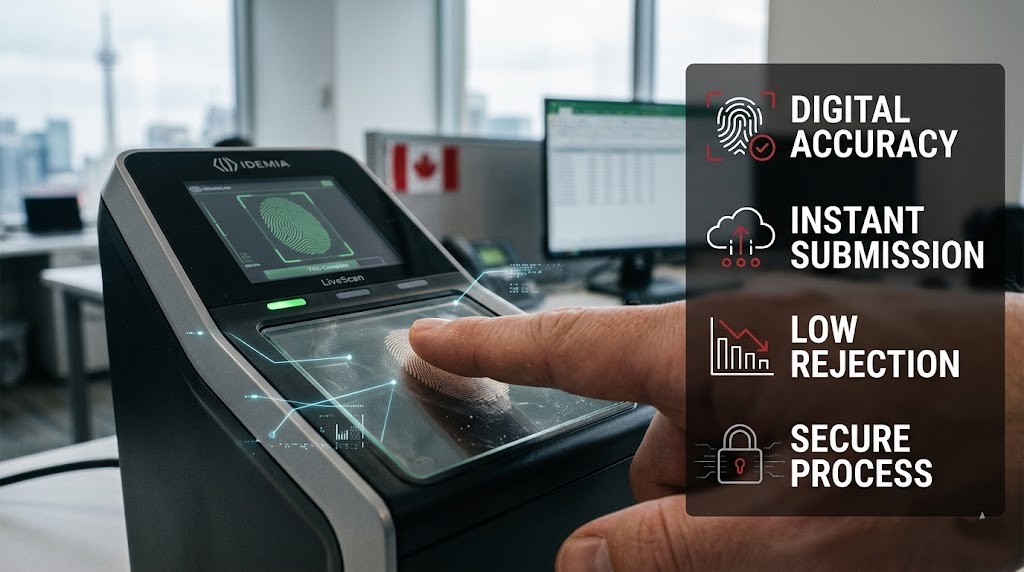
Electronic Submission Benefits
According to RCMP resources, electronic fingerprint submission offers substantial advantages over traditional ink-based methods:
Digital LiveScan vs. Ink Comparison:
| Factor | Digital LiveScan | Traditional Ink |
|---|---|---|
| Transmission Method | Instant electronic submission to RCMP | Physical mail submission |
| Quality Verification | Real-time feedback with immediate retake | Errors discovered after submission |
| Rejection Rate | Low (2–5% typical) | High (15–25% typical) |
| Environmental Impact | Zero consumables (fully digital) | Ink, paper, courier materials required |
| Processing Priority | Higher priority (electronic queue) | Lower priority (manual processing) |
| Audit Trail | Secure digital confirmation codes | Paper-based receipts |
Business impact: Lower rejection rates mean fewer delays in employee onboarding and reduced administrative burden from coordinating re-fingerprinting.
For more details on how digital fingerprinting improves accuracy, see: Can You Really ‘Erase’ Your Fingerprints? Separating Hollywood Fiction from Forensic Reality.
Cost-Benefit Analysis: The ROI of Mobile Fingerprinting
Hidden Costs of Traditional Approaches
Employee Time Valuation:
| Employee Type | Hourly Cost (Avg) | Traditional Time Lost | Cost per Employee |
|---|---|---|---|
| Healthcare RN | $45 | 1.5 hours | $67.50 |
| Manufacturing Supervisor | $35 | 1.5 hours | $52.50 |
| IT Professional | $55 | 1.5 hours | $82.50 |
| Administrative Staff | $28 | 1.5 hours | $42.00 |
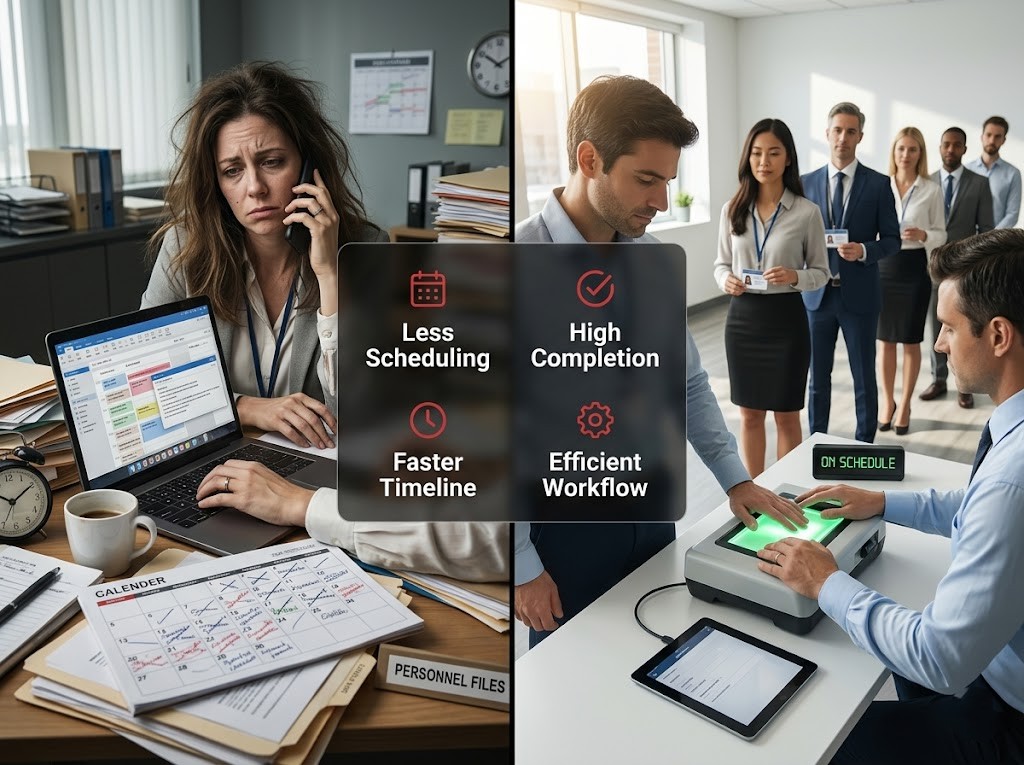
For 50-employee cohort: Traditional individual appointments cost $2,100-$4,125 in employee time alone (not counting fingerprinting fees).
Mobile on-site reduces time to 15-20 minutes per employee: Reduces time cost to $350-$825—saving $1,750-$3,300 in productivity.
Operational Efficiency Gains
Scheduling Administration:
- Traditional: 50 individual appointment bookings, confirmations, reminders
- Mobile: Single group session coordination
Completion Rates:
- Traditional: 10-15% no-show/reschedule rate
- Mobile: Near-100% completion (employees already on-site)
Compliance Timeline:
- Traditional: 4-8 weeks to complete all fingerprinting
- Mobile: 1-5 days to complete all fingerprinting
Conclusion: The Future of Workforce Screening in Canada

Mobile fingerprinting is no longer just a convenience—it’s a strategic advantage for modern Canadian businesses.
As hiring demands grow and compliance requirements become more complex, traditional fingerprinting methods simply cannot keep up. They create delays, increase costs, and disrupt operations. In contrast, mobile fingerprinting offers a faster, smarter, and more scalable solution.
By bringing RCMP-certified fingerprinting directly to your workplace, businesses can:
- Reduce employee downtime
- Complete bulk hiring faster
- Improve compliance accuracy
- Eliminate logistical challenges
For organizations managing high-volume hiring or strict regulatory requirements, the shift to mobile fingerprinting is not optional—it’s essential.
Get Started with Mobile Fingerprinting Today
If your organization is looking to streamline hiring and eliminate delays, on-site fingerprinting is the most efficient solution available in Canada.
Hiring 50 employees shouldn’t mean booking 50 appointments.
With mobile fingerprinting, you can complete everything in days—not weeks—and keep your business moving forward without disruption.
Our team provides fast, reliable, and RCMP-accredited mobile fingerprinting services tailored for businesses across healthcare, manufacturing, logistics, and more.
FAQ: Your Questions Answered
What is mobile fingerprinting in Canada?
Mobile fingerprinting is a service where RCMP-accredited technicians bring digital LiveScan equipment directly to your workplace, allowing businesses to complete fingerprinting for employees on-site without travel or scheduling delays.
Is mobile fingerprinting accepted by the RCMP?
Yes, mobile fingerprinting uses the same certified digital LiveScan technology as fixed locations and is fully accepted by the RCMP for background checks, vulnerable sector checks, and security clearances.
How long does mobile fingerprinting take for a group?
Most organizations can complete fingerprinting for large groups within 1 to 5 days, depending on team size. Smaller groups can often be completed in just a few hours with on-site sessions.
Which industries benefit most from mobile fingerprinting?
Mobile fingerprinting is ideal for:
- Healthcare & long-term care facilities
- Manufacturing & logistics companies
- Government contractors
- Educational institutions
- Financial services firms
These industries often require bulk hiring and strict compliance, making on-site solutions highly e
Is mobile fingerprinting more cost-effective than traditional meth
Yes. Traditional fingerprinting can cost businesses thousands in lost productivity due to employee travel and scheduling delays. Mobile fingerprinting significantly reduces time loss and improves completion rates.
Can mobile fingerprinting handle urgent hiring needs?
Absolutely. Many providers offer fast turnaround within 24–48 hours, making it ideal for urgent hiring, contract deadlines, or compliance requirements.
Do employees need to travel for mobile fingerprinting?
No. One of the biggest advantages is that employees do not need to travel, saving time and eliminating scheduling conflicts.

Navneet Lotey
Navneet Lotey has over 5 years of experience in fingerprinting. He aims to deliver accurate, easy-to-understand fingerprinting solutions for individuals and businesses alike.