



Table of Contents
You have worked hard to earn your credentials. You have completed your education, passed your exams, and are ready to begin your career in Canada. Then your regulatory college or licensing body tells you that you need a criminal record check — and in many cases, fingerprints. For internationally trained professionals and newcomers to Canada especially, this step can feel confusing and intimidating.
This guide explains exactly which professions require fingerprinting as part of the licensing process in Canada, why regulatory bodies ask for it, and how to get it done correctly so you can move forward without delays.
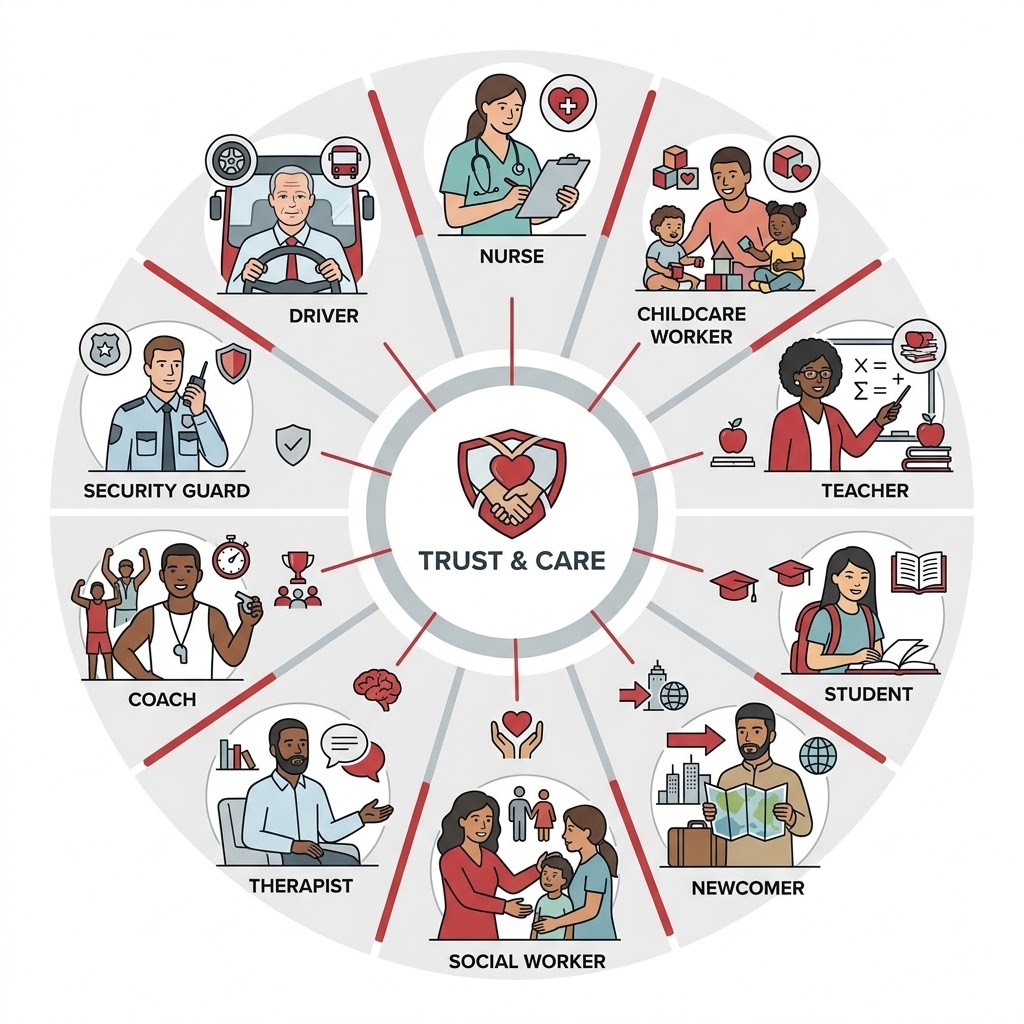
Who Is This Guide For?
- Teachers and educational assistants applying to the Ontario College of Teachers or provincial equivalents
- Nurses, PSWs, and healthcare professionals registering with CNOBC, CNO, or provincial nursing colleges
- Realtors and mortgage brokers applying for licensing through RECO or FSRA in Ontario
- Security guards and private investigators applying for a provincial licence
- Internationally trained professionals re-licensing in Canada
- Newcomers and immigrants entering regulated occupations for the first time
- Social workers, counsellors, and community service workers joining provincial colleges
- Financial advisors and insurance agents going through regulatory registration
Why Do Licensing Bodies Require Fingerprinting?

Professional licensing bodies in Canada are legally obligated to protect the public. When you work with clients, students, patients, or vulnerable individuals in a position of authority, the regulatory college must verify that you do not have a criminal history that could put others at risk.
A name-based criminal record check can produce errors — two people can share a name and date of birth. Fingerprinting eliminates this risk entirely by confirming your identity against the RCMP’s national criminal records database with biometric certainty. It is the most accurate identity verification method available in Canada. Learn more about how RCMP fingerprinting works: https://loteyfingerprinting.ca/rcmp-explained/
The RCMP’s Canadian Criminal Real Time Identification Services (CCRTIS) processes all certified fingerprint submissions and returns results to the requesting organisation. Read about the certified fingerprinting process: https://loteyfingerprinting.ca/rcmp-certified-fingerprinting-canada-2025-guide/
Which Professions Require Fingerprinting for Licensing in Canada?

| Profession | Licensing / Regulatory Body (Ontario) | Check Type Required | Fingerprints Needed? |
|---|---|---|---|
| Teacher | Ontario College of Teachers (OCT) | Criminal Record & VSC | Yes — RCMP certified |
| Registered Nurse / RPN | College of Nurses of Ontario (CNO) | Criminal Record Check | Yes — if match found |
| Personal Support Worker (PSW) | NACC / employers | Criminal Record & VSC | Yes — for VSC |
| Real Estate Agent | Real Estate Council of Ontario (RECO) | Criminal Record Check | Yes — RCMP certified |
| Mortgage Broker / Agent | Financial Services Regulatory Authority (FSRA) | Criminal Record Check | Yes — RCMP certified |
| Security Guard / PI | Ministry of the Solicitor General (Ontario) | Criminal Record & Judicial Matters Check | Yes — required by law |
| Social Worker / SSW | Ontario College of Social Workers (OCSWSSW) | Criminal Record Check | Yes — if name match |
| Insurance Agent / Broker | FSRA Ontario | Criminal Record Check | Yes — RCMP certified |
| Taxi / Rideshare Driver | Municipal licensing bodies | Police Record Check | Yes — varies by city |
| Pharmacist | Ontario College of Pharmacists (OCP) | Criminal Record Check | Yes — if match found |
| Dentist / Dental Hygienist | RCDSO / CDHO | Criminal Record Check | Yes — varies |
| Early Childhood Educator (ECE) | College of ECE Ontario (CECE) | Criminal Record & VSC | Yes — VSC required |
Fingerprinting for Teachers in Ontario

The Ontario College of Teachers (OCT) requires all applicants for certification to submit a criminal background check, which includes a Vulnerable Sector Check for those working with minors. Because teaching involves sustained, unsupervised authority over children, the VSC is standard — and fingerprints are commonly required, especially for newcomers whose names may not be uniquely identified through a name-based search.
Internationally trained teachers applying for OCT certification should expect fingerprinting as part of the process. Delays in getting fingerprints done are one of the most common reasons licensing applications take longer than expected. Getting this step done early saves weeks of waiting.
See how fingerprinting works for Vulnerable Sector Checks: https://loteyfingerprinting.ca/vulnerable-sector-check-canada-fingerprinting/
Fingerprinting for Nurses and Healthcare Professionals

The Real Estate Council of Ontario (RECO) and the Financial Services Regulatory Authority of Ontario (FSRA) both require applicants to submit an RCMP-certified criminal record check as part of the real estate or mortgage licensing process. A clean criminal history is a prerequisite for obtaining and renewing a licence.
An RCMP-certified check — the type that requires fingerprinting — is different from a basic police information check. RECO and FSRA specifically require the certified format because it searches the national RCMP database, not just local police records. Agents who submit the wrong type of check face delays and re-submission.
Read about ink-and-roll vs digital fingerprinting methods: https://loteyfingerprinting.ca/ink-roll-fingerprinting-guide-canada/
Fingerprinting for Security Guards and Private Investigators
Under Ontario’s Private Security and Investigative Services Act, all applicants for a security guard or private investigator licence must provide a Criminal Record and Judicial Matters Check. This check is submitted through the local police service and must include fingerprints in many cases. The Ministry of the Solicitor General requires that applicants have a clean criminal record or have received a record suspension for eligible past offences.
For those with a past record considering a record suspension before applying for a licence, read: https://loteyfingerprinting.ca/rcmp-fingerprinting-record-suspension-canada/
A Special Note for Newcomers and Internationally Trained Professionals

If you trained and worked in another country before coming to Canada, your licensing path will almost certainly require an RCMP-certified criminal record check — and fingerprints will be part of it. This is because your name may not appear in any Canadian database, making identity confirmation through biometrics the only reliable method.
In some cases, you may also need a police clearance certificate from your home country alongside your Canadian RCMP check. Understanding the difference between the two is important: https://loteyfingerprinting.ca/police-clearance-vs-criminal-record-check-international-students-canada/
Common mistakes newcomers make during this process are documented here: https://loteyfingerprinting.ca/top-5-mistakes-newcomers-canada/
How Does the Fingerprinting Process for Professional Licensing Work?
- Confirm with your regulatory college or licensing body exactly which type of criminal record check they accept — RCMP certified, police information check, or vulnerable sector check.
- Gather the required identification: two pieces of valid government ID, including at least one photo ID such as a passport, driver's licence, or PR card.
- Bring any documentation your licensing body requires — some provide a form letter that must accompany the fingerprint submission.
- Visit an RCMP-accredited fingerprinting service provider. At Lotey Fingerprinting in Brampton, we complete the process quickly and accurately.
- Choose your fingerprint method — digital live scan (faster) or ink-and-roll (accepted by all bodies). Read about digital fingerprinting: https://loteyfingerprinting.ca/digital-live-scan-fingerprinting-guide-canada/
- Your fingerprints are submitted to the RCMP's CCRTIS for processing. Results are typically returned within a few business days.
- Submit the results to your licensing body as part of your application package.
For a complete guide to RCMP criminal record checks and how the process works, visit: https://loteyfingerprinting.ca/rcmp-explained/
Tips to Avoid Delays in Your Licensing Application

- Start your criminal record check and fingerprinting early — do not wait until everything else is ready.
- Confirm the exact check type your licensing body requires before booking. Not all checks are the same.
- Use an RCMP-accredited provider. Non-accredited providers cannot submit to the RCMP national database.
- If your name has changed due to marriage or legal name change, bring documentation for both names.
- Do not submit a standard police information check when an RCMP-certified check is required — they are different documents.
- If you have a past record, speak to a legal professional about record suspension eligibility before applying.
To understand the difference between a police clearance and a criminal record check, read: https://loteyfingerprinting.ca/police-clearance-vs-criminal-record-check-international-students-canada/
Need Fingerprinting for a Vulnerable Sector Check?
At Lotey Fingerprinting in Brampton, we work with teachers, nurses, realtors, security professionals, social workers, and hundreds of other regulated professionals across the GTA every year. Our RCMP-accredited team knows exactly what each licensing body needs and ensures your fingerprinting is done accurately — the first time.
Whether you need ink-and-roll or digital live scan fingerprinting, we make the process simple and stress-free. Visit https://loteyfingerprinting.ca to book your appointment, or call us to discuss your specific licensing requirements.
Also explore: Security clearance fingerprinting — https://loteyfingerprinting.ca/security-clearance-fingerprinting-canada/
Immigration fingerprinting — https://loteyfingerprinting.ca/immigration-fingerprinting-services-canada/

FAQ: Your Questions Answered
Do all regulated professions in Canada require fingerprinting for licensing?
Not all, but many do. Licensing bodies that require an RCMP-certified criminal record check — rather than a basic police information check — will need fingerprints to confirm your identity. Always verify with your specific regulatory college.
What is the difference between a police information check and an RCMP-certified criminal record check?
A police information check searches local police records and is name-based. An RCMP-certified check searches the national RCMP database and requires fingerprints. Most licensing bodies require the RCMP-certified version. Read more: https://loteyfingerprinting.ca/rcmp-explained/
Can I use the same RCMP check for multiple licensing applications?
This depends on the licensing body. Some require a fresh check within a specific timeframe (e.g., 6 months). Check with each body individually.
How long does an RCMP criminal record check take for licensing purposes?
Processing times vary. Digital live scan results are typically faster than ink-and-roll. Allow at least several business days and factor this into your application timeline. Read the full guide: https://loteyfingerprinting.ca/rcmp-certified-fingerprinting-canada-2025-guide/
What ID do I need to bring for fingerprinting for professional licensing?
You typically need two pieces of valid government-issued ID, with at least one being photo ID. Learn more: https://loteyfingerprinting.ca/identification-requirements-fingerprinting/
I am an internationally trained professional — what do I need to know about fingerprinting for Canadian licensing?
You will almost certainly need an RCMP-certified criminal record check. You may also need a police clearance from your home country. Read the comparison: https://loteyfingerprinting.ca/police-clearance-vs-criminal-record-check-international-students-canada/
Where can I get RCMP-accredited fingerprinting for professional licensing in Brampton or the GTA?
Lotey Fingerprinting in Brampton provides professional RCMP-accredited fingerprinting services for all licensing and regulatory purposes. Visit https://loteyfingerprinting.ca to book.
Does having a past criminal record disqualify me from professional licensing?
Not automatically. Each licensing body evaluates records on a case-by-case basis. A record suspension may make you eligible. Read more: https://loteyfingerprinting.ca/rcmp-fingerprinting-record-suspension-canada/
Is digital live scan fingerprinting accepted for professional licensing?
Yes. Digital live scan is accepted by most regulatory bodies in Canada and is faster than ink-and-roll. Read the guide: https://loteyfingerprinting.ca/digital-live-scan-fingerprinting-guide-canada/
Can I get fingerprinting done on-site at my organization or school for licensing?
Yes. Lotey Fingerprinting offers mobile fingerprinting services for organizations needing multiple staff or students cleared at once. Visit: https://loteyfingerprinting.ca/mobile-fingerprinting-services-canada/

Navneet Lotey
Navneet Lotey has over 5 years of experience in fingerprinting. He aims to deliver accurate, easy-to-understand fingerprinting solutions for individuals and businesses alike.