



The Business Problem: When Security Clearance Delays Cost You Contracts
You’ve just won a major government contract. Your client needs three developers to start immediately on a classified project. There’s just one problem: none of your team has security clearance, and you’ve just learned that every single person needs RCMP fingerprinting as part of the screening process.
For HR managers at government contractors, security officers at defense companies, and staffing leads at professional services firms, this scenario is becoming increasingly common. According to Treasury Board of Canada Secretariat resources, Canada’s federal public service employs 367,772 people as of March 2024—and every single one required security screening before they could access their role.
Add thousands of contractors, consultants, and third-party service providers, and you’re looking at an enormous fingerprinting ecosystem that most businesses don’t fully understand until they need to navigate it.
The challenge? Security clearance requirements are complex, fingerprinting is mandatory at every level, and delays can derail project timelines, contract fulfillment, and revenue recognition. This isn’t just an HR checkbox—it’s a business continuity issue.
Who This Guide is For:
This analysis is designed for:
By Industry:
- Defense and aerospace contractors
- IT services and cybersecurity firms
- Professional services (consulting, engineering, architecture)
- Research institutions partnering with government
- Construction companies on federal projects
- Any business seeking government contracts
By Role:
- HR Directors and Managers
- Company Security Officers (CSO) and Alternate CSOs
- Compliance Officers
- Project Managers on government contracts
- Talent Acquisition Leaders
- Business Development teams pursuing federal opportunities
By Company Size:
- Small businesses (50-200 employees) navigating first government contracts
- Mid-market firms (200-1,000 employees) scaling government work
- Enterprise organizations (1,000+ employees) managing large contractor workforces
Understanding the Scale: Security Clearance by the Numbers
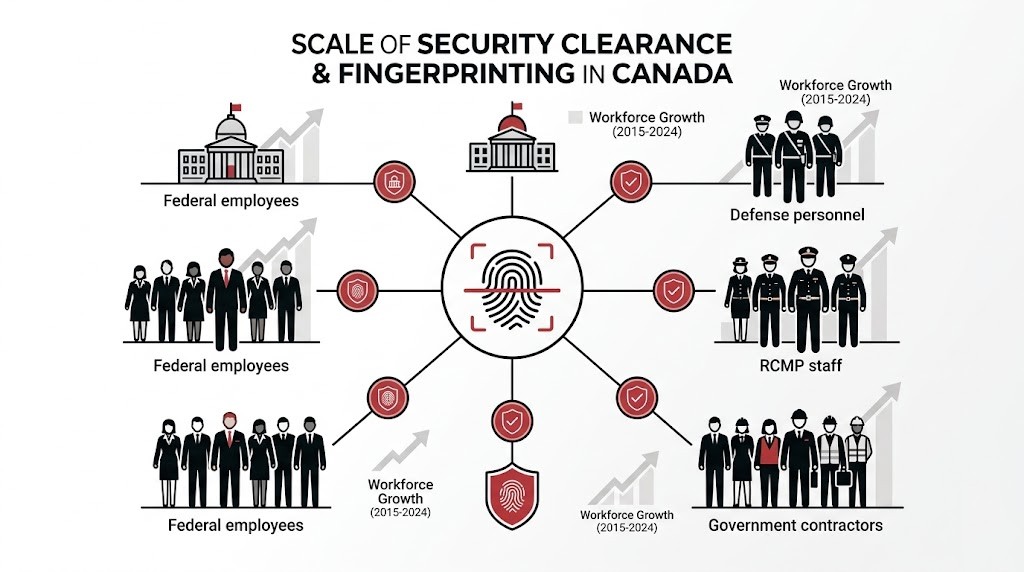
The Federal Workforce: A Statistical Overview
To understand fingerprinting demand for government work, we first need to grasp the scale of Canada’s federal employment:
Federal Public Service Growth (2015-2024):
| Metric | 2015 | 2024 | Change |
|---|---|---|---|
| Federal Public Servants | ~257,000 | 367,772 | +40.4% |
| Government Workers per 1,000 Canadians | ~7.2 | 8.9 | +23.6% |
| National Defence Employees | 27,356 | 28,740 | +5.1% |
| RCMP Civilian Staff | 9,386 | 10,309 | +9.8% |
Source: Treasury Board of Canada Secretariat; Statistics Canada; The Globe and Mail Analysis, 2024
According to government resources, this represents one of the most significant public service expansions in Canadian history—and every single hire required security screening with fingerprinting as a core component.
The Four-Tier Clearance System
Canada operates a hierarchical security clearance system administered by the Canadian Security Intelligence Service (CSIS). Understanding this structure is critical for businesses pursuing government contracts.
Security Clearance Levels and Requirements:
| EXPENSE | COST RANGE | NOTES |
|---|---|---|
| Government Fee | $50 | Parole Board of Canada |
| RCMP Fingerprinting | $50–$100 | Digital recommended |
| Local Police Checks | $0–$113 each | Per jurisdiction lived |
| Court Documents | $0–$100 each | Per conviction |
| Postage / Courier | $20–$50 | Registered mail |
| Service Provider Fee (if used) | $300–$800 | Optional |
| TOTAL (DIY) | $150–$400 | Doing it yourself |
| TOTAL (with service) | $500–$1,200 | Professional assistance |
Source: Treasury Board of Canada Secretariat; Statistics Canada; The Globe and Mail Analysis, 2024
Contractor Volume: The Hidden Numbers
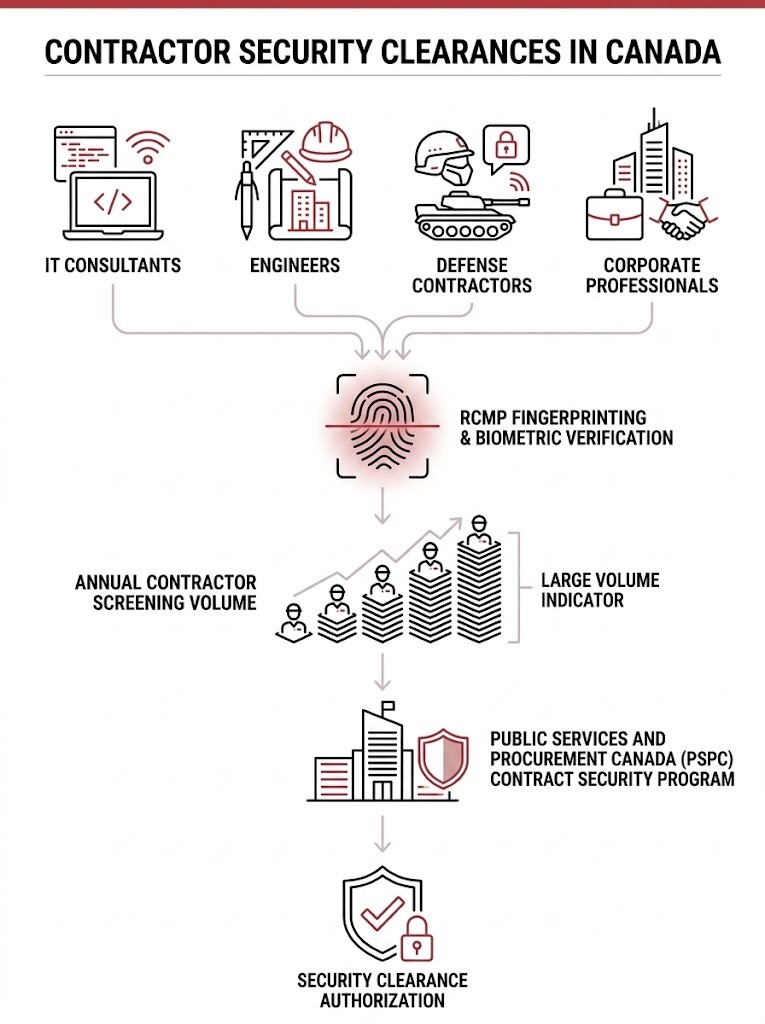
While federal employee counts are publicly reported, contractor statistics are less transparent. However, Public Services and Procurement Canada maintains data on security clearances granted to contractors:
What We Know About Contractor Clearances:
According to open government portal resources:
- Thousands of contractor security screenings are processed annually
- Clearances are granted by Public Services and Procurement Canada’s Contract Security Program
- Only Company Security Officers (CSO) or Alternate CSOs can request clearances
- Each contractor clearance requires the same fingerprinting as federal employees
Estimated contractor fingerprinting volume: Based on typical contractor-to-employee ratios in government work (approximately 15-25%), we can estimate 50,000-90,000+ contractors require security clearances annually, all involving RCMP fingerprinting.
The Fingerprinting Mandate: Why It's Non-Negotiable
Regulatory Requirements
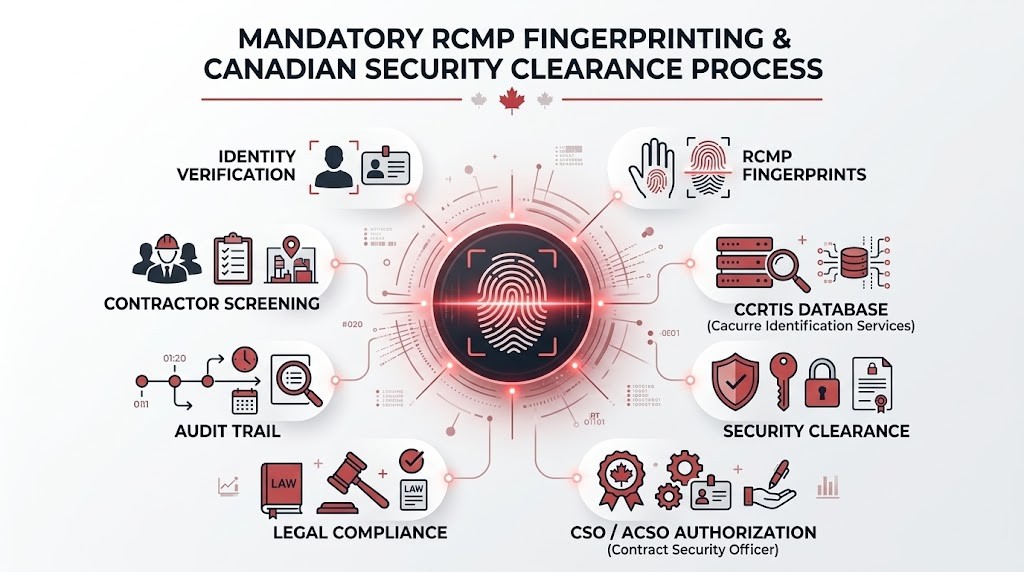
According to Treasury Board Standard on Security Screening resources, fingerprint-based criminal record checks are mandatory for all security clearance levels. This isn’t optional—it’s a legal requirement under the Security of Information Act and Privacy Act.
Why Fingerprints Are Required:
| Reason | Business Impact |
|---|---|
| Definitive Identification | Name-based checks can match multiple people; fingerprints eliminate ambiguity and reduce false positives. |
| National Database Search | RCMP Canadian Criminal Real Time Identification Services (CCRTIS) searches records across all Canadian jurisdictions. |
| International Cross-Reference | Fingerprints can be cross-referenced with international law enforcement databases. |
| Legal Compliance | Required under the Federal Accountability Act for departments granting security clearances. |
| Audit Trail | Creates verifiable documentation for security compliance audits. |
For more context on fingerprinting requirements and common misconceptions, see our guide: Does Getting Fingerprinted Mean You Have a Criminal Record? Debunking the #1 Fear.
The CSO/ACSO Role: Your Compliance Gateway
According to security screening resources, only designated Company Security Officers (CSO) or Alternate Company Security Officers (ACSO) can request security clearances for contractors. This creates a compliance bottleneck many businesses don’t anticipate.
CSO Responsibilities Related to Fingerprinting:
- Verify employee identity using two pieces of ID (one with photo)
- Coordinate RCMP fingerprinting appointments
- Ensure fingerprints are submitted electronically to CCRTIS
- Track clearance application status
- Maintain clearance records and renewal schedules
- Coordinate renewals before expiration
Common challenge: Many small-to-medium contractors don’t have dedicated security personnel, meaning HR managers or project leads must fulfill CSO duties—often without understanding the fingerprinting requirements.
Industry-Specific Clearance Challenges
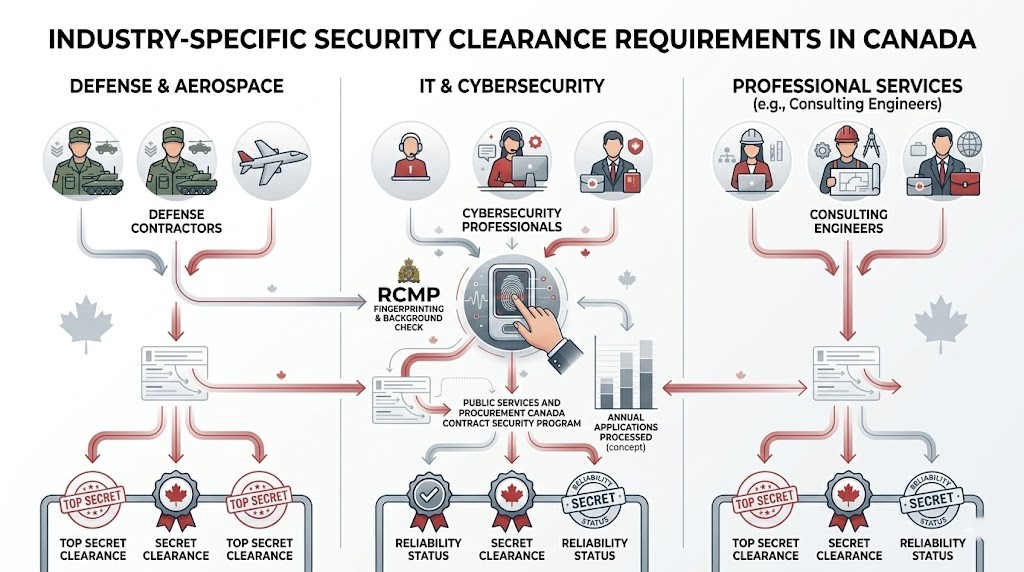
Defense and Aerospace: Top Secret Requirements
According to industry standards, defense contractors frequently need Top Secret clearances for employees working on classified projects. This creates unique challenges:
Defense Sector Fingerprinting Realities:
- Top Secret clearances expire every 5 years (vs. 10 for lower levels)
- Requires more comprehensive background investigation
- Foreign travel and assets must be disclosed and verified
- Higher scrutiny of criminal record results
Business impact: Defense contractors must maintain a continuous pipeline of cleared personnel, meaning fingerprinting is an ongoing operational requirement, not a one-time event.
IT and Cybersecurity: The Secret Clearance Standard
According to government contractor resources, IT professionals working on government systems typically require Secret clearance as a minimum. Given Canada’s cybersecurity workforce shortages, this creates competitive pressure.
- High demand for cleared IT professionals exceeds supply
- Cleared candidates can command premium salaries
- Employee turnover means constant new clearance applications
- Overseas workers may face additional screening requirements
Professional Services: The Reliability Status Reality
Consulting firms, engineering companies, and architectural practices often need Reliability Status for employees working on government projects, even non-classified ones.
- Projects may start before clearances are processed
- "Escort required" interim access has limitations
- Client expectations for rapid deployment conflict with clearance timelines
- Clearance costs aren't always billable to clients
The GTA Advantage: Regional Considerations for Brampton Contractors
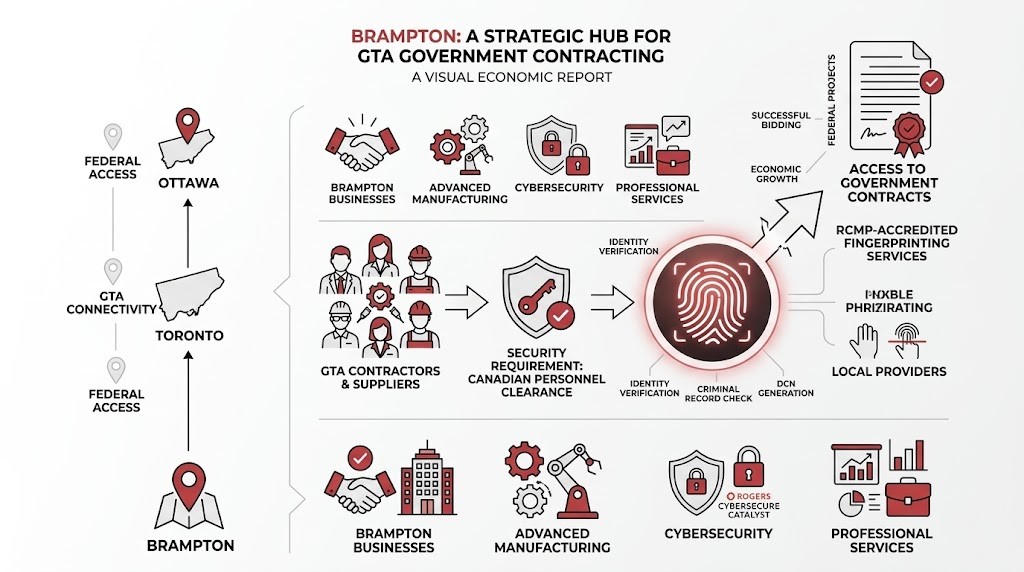
With Ottawa as the federal capital and Toronto as Canada’s business hub, the Greater Toronto Area—including Brampton—sees significant government contracting activity.
Why Brampton Contractors Need Local Expertise:
According to economic resources, Brampton hosts:
- Over 122,000 businesses, many pursuing government contracts
- Major advanced manufacturing firms (defense industry suppliers)
- Cybersecurity and technology companies (Rogers Cybersecure Catalyst)
- Professional services firms serving federal clients
Local advantage: Proximity to RCMP-accredited fingerprinting providers reduces employee travel time, accelerates the submission process, and enables better project planning.
For international contractors hiring in Brampton, understanding Canadian requirements is essential. See our comprehensive guide: Police Clearance Certificate vs. Criminal Record Check: What International Students in Canada Actually Need.
Best Practices: Enterprise Approaches to Security Clearance Management
Based on analysis of government contractor operations and security officer resources, leading organizations implement these strategies:
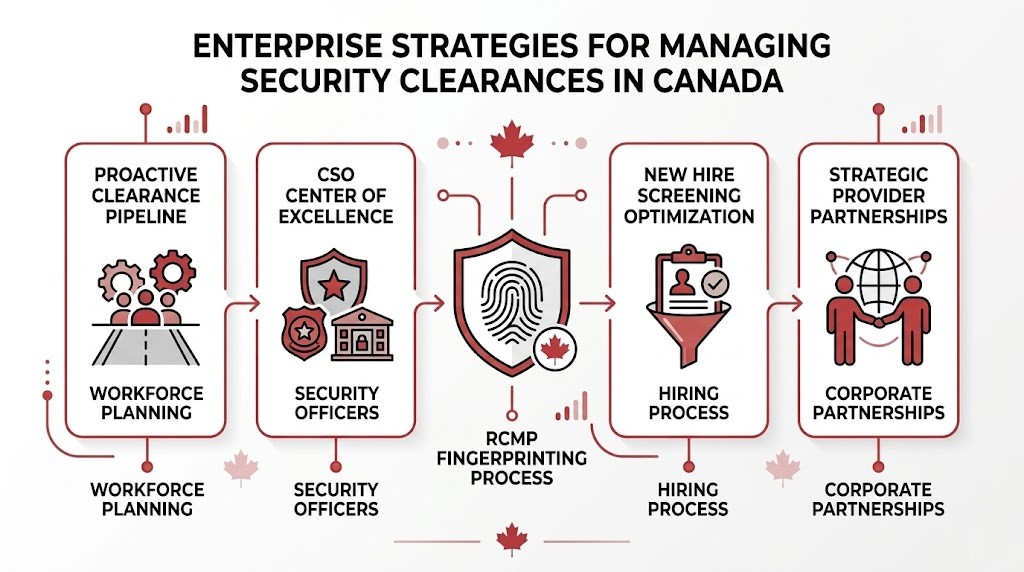
1. Proactive Clearance Pipeline Management
The approach:
- Maintain a roster of cleared personnel beyond immediate project needs
- Track clearance expiration dates 6-12 months in advance
- Budget for renewal fingerprinting as recurring operational expense
- Cross-train employees so cleared staff can cover multiple roles
Why it works: Eliminates “just-in-time” clearance pressure that delays project starts.
2. CSO Center of Excellence Model
The approach:
- Designate dedicated security personnel (even part-time at smaller firms)
- Develop standardized clearance request procedures
- Create employee self-service portals for document gathering
- Maintain relationships with RCMP-accredited fingerprinting providers
Why it works: Reduces errors, accelerates submissions, improves audit readiness.
3. New Hire Screening Optimization
The approach:
- Include clearance eligibility questions in job postings
- Pre-screen candidates for Canadian citizenship requirement
- Initiate fingerprinting immediately upon conditional offer
- Build clearance timelines into project staffing plans
Why it works: Eliminates late-stage disqualifications, sets realistic expectations.
4. Strategic Provider Partnerships
The approach:
- Establish relationships with RCMP-accredited fingerprinting agencies
- Negotiate bulk service agreements for predictable pricing
- Utilize mobile fingerprinting for new employee orientations
- Ensure provider uses electronic submission (not ink-based)
Why it works: Streamlines logistics, reduces administrative burden, ensures compliance.
Common Pitfalls: What Goes Wrong and Why
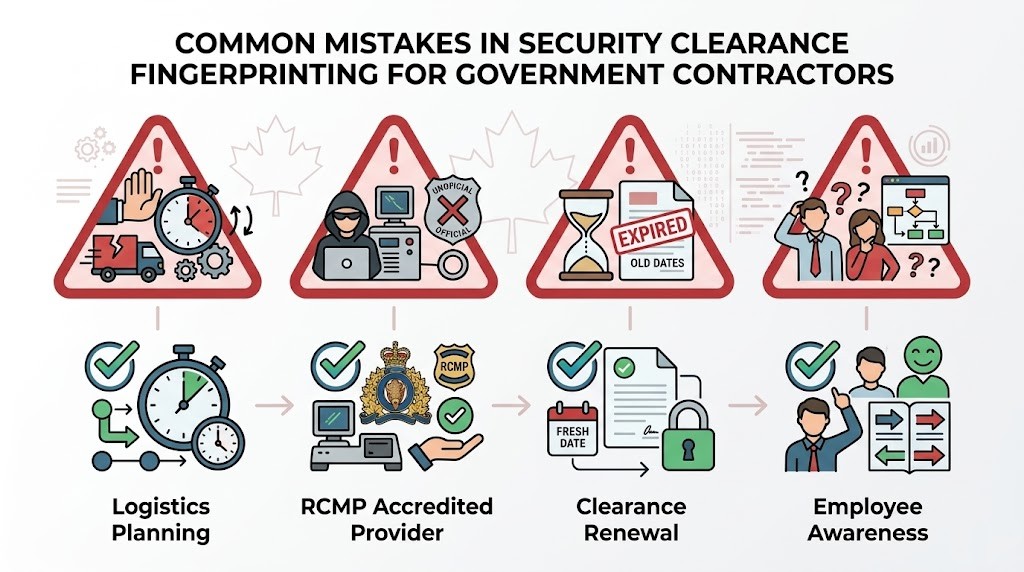
Pitfall #1: Underestimating Fingerprinting Logistics
The problem: Businesses assume fingerprinting is a simple checkbox without understanding the operational requirements.
The reality: According to RCMP resources, applicants must visit RCMP-accredited providers, which may have limited appointment availability during peak hiring periods.
Solution: Build fingerprinting capacity into workforce planning, establish provider partnerships, consider mobile services for volume hiring.
Pitfall #2: Using Non-Accredited Providers
The problem: Well-meaning HR staff arrange fingerprinting through local police services or non-accredited agencies.
The reality: According to security screening resources, only RCMP-accredited agencies can submit to CCRTIS for security clearances. Non-accredited submissions will be rejected.
Solution: Verify RCMP accreditation before any fingerprinting, educate hiring managers on requirements, maintain an approved provider list.
Pitfall #3: Ignoring Clearance Renewal Timelines
The problem: Companies track initial clearances but not expiration dates.
The reality: Reliability and Secret clearances are valid for 10 years, Top Secret for 5 years. Working beyond expiration can violate contract terms.
Solution: Implement clearance tracking systems, automate renewal reminders, budget for periodic fingerprinting costs.
Pitfall #4: Inadequate Employee Communication
The problem: Employees receive fingerprinting requests without context, creating anxiety and resistance.
The reality: According to employment resources, many Canadians have misconceptions about fingerprinting and criminal record checks.
Solution: Educate employees about security clearance processes, explain that fingerprinting is standard practice, refer to resources that address common concerns.
For addressing employee concerns, our myth-busting guide can help: 7 Dangerous Myths About Criminal Record Checks in Canada That Could Cost You a Job.
The Compliance Imperative: Audit and Reporting Requirements
Regulatory Requirements
According to Treasury Board Directive on Security Screening resources, organizations must maintain:
Required Documentation:
- Personnel security screening forms (TBS/SCT 330-23E)
- Security clearance forms
- Consent and authorization documentation
- Criminal record check results
- Clearance grant/renewal notifications
- Clearance expiration tracking
Retention periods: Vary by clearance level and organizational policy, but typically 7+ years after clearance expires.
Audit Preparedness
Government contracts frequently include security compliance audits. According to procurement resources, auditors verify:
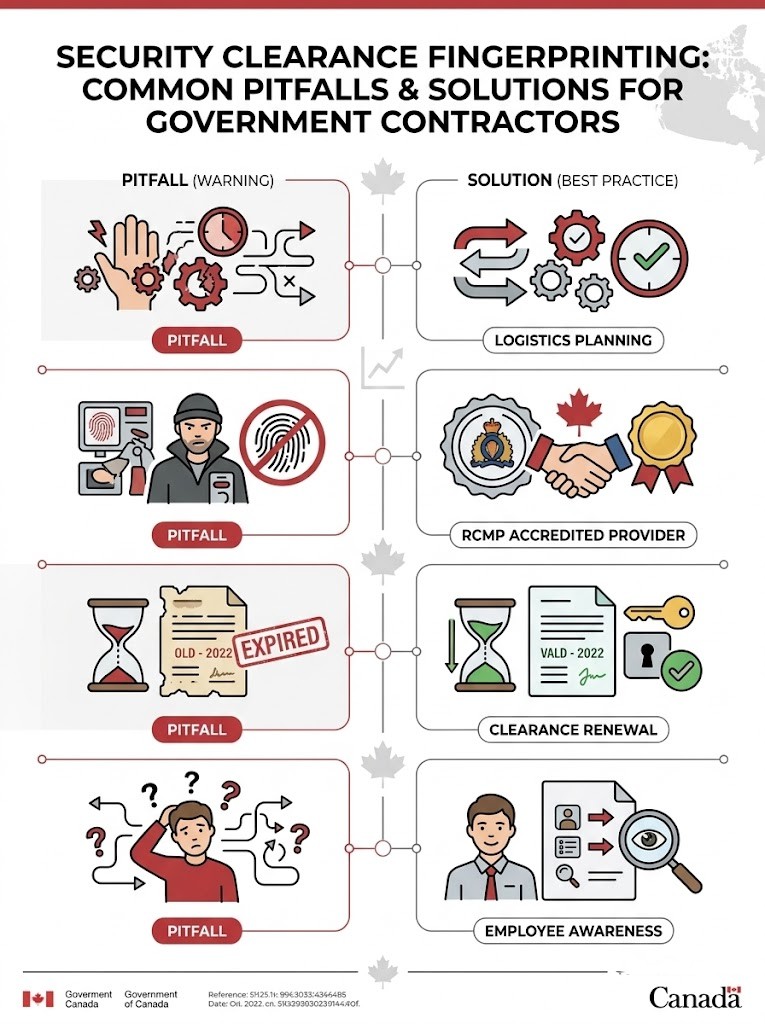
Audit Focus Areas:
| Audit Element | What Auditors Check |
|---|---|
| CSO Designation | Properly appointed CSO/ACSO with documented authority. |
| Identity Verification | Two-piece ID verification documented for each clearance. |
| Fingerprint Submission | Proof that an RCMP-accredited fingerprint provider was used. |
| Clearance Validity | Active security clearances for all personnel with classified access. |
| Document Retention | Complete documentation files for all cleared individuals. |
| Renewal Compliance | Evidence that security clearances are renewed before expiration. |
Risk: Failed audits can result in contract suspension, security clearance revocation, or disqualification from future government work.
Technology and Process Innovation
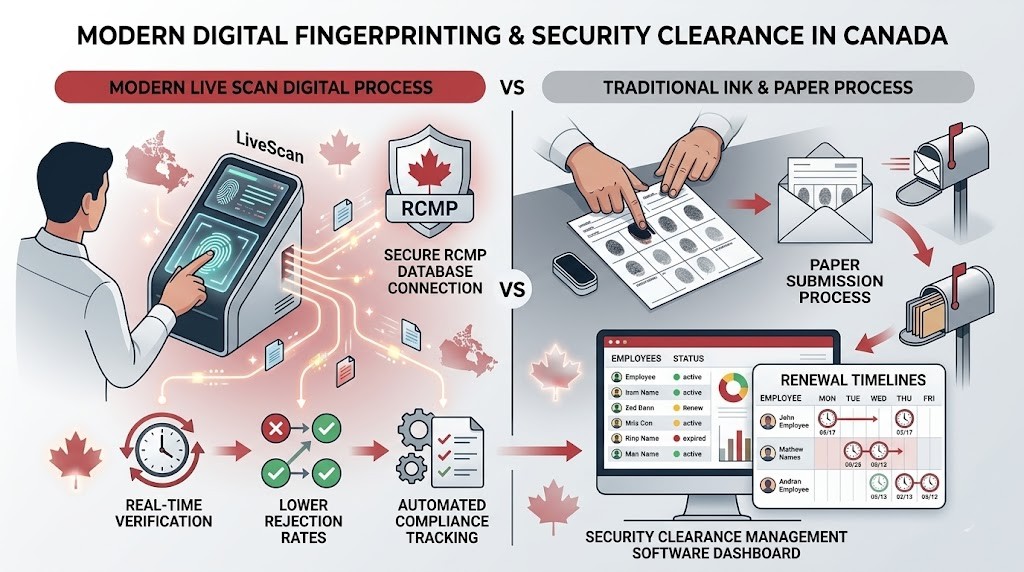
Digital Fingerprinting Advantages
According to RCMP technical resources, electronic fingerprint submission offers significant advantages over traditional ink-based methods:
Electronic vs Ink Comparison:
| Factor | Electronic (LiveScan) | Ink-Based (Paper) |
|---|---|---|
| Submission Method | Instant electronic submission to RCMP | Physical mail to RCMP |
| Quality Control | Real-time verification, immediate retake if needed | Errors discovered after submission |
| Rejection Rate | Lower (better image quality) | Higher (smudging, pressure issues) |
| Environmental Impact | No consumables | Ink, paper, courier materials |
| Audit Trail | Digital confirmation codes | Paper receipt only |
Recommendation: For contractors processing multiple clearances, partnering with providers offering digital LiveScan technology reduces rejection-related delays.
Clearance Management Software
Large government contractors increasingly deploy specialized security clearance management platforms that:
- Track employee clearance status and expiration dates
- Automate renewal notification workflows
- Generate compliance reports for audits
- Interface with HR and project management systems
- Maintain centralized document repositories
ROI consideration: For organizations processing 50+ clearances annually, dedicated software can significantly reduce administrative burden and compliance risk.
Looking Forward: Trends Shaping Security Clearance Demand
Trend #1: Continued Government Employment Growth
Despite recent discussions about federal workforce reductions, according to demographic resources and public administration research, Canada’s aging population and expanding government services suggest sustained demand for cleared personnel through 2030.
Trend #2: Cybersecurity Clearance Surge
According to technology sector analysis, Canada’s focus on critical infrastructure protection and cybersecurity is driving demand for Secret and Top Secret cleared IT professionals. This creates competitive pressure in an already tight labor market.
Trend #3: Indigenous Procurement Requirements
According to federal procurement policy, increased emphasis on Indigenous business participation in government contracting means more Indigenous-owned firms will need to navigate security clearance processes, including fingerprinting requirements.
Trend #4: Automated Clearance Processing
Government resources indicate ongoing modernization of security screening systems. Future innovations may include:
- Faster CSIS assessment timelines
- More comprehensive automated database checks
- Continuous screening vs. periodic renewals
- Enhanced biometric verification beyond fingerprints
For contractors, staying informed about process changes will be essential for maintaining compliance and competitiveness.
Key Takeaways
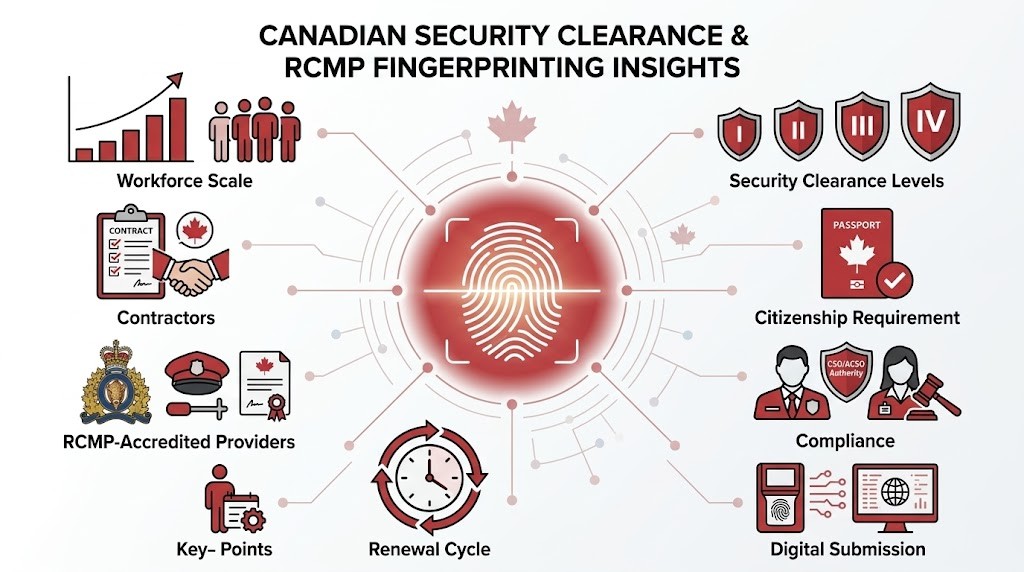
📌 367,772 federal public servants required security screening with fingerprinting as of March 2024
📌 All four clearance levels (Reliability, Enhanced Reliability, Secret, Top Secret) require RCMP fingerprinting
📌 Estimated 50,000-90,000+ contractors need security clearances annually, all involving fingerprints
📌 Canadian citizenship is mandatory for security clearances—no exceptions
📌 Only Company Security Officers (CSO/ACSO) can request contractor clearances
📌 Electronic fingerprint submission reduces rejection rates and accelerates processing
📌 Clearance renewal is required every 5-10 years depending on level
📌 Proactive clearance pipeline management prevents project start delays
📌 RCMP accreditation is mandatory for fingerprinting providers—non-accredited submissions are rejected
📌 Security clearance is a business enabler—strategic planning reduces risks and costs
Partner With Experts Who Understand Government Contractor Needs
At Lotey Fingerprinting Services, we recognize that security clearance fingerprinting isn’t just a compliance requirement—it’s a business enabler that determines whether you can fulfill contracts, deploy personnel, and grow your government business.
Why Government Contractors Work With Us
As an RCMP-accredited provider, we understand the unique needs of organizations managing security clearances:
Enterprise-Ready Capabilities:
- Digital LiveScan technology for instant electronic submission
- Volume capacity for new contract staffing surges
- Mobile fingerprinting services for corporate locations
- Dedicated account support for CSO/ACSO coordination
Government Contractor Expertise:
- Deep understanding of Treasury Board security screening standards
- Experience with all clearance levels (Reliability through Top Secret)
- Knowledge of Contract Security Program requirements
- Guidance for companies new to government contracting
Operational Excellence:
- Streamlined appointment scheduling to minimize employee disruption
- Same-day processing to reduce project timeline impacts
- Comprehensive documentation for audit compliance
- Proactive communication with your security personnel
Let's Discuss Your Security Clearance Needs
Whether you’re pursuing your first government contract or managing hundreds of cleared personnel, we’re here to help you navigate the fingerprinting requirements that underpin Canada’s security clearance system.
Explore your options: Contact us to discuss how we can support your organization's security clearance objectives.
FAQ: Your Questions Answered
How many Canadians actually need security clearance fingerprinting?
According to official government resources, Canada’s federal public service employs 367,772 people, all of whom required security screening including fingerprinting. When you add contractors, consultants, provincial government workers on federal projects, and private sector employees requiring clearances for regulated industries, the annual volume likely exceeds 400,000-500,000 fingerprinting requests for security clearance purposes.
Can employees who aren't Canadian citizens get security clearances?
No. According to CSIS security screening resources and the Treasury Board Standard on Security Screening, applicants must be Canadian citizens to obtain security clearances. This is a fundamental eligibility requirement that cannot be waived. For contractors, this means international workers—even those with permanent residency—cannot access classified information or secure sites requiring clearances.
What happens if an employee's criminal record check shows a conviction?
According to security screening resources, having a criminal conviction doesn’t automatically disqualify someone from security clearance. Each case is assessed individually based on:
- Nature and severity of the offense
- How long ago it occurred
- Rehabilitation efforts
- Relevance to the position
- Overall pattern of behavior
However, certain offenses (espionage, terrorism, serious violent crimes) will generally result in clearance denial. Departments make final clearance decisions based on CSIS security assessments.
How do companies become authorized to request contractor clearances?
According to Public Services and Procurement Canada resources, companies must register with the Contract Security Program (CSP) and designate a Company Security Officer (CSO) and Alternate CSO (ACSO). This involves:
- Submitting company registration forms
- Demonstrating valid government contracts requiring clearances
- Providing CSO/ACSO personal information
- Completing security awareness training
- Maintaining facility security standards (if applicable)
Only registered companies with designated CSOs can request personnel security screenings.
Do clearances transfer if an employee changes government contractors?
Generally, no. According to security screening resources, clearances are granted by individual departments and are typically “inactivated” when an employee transfers out of that department or ends their contract. However, if the new role requires the same clearance level, the previous clearance can often be “reactivated” more quickly than processing a new application from scratch. This requires coordination between the previous and new sponsoring departments.
What's the biggest mistake companies make with security clearance fingerprinting?
Based on security officer resources and contractor experiences, the most common mistake is waiting until the last minute. Many companies don’t initiate fingerprinting until after winning a contract, then discover they can’t start work because employees aren’t cleared. Best practice: identify likely cleared personnel needs during the proposal stage and begin preliminary fingerprinting for key staff before contract award (with their consent).
Are there any exemptions to the fingerprinting requirement for security clearances?
No. According to Treasury Board security screening standards, fingerprint-based criminal record checks are mandatory for all security clearance levels without exception. This applies equally to federal employees, contractors, students, researchers, or any other individual requiring access to classified information or secure sites. The only scenario where fingerprinting might not be required is for positions that don’t need any security clearance at all.
How do security clearance requirements affect recruitment and retention?
According to government contractor industry resources and HR professional insights, clearance requirements significantly impact talent strategy:
Recruitment challenges:
- Smaller candidate pool (Canadian citizens only)
- Extended time-to-productivity (can’t start sensitive work until cleared)
- Competition with other cleared-position employers
Retention considerations:
- Cleared employees have higher market value
- Losing a cleared employee means training AND clearance costs for replacement
- Some companies offer retention bonuses tied to maintaining active clearances
This makes fingerprinting and clearance management a strategic workforce planning issue, not just an administrative task.

Navneet Lotey
Navneet Lotey has over 5 years of experience in fingerprinting. He aims to deliver accurate, easy-to-understand fingerprinting solutions for individuals and businesses alike.
References and Official Resources
This analysis draws from official government resources and verified industry data:
- Treasury Board of Canada Secretariat. (2024). Demographic Snapshot of Canada’s Public Service, 2024. Retrieved from https://www.canada.ca/en/treasury-board-secretariat/services/innovation/human-resources-statistics/demographic-snapshot-federal-public-service-2024.html
- The Globe and Mail. (2024). Number of federal workers hits new high in 2024. Retrieved from https://www.theglobeandmail.com/business/article-federal-public-service-workers-2024/
- Government of Canada. Security Screening. Retrieved from https://www.canada.ca/en/government/publicservice/workforce/staffing/security-screening.html
- Canadian Security Intelligence Service (CSIS). Government Security Screening. Retrieved from https://www.canada.ca/en/security-intelligence-service/services/government-security-screening.html
- Government of Canada. Security clearance request process. Retrieved from https://www.canada.ca/en/public-services-procurement/services/industrial-security/security-requirements-contracting/personnel-security-screening/processes/security-clearance-request.html
- Coursera. (2024). What Is Security Clearance? Types and Requirements for Jobs in Canada. Retrieved from https://www.coursera.org/ca/articles/security-clearance
- Indeed Canada. (2024). How to Get Security Clearance in 4 Simple Steps. Retrieved from https://ca.indeed.com/career-advice/career-development/how-to-get-security-clearance
- Public Services and Procurement Canada. Number of personnel security screenings/clearances granted to contractors by level. Open Government Portal.
- Wikipedia. (2025). Canada security clearance. Retrieved from https://en.wikipedia.org/wiki/Canada_security_clearance
- FINTRAC. Security and suitability requirements. Retrieved from https://fintrac-canafe.canada.ca/emplo/req-eng
This content is provided for informational purposes and reflects our understanding of security clearance requirements based on official government resources. Requirements may change; always consult official Treasury Board and CSIS resources for the most current standards. We are a fingerprinting service provider, not legal or compliance advisors.