



The Fear That Stops Thousands of Canadians
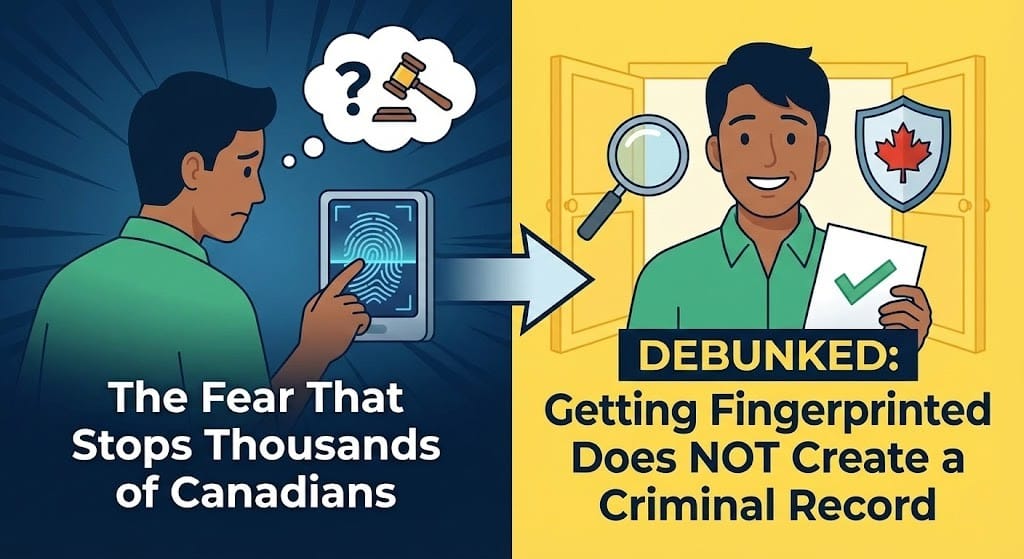
“If I get fingerprinted, will that create a criminal record?”
This single question causes more anxiety than any other aspect of the fingerprinting process. Every week at our Brampton location, we meet clients—first-time job seekers, new immigrants, volunteers—who walk through our doors worried that the simple act of having their fingerprints taken will somehow label them as criminals.
Here’s the truth: Getting fingerprinted does NOT create, imply, or indicate a criminal record. Let’s break down this myth once and for all.
Understanding the Difference: Fingerprinting vs. Criminal Record
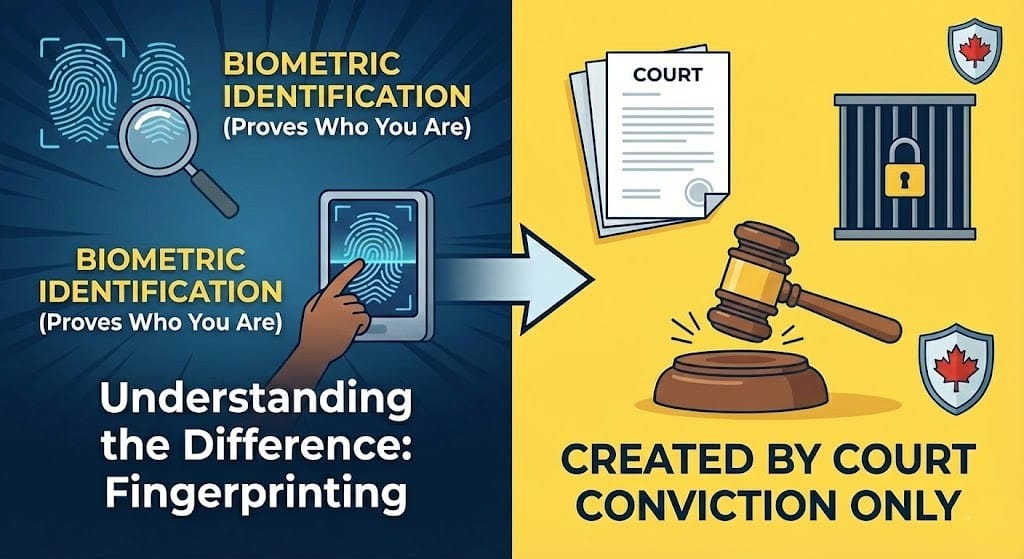
What IS Fingerprinting?
Fingerprinting is simply a biometric identification method that captures the unique patterns of your fingerprints. According to RCMP policy, fingerprinting serves as a definitive way to confirm your identity when name-based searches cannot provide certainty (RCMP, 2024).
Think of it like a highly secure ID card—it proves who you are, nothing more.
What IS a Criminal Record?
A criminal record (also called a criminal conviction record) is created ONLY when you have been convicted of a criminal offence in a Canadian court. Certified criminal record checks show different information depending on the type of application and whether you have a criminal record.
Key Point: You can only get a criminal record through a court conviction, not through fingerprinting.
The Numbers Don't Lie: Who Gets Fingerprinted in Canada?
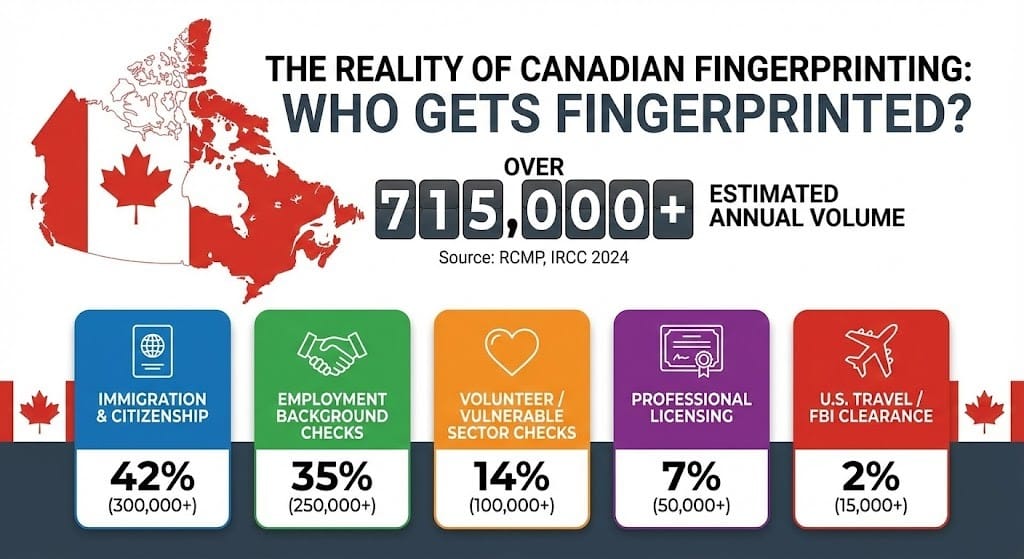
Millions of Canadians Get Fingerprinted Every Year
Let’s look at the data to understand just how common fingerprinting is for legitimate, non-criminal purposes:
| Purpose of Fingerprinting | Estimated Annual Volume | Percentage of Total |
|---|---|---|
| Immigration & Citizenship Applications | 300,000+ | 42% |
| Employment Background Checks | 250,000+ | 35% |
| Volunteer / Vulnerable Sector Checks | 100,000+ | 14% |
| Professional Licensing | 50,000+ | 7% |
| U.S. Travel / FBI Clearance | 15,000+ | 2% |
| Total | 715,000+ | 100% |
Source: RCMP Canadian Criminal Real Time Identification Services (CCRTIS), 2024; IRCC Annual Reports, 2024
Breaking Down the Immigration Numbers
Based on recent IRCC data, Canada’s immigration system drives significant fingerprinting demand:
- Over 300,000 individuals became Canadian citizens in 2024 (IRCC, 2024)
- In 2024, more than 550 partner organizations helped slightly over 690,000 newcomers contribute to their communities
- Canada’s 2024 Immigration Levels Plan admitted 485,000 permanent residents (IRCC Annual Report, 2024)
- RCMP may ask for fingerprints if you have lived in Canada for more than 6 months since the age of 18
Reality Check: If getting fingerprinted meant having a criminal record, that would suggest hundreds of thousands of new immigrants, job seekers, and volunteers are criminals. Clearly, that's absurd.
Why You're Being Asked for Fingerprints: The Real Reasons
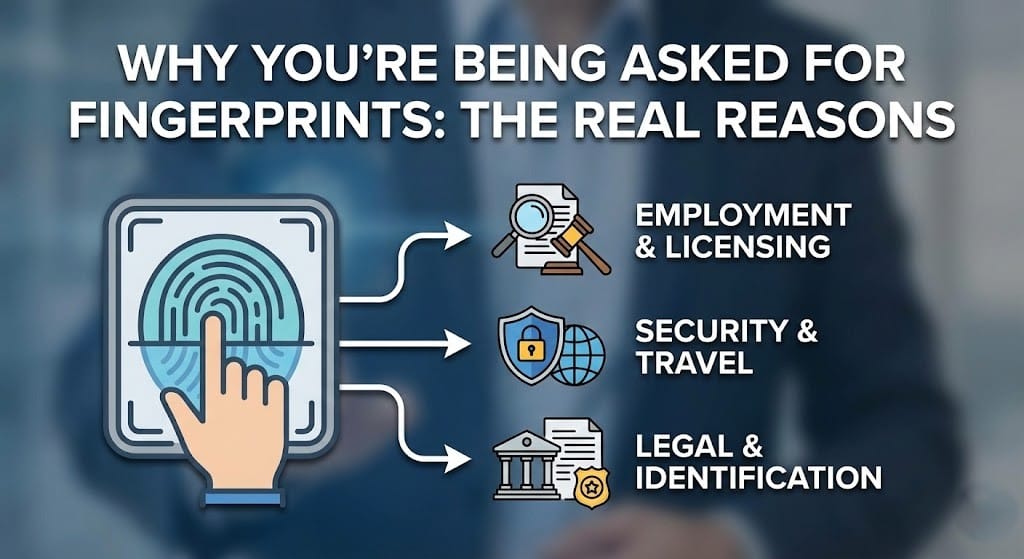
1. Immigration & Citizenship Applications
If you have lived in Canada for more than 6 months since the age of 18, the RCMP may ask you for fingerprints to complete your criminal record check.
This is standard procedure for:
- Permanent residency applications
- Citizenship applications
- Spousal sponsorship
- Study permit extensions
- Work permit renewals
2. Employment Screening
Employers in sensitive sectors require fingerprint-based background checks to verify identity definitively. This includes:
| Industry | Why Fingerprinting Required |
|---|---|
| Healthcare | Working with vulnerable patients |
| Education | Contact with children |
| Financial Services | Handling sensitive financial data |
| Government | Security clearance requirements |
| Transportation | Safety-sensitive positions |
| Childcare | Vulnerable sector requirements |
3. Vulnerable Sector Checks
Fingerprinting is a common requirement when completing a criminal record check for working with the vulnerable sector and is not an accusation of criminal activity or guilt.
You may need fingerprints if:
- Your gender and date of birth match someone on the pardoned sex offender database
- You’re applying to work with children or vulnerable adults
- Your employer requires the highest level of screening
4. Professional Licensing
Many professions in Ontario require RCMP-certified criminal record checks, including:
- Real estate agents
- Security guards
- Private investigators
- Mortgage brokers
- Insurance agents
- Notaries public
What Actually Shows Up on Your Fingerprint Check?
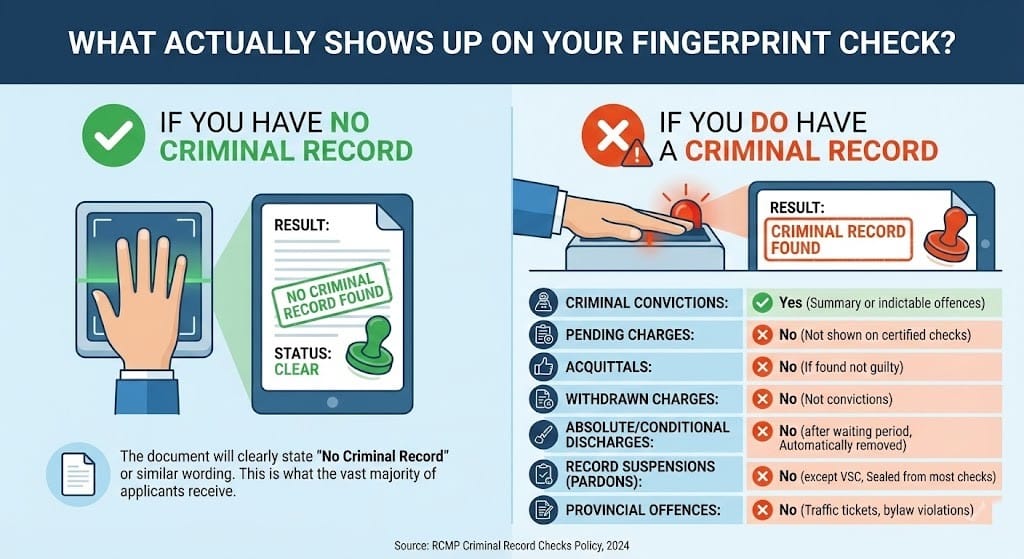
Here’s what RCMP-certified criminal record checks reveal:
If You Have NO Criminal Record:
RESULT: No Criminal Record Found
 STATUS: Clear
The document will clearly state “No Criminal Record” or similar wording. This is what the vast majority of applicants receive.
If You DO Have a Criminal Record:
| Type of Record | Shows on Check? | Notes |
|---|---|---|
| Criminal Convictions | ✅ Yes | Summary or indictable offences |
| Pending Charges | ❌ No | Not shown on certified checks |
| Acquittals | ❌ No | If found not guilty |
| Withdrawn Charges | ❌ No | Not convictions |
| Absolute/Conditional Discharges | ❌ No (after waiting period) | Automatically removed |
| Record Suspensions (Pardons) | ❌ No (except VSC) | Sealed from most checks |
| Provincial Offences | ❌ No | Traffic tickets, bylaw violations |
Source: RCMP Criminal Record Checks Policy, 2024
Processing Times & What to Expect
Understanding the timeline can reduce anxiety:
RCMP Processing Timeline
| Scenario | Processing Time | Explanation |
|---|---|---|
| No Criminal Record (Electronic) | 3-5 business days | Fast electronic verification |
| Possible Match Requires Review | 8-12 weeks | RCMP manually verifies identity |
| Manual Processing Required | 10-14 weeks | Paper fingerprints or quality issues |
| International Applicants | 12-16 weeks | Additional verification steps |
Processing times vary depending on factors such as the number of applications received at different times of the year and the amount of manual processing related to your application.
Brampton Advantage: Using a local RCMP-accredited provider like Lotey Fingerprinting ensures your fingerprints are captured correctly the first time, avoiding delays caused by rejections.
Common Scenarios That Cause Confusion
Scenario 1: "I Was Fingerprinted at a Police Station Once"
The Fear: “Does this mean I have a record?”
The Reality: No. Being fingerprinted at a police station for identification purposes (civil fingerprinting) is completely different from being fingerprinted after a criminal arrest.
Scenario 2: "I Need Fingerprints for Immigration"
The Fear: “Why do they need my fingerprints if I haven’t done anything wrong?”
The Reality: Immigration fingerprinting verifies your identity and ensures you don’t have a criminal record that would make you inadmissible to Canada. It’s a security measure, not an accusation.
Scenario 3: "My Employer Requested Fingerprinting"
The Fear: “Do they think I’m a criminal?”
The Reality: Many employers require the highest level of background screening for liability protection and regulatory compliance. It’s about due diligence, not suspicion.
Scenario 4: "I Was Asked for Fingerprints for Vulnerable Sector Check"
The Fear: “This feels like I’m being accused of something.”
The Reality: Per RCMP policy, providing fingerprints is mandatory whenever the gender and date of birth of the applicant matches to an existing pardoned sexual offence record. This is not an accusation of criminality but is required to verify identity.
The Brampton Context: Local Immigration Impact
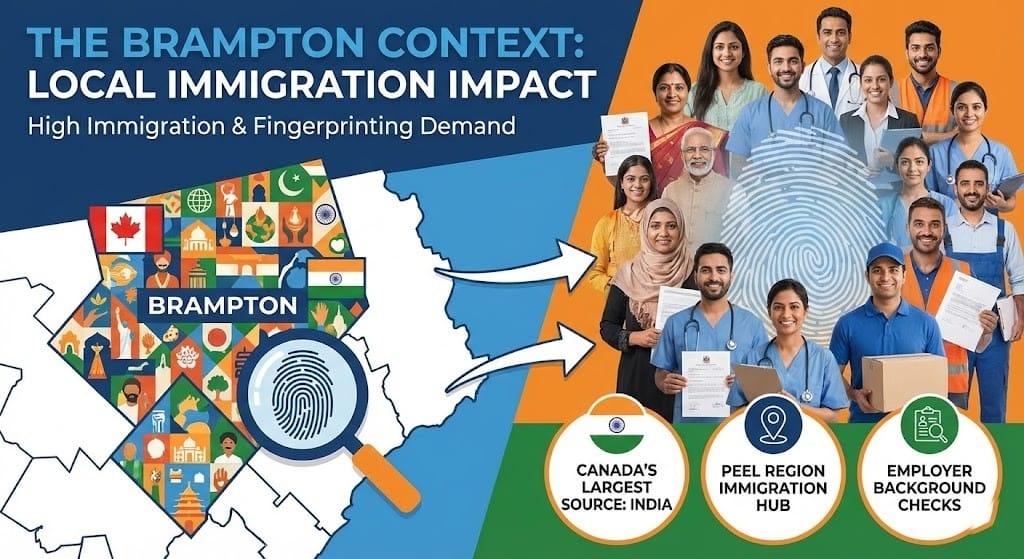
Brampton’s diverse community means fingerprinting demand is particularly high in our region:
Brampton Immigration Statistics
- India remains Canada’s largest source of immigrants, with cities like Brampton having thriving Indian-Canadian communities
- Peel Region (which includes Brampton) has one of the highest immigration rates in the GTA
- Local employers in healthcare, education, and logistics frequently require background checks
What This Means: If you’re in Brampton and being asked for fingerprints, you’re part of a large, legitimate group of people—immigrants, job seekers, volunteers—all going through the same process.
How to Approach Your Fingerprinting Appointment
Before You Go:
- Verify the provider is RCMP-accredited
- Bring two pieces of government-issued ID
- Know the purpose of your fingerprinting
- Moisturize hands 24 hours before (helps with quality)
- Avoid heavy hand cream day-of (can interfere with capture)
During the Appointment:
- Relax—stress makes hands tense and affects quality
- Follow the technician's instructions carefully
- Ask questions if you're confused about the process
- Request a receipt and timeline for results
After Fingerprinting:
- Keep your receipt with the transaction number
- Track your results according to the timeline provided
- Contact the agency if results are delayed beyond expected timeframe
Key Privacy Protections You Should Know
DO Worry About:
- Fingerprint Quality: Poor-quality prints get rejected, causing delays
- Using Non-Accredited Providers: Only RCMP-accredited agencies can submit to CCRTIS
- Missing Documentation: Bring proper ID and required forms
- Timing: Start the process early if you have deadlines
DON'T Worry About:
- "Creating" a Criminal Record: Impossible through fingerprinting alone
- Privacy Violations: RCMP has strict handling protocols
- Future Background Checks: Being fingerprinted won't show up
- Employer Assumptions: Standard procedure, not suspicion
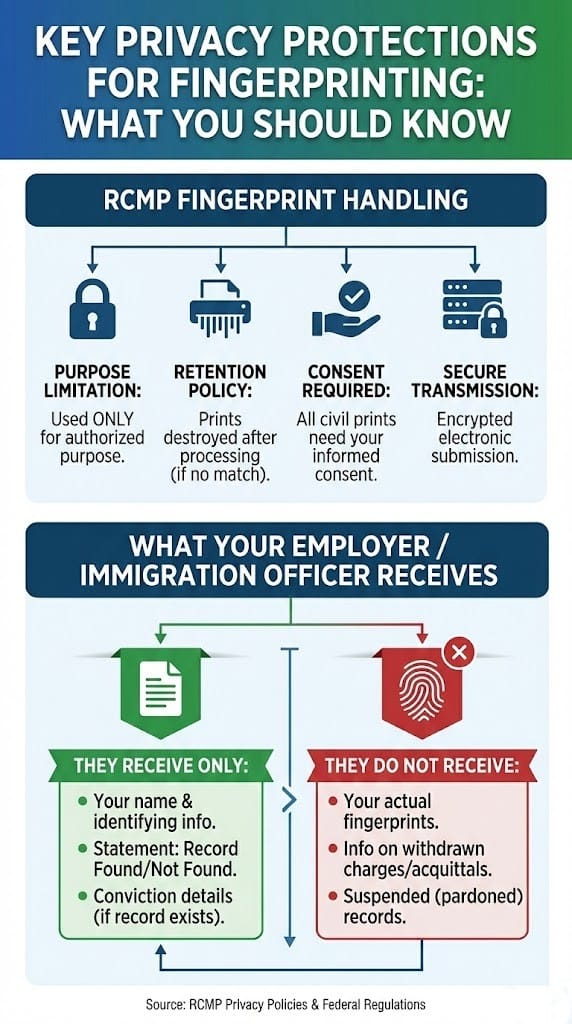
Key Privacy Protections You Should Know
RCMP Fingerprint Handling
- Purpose Limitation: Your fingerprints are only used for the specific purpose you authorize
- Retention Policy: If no match is found, fingerprint submissions are destroyed after processing
- Consent Required: All civil fingerprinting requires your informed consent
- Secure Transmission: RCMP-accredited agencies use encrypted electronic submission
What Your Employer/Immigration Officer Receives
They receive ONLY:
- Your name and identifying information
- A statement of whether a criminal record was found or not
- If a record exists, details of convictions
They do NOT receive:
- Your actual fingerprints
- Information about withdrawn charges or acquittals
- Records that have been suspended (pardoned)
The Bottom Line: You're In Good Company
Over 715,000 Canadians get fingerprinted annually for legitimate, non-criminal reasons. That’s more than the population of Mississauga and Brampton combined.
The truth is simple:
- Fingerprinting = Identity verification
- Criminal Record = Court conviction
These are separate things. One does not cause the other.
If you're being asked for fingerprints for immigration, employment, volunteering, or licensing, you're simply going through a standard verification process that hundreds of thousands of people complete successfully every year.
FAQ: Your Burning Questions Answered
Will getting fingerprinted show up on future background checks?
No. The act of being fingerprinted is not recorded as part of your criminal history. Only actual criminal convictions appear on background checks.
Can employers see that I've been fingerprinted before?
No. Previous fingerprinting submissions are not tracked or shared with employers. Each fingerprint check is a standalone verification.
If I have no criminal record, why does it take weeks to get results?
It can take up to 12 weeks for fingerprint results to reach from the CCRTIS in Ottawa when manual processing is required to verify there’s no match to the criminal database.
I was charged but not convicted. Will this show up?
No. Certified criminal record checks only show convictions. Charges that were withdrawn, stayed, or resulted in acquittal do not appear.
What if my fingerprints are rejected?
Fingerprint rejections happen due to quality issues (dry skin, worn fingerprints, incorrect capture). This has nothing to do with having a criminal record. Simply get re-fingerprinted with proper technique.
Does getting fingerprinted for immigration affect my application?
Not unless you actually have an inadmissible criminal record. The fingerprinting itself is neutral—it simply verifies your identity and criminal history status.
Can I refuse to be fingerprinted?
You can refuse, but this will likely result in your application (employment, immigration, licensing) being denied or incomplete. Fingerprinting is often a mandatory requirement.
Disclaimer: This blog post is for informational purposes only and does not constitute legal advice. Immigration and criminal record policies may change. Always consult official government sources or legal professionals for your specific situation.

Navneet Lotey
Navneet Lotey has over 5 years of experience in fingerprinting. He aims to deliver accurate, easy-to-understand fingerprinting solutions for individuals and businesses alike.
References
- Royal Canadian Mounted Police (RCMP). (2024). Criminal Record Checks. Retrieved from https://rcmp.ca/en/criminal-records/criminal-record-checks
- Royal Canadian Mounted Police (RCMP). (2024). Processing Times and Fees. Retrieved from https://rcmp.ca/en/criminal-records/criminal-record-checks/processing-times-and-fees
- Immigration, Refugees and Citizenship Canada (IRCC). (2024). How do I give my fingerprints and get an RCMP criminal record check? Retrieved from https://ircc.canada.ca/
- Immigration, Refugees and Citizenship Canada (IRCC). (2024). 2024 Annual Report to Parliament on Immigration. Government of Canada.
- Immigration, Refugees and Citizenship Canada (IRCC). (2025). Departmental Results Report 2024-25. Government of Canada.
- Province of British Columbia. (2024). Criminal Record Check Process. Retrieved from https://www2.gov.bc.ca/gov/content/safety/crime-prevention/criminal-record-check/
- Toronto Police Service. (2024). Police Record Checks. Retrieved from https://www.tps.ca/services/police-record-checks/
- Canadian Title Immigration and Visa Consulting Inc. (2024). Canadian Citizenship Statistics 2024: Top Source Countries & Trends. Retrieved from https://www.ctivci.ca/