



Table of Contents
If you have ever been told your fingerprinting application was rejected because it was not submitted by an accredited agency — or if you are shopping for a fingerprinting service and wondering why accreditation matters — this guide is for you.
The RCMP’s fingerprinting accreditation programme is one of the most misunderstood requirements in the Canadian background check process. Most people simply know they need an “RCMP-approved” fingerprinting service — but few understand what that accreditation actually requires, what the standards are, what has changed in recent years, and why cutting corners here creates serious consequences.
At Lotey Fingerprinting Services in Brampton, we are RCMP accredited. We have gone through the full CCRTIS accreditation process — and we maintain those standards every day. This guide explains exactly what that means, what changed in the RCMP’s accreditation framework, and what every applicant should look for when choosing a fingerprinting service.
What Is RCMP Fingerprinting Accreditation?
RCMP accreditation for fingerprinting agencies is administered by the RCMP’s Canadian Criminal Real Time Identification Services (CCRTIS) — the national unit responsible for maintaining Canada’s National Repository of Criminal Records and processing all civil fingerprint submissions.
Private agencies must be accredited by CCRTIS before they are permitted to take fingerprints for civil purposes and submit them electronically to the RCMP for criminal record verification. An accredited agency has been assessed, inspected, and certified against a defined set of requirements covering:
- Personnel security
- Physical site security
- IT and data security
- Device and technology standards
- Network connection requirements
- Submission format compliance
Without this accreditation, a fingerprinting agency’s submissions are not accepted by the RCMP. Fingerprints taken by a non-accredited provider are administratively rejected — regardless of print quality. Your application goes nowhere, and you must start again.
Most rejections are technical. Most are entirely preventable.
What Are the RCMP CCRTIS Accreditation Requirements?
The CCRTIS accreditation programme is comprehensive. Here is what a private fingerprinting company must satisfy before being granted accreditation and access to the RCMP’s Real Time Identification (RTID) system:
Personnel Security Screening
What causes it: When a finger is pressed too hard onto the ink pad or scanner, the ridges compress against each other and flood with ink or become distorted. The result is a dark, smeared print where the ridge detail — loops, whorls, and deltas — becomes illegible.
What it looks like: Dark, filled-in prints where the ridge detail is fused or indistinguishable. Centre loops and delta points are invisible.
How to avoid it: The fingerprint technician should be doing all the work — your job is to relax your hand and let your finger be guided without resistance or tension. A common mistake is applicants unconsciously pressing down while the technician rolls. Consciously let your hand go limp. The right amount of pressure is light and consistent — not forceful.
Pro tip from Lotey: Tell your technician before the session if you tend to grip or tense. A good technician will guide your hand and coach you through the process — this is exactly what our team is trained to do.
Personnel security screening is not optional and not self-administered. It is conducted by the RCMP as part of the accreditation process. This requirement alone eliminates many informal or ad hoc fingerprinting providers.
Physical Site Security Inspection
The physical premises where fingerprinting takes place must pass an inspection assessing whether the site meets RCMP security standards for:
- Access control and physical security of the premises
- Safeguarding of biometric data
- Protection against unauthorised access to fingerprint records and submission systems
Key 2025–2026 Update: Security Inspection Outsourcing
One of the most significant structural changes in the RCMP CCRTIS accreditation programme is the outsourcing of security inspections to the private sector. The CCRTIS has established mandatory requirements that private security companies must meet in order to qualify to conduct physical site and IT security inspections on behalf of CCRTIS.
What this means practically:
- Accredited fingerprinting agencies are now responsible for contracting and paying for their own security inspections through approved private security firms
- This change shifts the administrative and financial burden of compliance onto the fingerprinting provider
- Costs are negotiated directly between the fingerprinting company and the private security firm performing the inspection
- Only security companies that have met CCRTIS qualification criteria are permitted to conduct these inspections
This is a meaningful operational change. It adds a layer of financial accountability for fingerprinting agencies — agencies that are not serious about maintaining their operations to standard cannot easily absorb these compliance costs.
IT Security Inspection
Alongside the physical site inspection, IT security is assessed separately. The fingerprinting company’s information systems — computers, networks, data storage, and submission infrastructure — must meet RCMP standards for:
- Protection of civil fingerprint transaction data
- Secure connectivity to the RTID system
- Network isolation and access controls appropriate for handling biometric criminal record data
Device Certification: EFCD Requirements
For electronic fingerprinting, accredited agencies must use RCMP-certified Electronic Fingerprint Capture Devices (EFCDs) — manufactured by RCMP-certified vendors. This is not a preference; it is a mandatory requirement.
The certification process assesses whether the device:
- Is properly installed, integrated, and configured at the agency’s site
- Is capable of electronically exchanging NIST-compliant transactions with the RCMP RTID system
- Is an RCMP-certified device manufactured by a certified vendor
What is NIST compliance in fingerprinting? NIST stands for the National Institute of Standards and Technology — the US federal standards body whose biometric data format specifications (specifically the NIST/ANSI standard for fingerprint data interchange) are used as the technical baseline for RCMP fingerprint submissions. Every electronic fingerprint transaction submitted to the RCMP RTID system must conform to the National Police Services – NIST – Interface Control Document (NPS-NIST-ICD) specifications. Devices that do not meet this standard cannot interface with the RTID system.
Agency Certification Process
| Step | What It Assesses |
|---|---|
| Personnel security screening | Who is running the operation |
| Physical site inspection | Where fingerprinting happens |
| IT security inspection | How data is protected |
| Agency certification | Whether the devices and systems can technically interface with RCMP RTID |
Certification confirms the fingerprinting company’s complete setup — device, network, and submission system — can operate within the RCMP’s technical environment. Only after certification is passed is accreditation formally granted and the agency listed on the RCMP’s public accredited agencies list.
What Has Changed in RCMP Fingerprinting Standards?
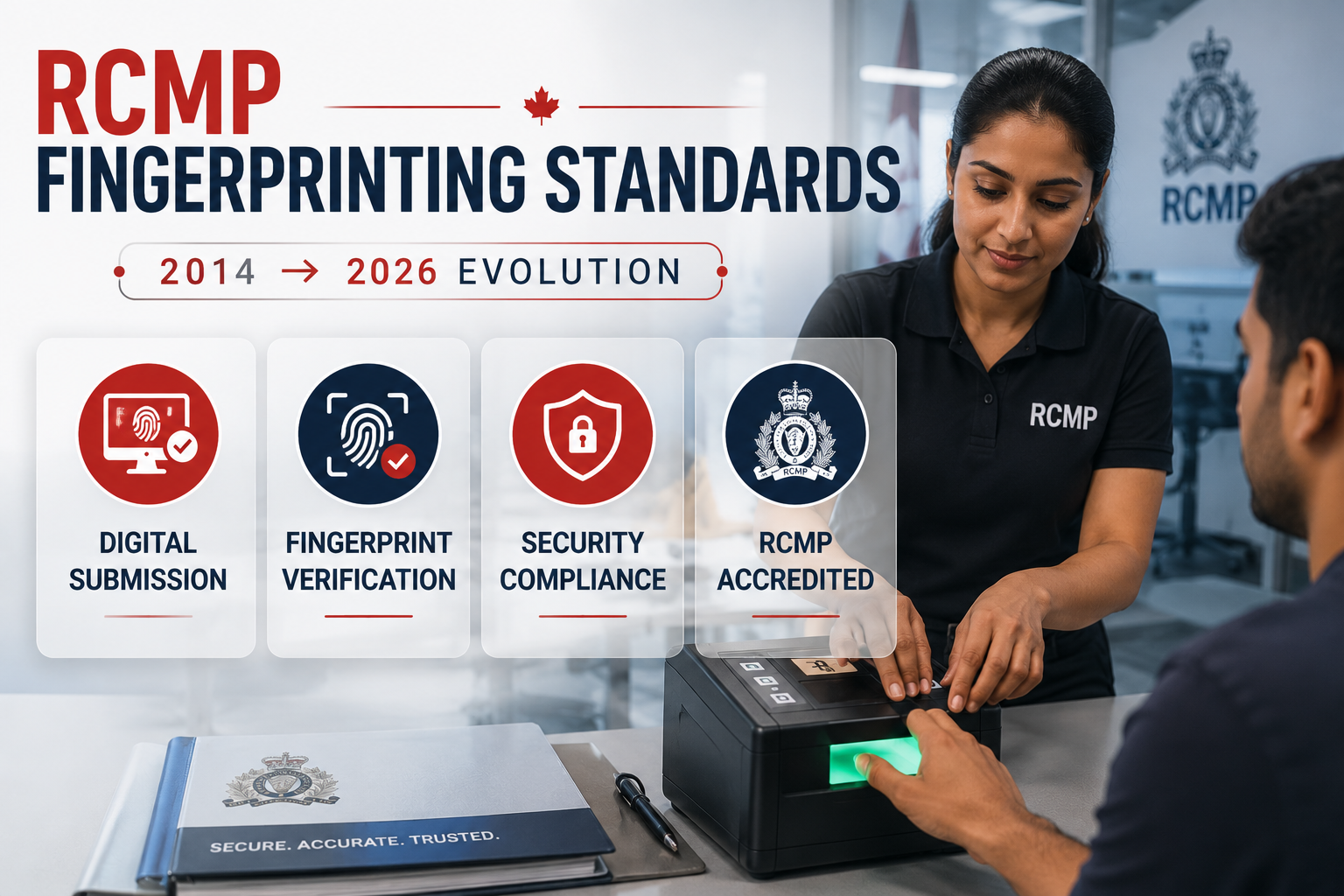
The RCMP’s fingerprinting standards have evolved considerably over the past decade. Here is a clear timeline of the most significant changes:
| Year | Change | Impact |
|---|---|---|
| 2014 | RCMP mandates all civil fingerprints be submitted electronically (digital, not ink-card only) | End of the era where any police station or informal provider with an ink pad was sufficient |
| 2015 onward | Phased transition from name-based checks to fingerprint-based checks for government employees (Phase I) | Higher accuracy; eliminates name-confusion false positives in criminal record verification |
| Ongoing | Phase II (vulnerable employment sectors) and Phase III (general employers) — mandated fingerprint-based checks replacing name-based system | Long-term move to universal fingerprint-based background checks across all sectors |
| 2024–2025 | CCRTIS outsources physical and IT security inspections to private sector | Fingerprinting agencies now responsible for arranging and paying for their own inspections through approved private security firms |
| 2026 | RCMP accredited agencies list updated monthly — agencies can be added or removed at any time | Applicants must verify accreditation status at the time of booking, not just once |
The most significant ongoing shift is the long-term direction toward mandatory fingerprint-based criminal record checks replacing name-based checks. The RCMP’s rationale is accuracy: fingerprint-based checks identify individuals with certainty, eliminating false positives and negatives that occur when multiple people share the same name. Phase I (government employees) was implemented in 2015. Phase II and Phase III implementation for broader employment sectors remains on a phased timeline.
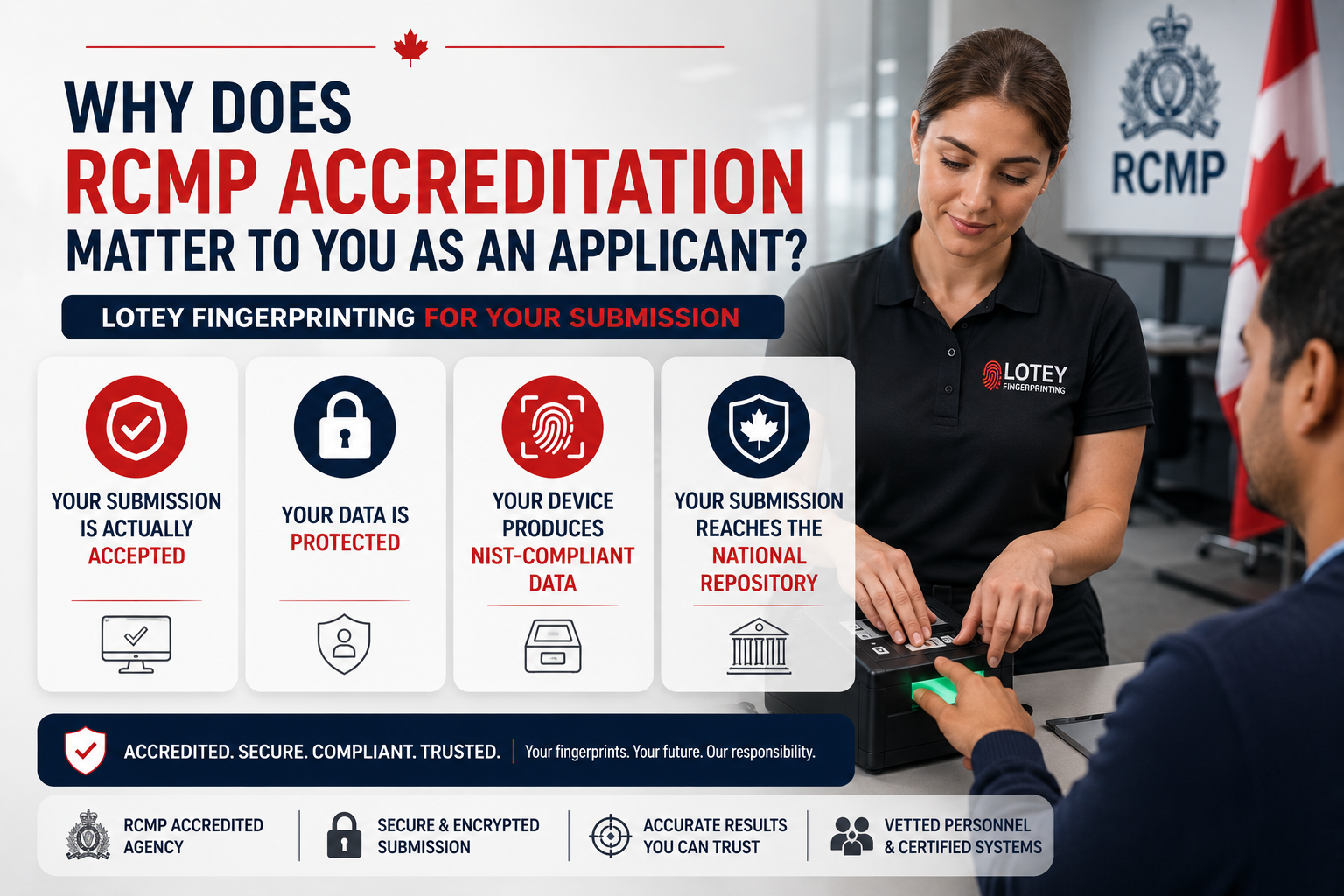
Why Does RCMP Accreditation Matter to You as an Applicant?
The accreditation framework exists to protect you — the applicant — in several ways:
Your submission is actually accepted. Only accredited agencies can submit electronic fingerprint transactions to the RCMP RTID system. If you use a non-accredited provider, your fingerprints are not accepted — your application is rejected and you must resubmit with an accredited agency, paying again and losing weeks of processing time.
Your data is protected. The physical security, IT security, and personnel screening requirements in the accreditation framework ensure that your biometric data — fingerprints that are permanently, uniquely yours — is handled in a secure environment by vetted personnel using secure systems. A non-accredited provider has no obligation to meet these standards.
Your device produces NIST-compliant data. The EFCD certification requirement ensures that the device capturing your fingerprints can produce data in the exact technical format the RCMP system requires. Non-certified devices produce data that fails at the technical level before it even reaches a human reviewer.
Your submission reaches the National Repository. Criminal record verification checks your fingerprints against Canada’s National Repository of Criminal Records — maintained by CCRTIS. Only submissions from accredited agencies reach this repository. Name-based or non-RCMP-channel submissions are not the same and do not access the same records.
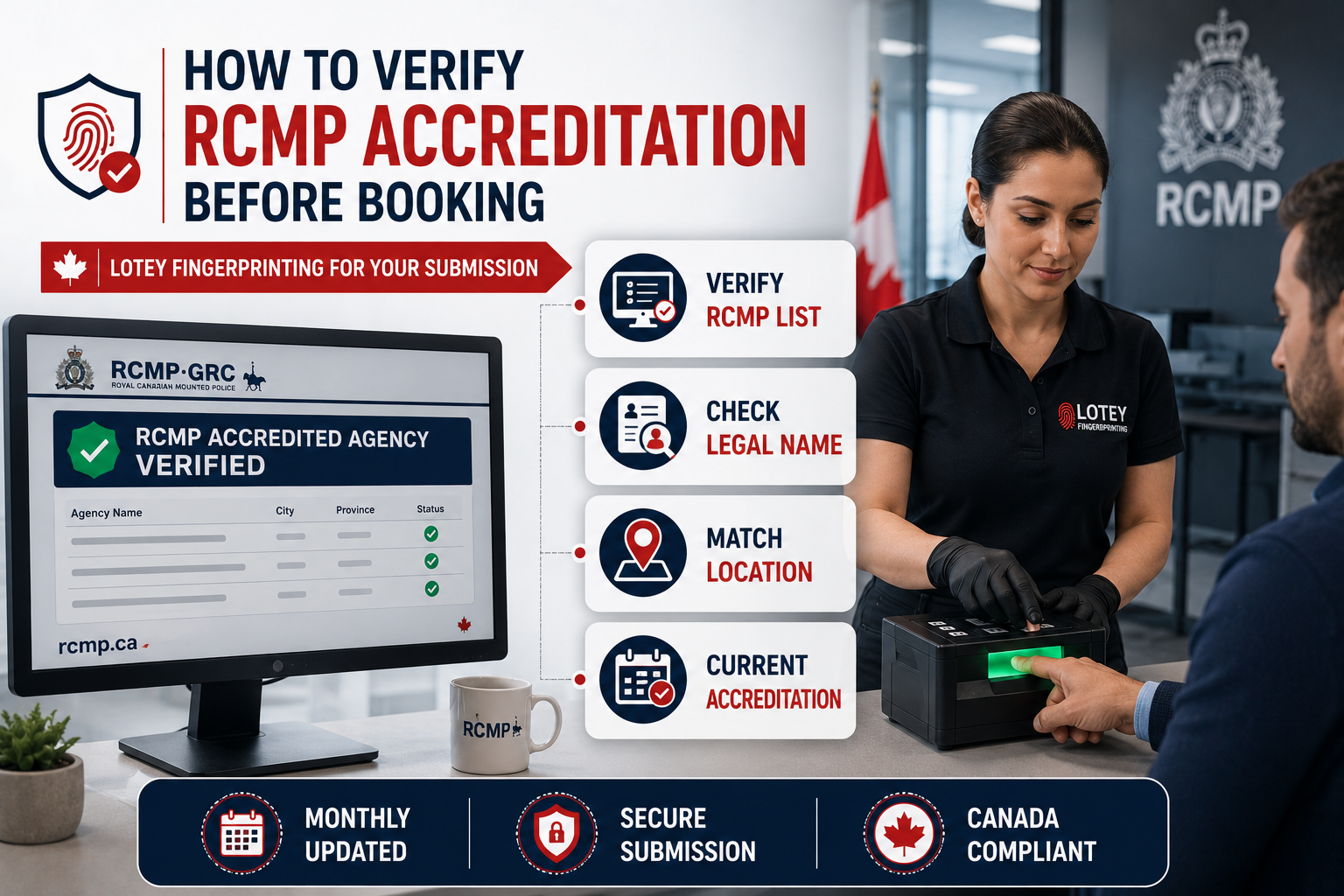
How to Verify RCMP Accreditation Before Booking
The RCMP maintains a public list of all accredited private fingerprinting companies at: → rcmp.ca/en/criminal-records/criminal-record-checks/private-fingerprinting-companies-accredited-rcmp
This list is updated at the beginning of each month. Agencies can be added or removed at any time — accreditation is not permanent and can be revoked. Before booking any fingerprinting service, verify that the agency currently appears on this list.
What to check:
- The agency’s legal name matches what appears on the RCMP list
- The address on the list matches where you will be fingerprinted
- The list is current — check the RCMP page directly rather than relying on an agency’s own marketing materials
Important: There are no RCMP-accredited private fingerprinting companies operating outside Canada. If you are outside Canada and need fingerprints for an RCMP submission, the process is different — typically involving local police or consular channels with subsequent submission through an accredited Canadian agency.
What Accreditation Means at Lotey Fingerprinting
Yes. Lotey Fingerprinting Services in Brampton, Ontario is RCMP accredited. Our accreditation means:
- Our personnel have completed RCMP CCRTIS security screening
- Our Brampton site has passed physical and IT security inspections meeting CCRTIS standards
- We use RCMP-certified EFCD devices from certified vendors
- Our submissions are NIST-compliant and accepted by the RCMP RTID system
- We are listed on the RCMP’s public accredited agencies list and our accreditation is maintained and current
When you book with Lotey Fingerprinting, your submission reaches the National Repository of Criminal Records. Your criminal record check is conducted against the complete federal record — not a partial or name-based search. And your biometric data is handled under the security standards the RCMP requires.
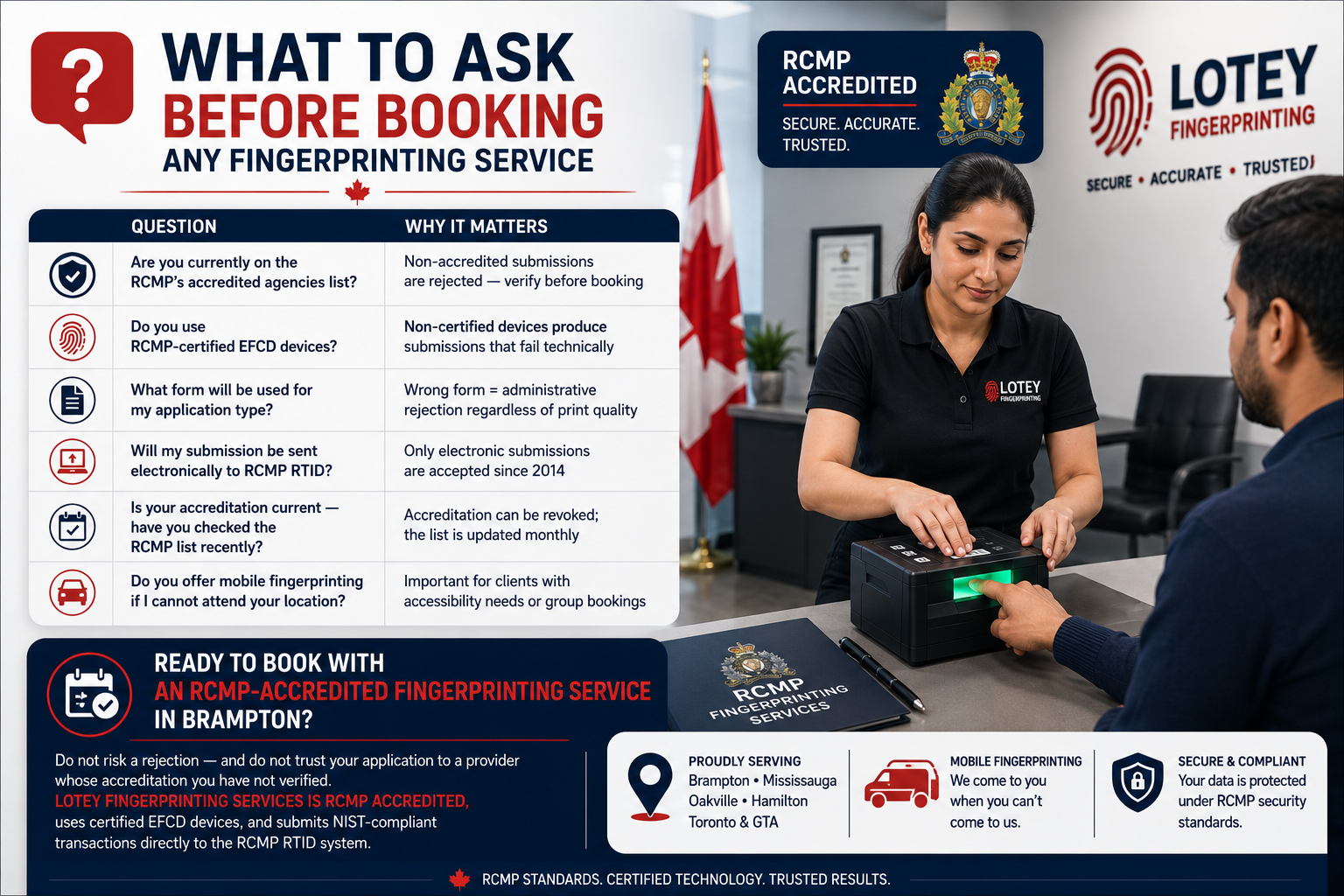
What to Ask Before Booking Any Fingerprinting Service
The RCMP’s fingerprinting standards have evolved considerably over the past decade. Here is a clear timeline of the most significant changes:
| Question | Why It Matters |
|---|---|
| Are you currently on the RCMP’s accredited agencies list? | Non-accredited submissions are rejected — verify before booking |
| Do you use RCMP-certified EFCD devices? | Non-certified devices produce submissions that fail technically |
| What form will be used for my application type? | Wrong form = administrative rejection regardless of print quality |
| Will my submission be sent electronically to RCMP RTID? | Only electronic submissions are accepted since 2014 |
| Is your accreditation current — have you checked the RCMP list recently? | Accreditation can be revoked; the list is updated monthly |
| Do you offer mobile fingerprinting if I cannot attend your location? | Important for clients with accessibility needs or group bookings |
Ready to Book with an RCMP-Accredited Fingerprinting Service in Brampton?
Do not risk a rejection — and do not trust your application to a provider whose accreditation you have not verified. Lotey Fingerprinting Services is RCMP accredited, uses certified EFCD devices, and submits NIST-compliant transactions directly to the RCMP RTID system.
We serve clients from across the Greater Toronto Area — Brampton, Mississauga, Oakville, Hamilton, Toronto — and offer mobile fingerprinting when attending our office is not possible.
FAQ: Your Questions Answered
What is RCMP CCRTIS and why is it important for fingerprinting?
CCRTIS stands for Canadian Criminal Real Time Identification Services — the RCMP unit that maintains Canada’s National Repository of Criminal Records and processes all civil fingerprint submissions. Every legitimate criminal record check in Canada runs through CCRTIS. Only fingerprints submitted by RCMP-accredited agencies are accepted by CCRTIS, which is why accreditation is not optional. Non-accredited submissions are rejected outright, regardless of print quality or completeness.
What happened to ink fingerprinting — is it still accepted by the RCMP?
Since July 1, 2014, the RCMP has required all civil fingerprints to be submitted electronically. Ink fingerprint cards on their own are no longer a direct submission channel to the RCMP RTID system. Some accredited agencies digitise ink card submissions before transmitting them electronically — but the submission itself must be electronic. For most applicants today, digital (livescan) fingerprinting at an RCMP-accredited agency is the standard and most reliable method.
Can my employer or a volunteer organisation conduct their own fingerprinting for background checks?
No — unless they are RCMP-accredited, which requires meeting the full CCRTIS accreditation requirements including personnel security screening, physical and IT security inspections, certified EFCD devices, and agency certification. Self-administered fingerprinting or fingerprinting conducted by unaccredited HR departments is not accepted by the RCMP. Employers requiring fingerprint-based criminal record checks must direct employees to an accredited fingerprinting agency.
What is the RTID system?
RTID stands for Real Time Identification — the RCMP’s electronic system that receives civil fingerprint transactions from accredited agencies and processes them against the National Repository of Criminal Records. Access to the RTID system is restricted to accredited fingerprinting agencies that have passed full CCRTIS accreditation. Fingerprint submissions reach RTID through certified EFCD devices producing NIST-compliant transactions. The name reflects the system’s capability to return results faster than the legacy paper-based system it replaced.
What does NIST compliance mean for fingerprinting?
NIST (National Institute of Standards and Technology) compliance refers to the technical standards governing the format and quality of fingerprint data exchanged between fingerprinting devices and criminal record systems. The RCMP requires all civil fingerprint transactions to conform to the NPS-NIST-ICD (National Police Services – NIST – Interface Control Document) specifications. Devices that cannot produce NIST-compliant data cannot connect to or submit to the RCMP RTID system. This is why only RCMP-certified EFCD devices from certified vendors are permitted.
How often is the RCMP accredited agencies list updated?
The RCMP’s public list of accredited private fingerprinting companies is updated at the beginning of each month. Importantly, agencies can be added or removed at any time — accreditation can be revoked if an agency fails to maintain required standards. This means you should verify the current list at rcmp.ca directly at the time of booking, rather than relying on an agency’s own claims or marketing materials from months prior.
What is the federal processing fee for an RCMP criminal record check in 2026?
The RCMP federal processing fee for a criminal record check is $25 CAD per submission. This fee is collected by the accredited fingerprinting agency at the time of fingerprinting and remitted to the RCMP. It is in addition to the service fee charged by the fingerprinting agency. Fee waivers are available in specific circumstances — including for residential school survivors seeking to reclaim Indigenous names. The federal fee is separate from any local police or agency fees.
Does RCMP accreditation cover fingerprinting for immigration and IRCC applications?
Yes — RCMP-accredited agencies are authorised to take and submit civil fingerprints for immigration and IRCC-related criminal record checks. For citizenship applications specifically, IRCC requires that fingerprints be collected inside Canada by an accredited agency. For permanent residence and other immigration applications that may require fingerprints, the accreditation standard is the same. Lotey Fingerprinting in Brampton handles IRCC and immigration fingerprinting as part of our accredited service offering.
Why are private sector companies now conducting RCMP accreditation security inspections?
The CCRTIS accreditation programme has outsourced physical site and IT security inspections to qualified private security companies. The RCMP has established mandatory qualification criteria that private security firms must meet before being permitted to conduct these inspections. Fingerprinting agencies are responsible for contracting and paying for their own inspections through these approved firms. The rationale is operational efficiency — allowing CCRTIS to focus on its core criminal records function while maintaining rigorous standards through qualified private inspectors. This change adds financial accountability for fingerprinting agencies, as non-compliant operations cannot easily absorb the ongoing inspection costs.
What happens if I get fingerprinted by a company that loses RCMP accreditation after my appointment?
Your fingerprints would have been submitted to the RCMP at the time of your appointment — if the submission was made while the agency was still accredited, the submission should be on record. However, if the agency’s accreditation was revoked before your submission was processed, you may need to resubmit with a currently accredited agency. This is why Lotey Fingerprinting emphasises the importance of booking with an agency whose accreditation is current and well-maintained, not one whose status may be uncertain.

Navneet Lotey
Navneet Lotey has over 5 years of experience in fingerprinting. He aims to deliver accurate, easy-to-understand fingerprinting solutions for individuals and businesses alike.