


Table of Contents
Getting your fingerprints rejected is one of the most frustrating — and avoidable — delays in any immigration, employment, or background check process. Whether you are applying for Canadian citizenship, permanent residence, a police clearance certificate, or a job that requires a criminal record check, rejected fingerprints mean starting over: rebooking, reprinting, paying again, and losing weeks of processing time you cannot get back.
At Lotey Fingerprinting Services in Brampton, we are an RCMP-accredited fingerprinting agency. We have helped thousands of clients complete their fingerprinting correctly — and we have seen exactly why prints get rejected, both from applicants who come to us for a second attempt and from the technical standards the RCMP and partner agencies apply to every submission. This guide covers the ten most common reasons fingerprinting applications are rejected, what causes each one, and precisely how to avoid them
Who Gets Affected by Fingerprint Rejection?
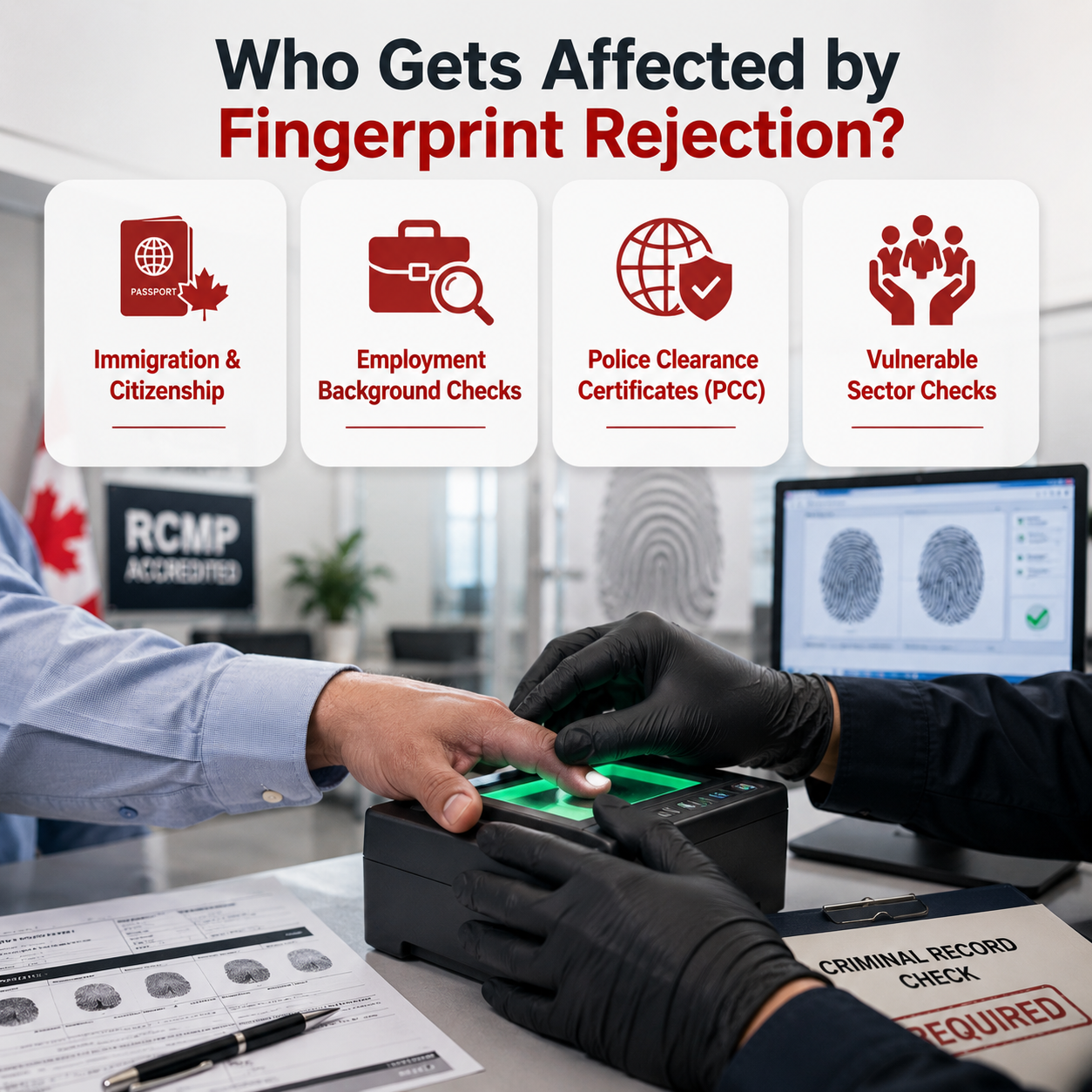
Before diving into the reasons, it is worth understanding who needs fingerprints — and what is at stake when they are rejected:
- Immigration & Citizenship applicants: IRCC may request fingerprints as part of criminal record checks during PR and citizenship processing. RCMP fingerprints for citizenship applications must be taken inside Canada.
- Employment background checks: Many employers — particularly in regulated industries such as healthcare, finance, childcare, and transportation — require RCMP criminal record checks based on fingerprints.
- Police Clearance Certificates (PCC): Required for international travel, visa applications, and foreign government submissions.
- Vulnerable Sector Checks: Required for work or volunteering with children, seniors, and vulnerable populations.
- International submissions: FBI and other agency fingerprinting for US visa, NEXUS, work permit, and other cross-border applications.
A rejection in any of these contexts triggers a mandatory re-submission — with time, cost, and application deadlines often at stake.
What Are the Two Main Categories of Fingerprint Rejection?
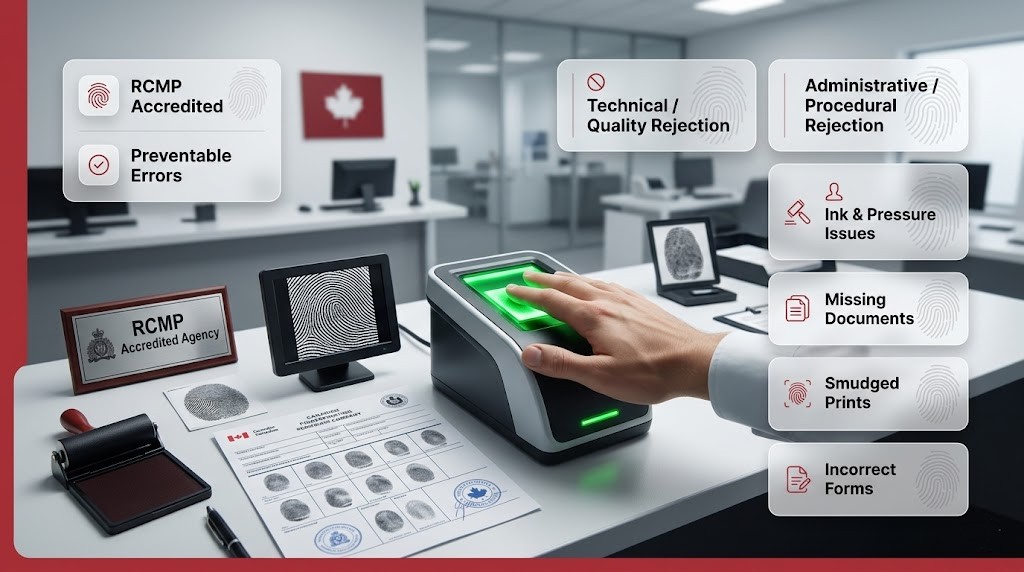
Fingerprint rejections in Canada fall into two broad categories:
| Category | What It Means | Most Common Cause |
|---|---|---|
| Technical / Quality Rejection | The physical print image is unusable — too light, too dark, smudged, or incomplete. | Ink application, rolling technique, pressure, hand condition |
| Administrative / Procedural Rejection | The submission has incomplete forms, incorrect documentation, or process errors. | Wrong form used, missing fields, non-accredited agency used, taken outside Canada |
Most rejections are technical. Most are entirely preventable.
Top 10 Reasons Your Fingerprinting Application Was Rejected
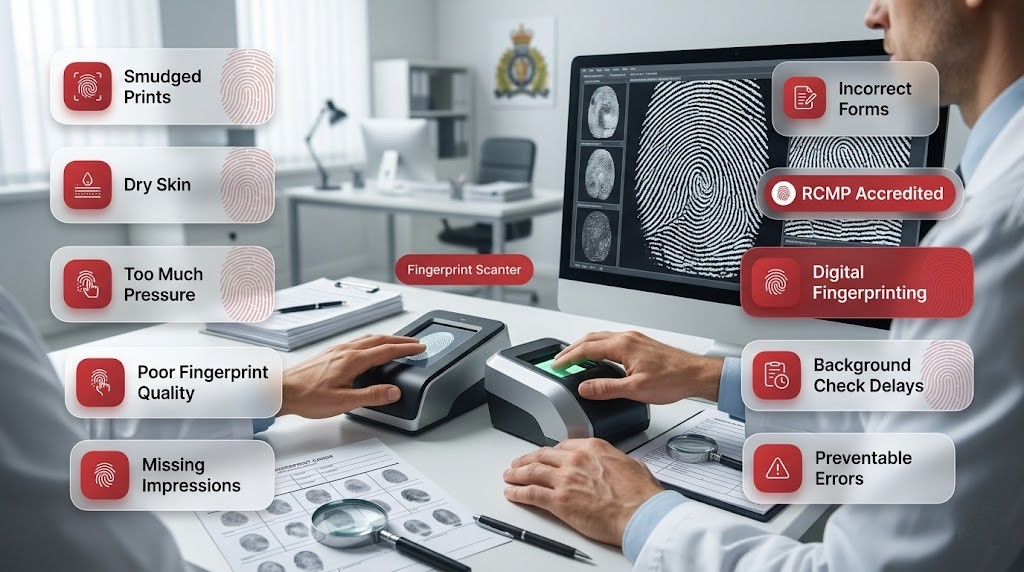
Reason 1: Too Much Pressure Applied During Rolling
What causes it: When a finger is pressed too hard onto the ink pad or scanner, the ridges compress against each other and flood with ink or become distorted. The result is a dark, smeared print where the ridge detail — loops, whorls, and deltas — becomes illegible.
What it looks like: Dark, filled-in prints where the ridge detail is fused or indistinguishable. Centre loops and delta points are invisible.
How to avoid it: The fingerprint technician should be doing all the work — your job is to relax your hand and let your finger be guided without resistance or tension. A common mistake is applicants unconsciously pressing down while the technician rolls. Consciously let your hand go limp. The right amount of pressure is light and consistent — not forceful.
Pro tip from Lotey: Tell your technician before the session if you tend to grip or tense. A good technician will guide your hand and coach you through the process — this is exactly what our team is trained to do.
Reason 2: Too Little Pressure — Prints Too Light
What causes it: Insufficient contact between the fingertip and the ink pad, or lifting the finger too early during the rolling motion, produces faint prints where ridge detail is visible but incomplete — missing portions of the core fingerprint area.
What it looks like: Pale, incomplete prints — especially at the edges of the rolled area. The centre of the fingerprint may be present but the periphery cuts off.
How to avoid it: Again — let the technician control the pressure. Do not pull your finger away during the roll. The full tip of each finger must make complete, even contact across the fingerprint card space. This is why professional, experienced fingerprint technicians produce far better results than self-administered or untrained attempts.
Reason 3: Smudging During or After Printing
What causes it: Movement of the finger during the rolling process, touching the inked print before it dries, or placing fingers on the wrong portion of the card after printing. Even micro-movements during rolling create smears that distort ridge patterns.
What it looks like: Streaks, double images, or blurred ridge lines that follow the direction of the unwanted movement.
How to avoid it: Once a print is placed on the card, do not touch that area again. Ink fingerprint cards require brief drying time before handling. Your technician should be managing card placement — your role is to remain still during the rolling motion and not re-contact the printed area.
Reason 4: Sweaty or Overly Moist Hands
What causes it: Perspiration on the fingertips adds excess moisture that dilutes ink, causes smearing, and reduces the contrast between ridges and the card surface. This is one of the most common physical conditions that lead to rejection.
What it looks like: Blurred, washed-out prints where ridge detail is present but softened — as if smeared through a wet surface.
How to avoid it:
- Wash hands with soap and warm water and dry thoroughly before the session
- Avoid exercising, carrying heavy items, or being in a warm environment immediately before your appointment — all increase perspiration
- If your hands are naturally sweaty, briefly hold an ice pack before the session and dry hands completely before the first print
- Inform your technician — they can wipe your fingertips between prints and manage moisture during the session
Reason 5: Excessively Dry or Cracked Skin
What causes it: Dry skin reduces ridge definition and makes prints appear faint, fragmented, or incomplete. Cracked or calloused fingertips from manual labour, frequent handwashing (healthcare workers), cleaning chemicals, or seasonal dryness all reduce print quality.
What it looks like: Light, broken prints — particularly at the core area of the fingerprint where ridge definition is most critical.
How to avoid it:
- Begin moisturising your hands with a quality lotion two to seven days before your fingerprinting appointment
- Apply lotion multiple times per day — morning, midday, evening, and before bed
- Sleep with moisturiser applied and light cotton gloves on overnight for deep absorption
- Avoid alcohol-based hand sanitisers in the days before your appointment — they strip moisture and dry the skin rapidly
- Wear protective gloves for cleaning, gardening, or any activity that wears on hands in the week before your appointment
Reason 6: Worn Fingerprint Ridges — Occupational Wear
What causes it: Repeated friction, chemical exposure, or physical wear from certain occupations — bricklayers, mechanics, cooks, gardeners, cleaners, and healthcare workers — can gradually wear down fingerprint ridge definition over time. This is a physical characteristic, not a technique error.
What it looks like: Flat, shallow prints where ridge detail is genuinely reduced — not smeared, but faint and difficult to classify.
How to avoid it:
- Intensive moisturising in the weeks before the appointment genuinely helps — it promotes skin regeneration and can partially restore ridge definition
- A mix of sugar with moisturising cream, gently massaged into the fingertips, can help resurface worn ridges
- If your ridges are severely worn, request a senior or highly experienced fingerprint technician — technique matters significantly when working with borderline prints
- At Lotey Fingerprinting, we have experience working with clients from manual trades and healthcare who regularly face this challenge
Reason 7: Using a Non-RCMP-Accredited Agency
What causes it: Fingerprints submitted to the RCMP must be taken by an RCMP-accredited fingerprinting agency. Fingerprints taken by non-accredited individuals, non-approved agencies, or taken outside Canada (for citizenship applications) are rejected outright — regardless of print quality.
The RCMP maintains a public list of all accredited private fingerprinting companies at rcmp.ca. Before booking, verify that your provider appears on this list.
What it looks like: Administrative rejection — your application is returned with a notice that the fingerprints were not taken by an approved agency.
How to avoid it:
- Always verify RCMP accreditation before booking — check the RCMP’s official list of accredited private fingerprinting companies
- For citizenship applications, note that fingerprints must be taken inside Canada — fingerprints submitted from abroad will be rejected
- Lotey Fingerprinting is RCMP accredited — our submissions are accepted by the RCMP Canadian Criminal Real Time Identification Services (CCRTIS)
Reason 8: Incomplete or Missing Fingerprint Impressions
What causes it: Not capturing all required fingerprint impressions on the form — missing fingers, not completing the four-finger simultaneous flat impressions, or failing to capture the thumb. Most fingerprint cards require ten individual rolled prints plus four-finger flat impressions and two thumb flat impressions.
What it looks like: Cards returned incomplete or noted as missing required impressions.
How to avoid it: Use a qualified, trained fingerprint technician who is familiar with the exact form requirements for your specific application type (RCMP C-216C for criminal record checks; FD-258 for FBI submissions). Different applications use different forms and have different impression requirements. A professional technician checks the card for completeness before you leave the appointment.
Reason 9: Wrong Form Used for the Application Type
What causes it: Different fingerprinting purposes require different official forms. Using the wrong form results in an administrative rejection regardless of print quality. RCMP civil fingerprint submissions use Form C-216C. FBI submissions use FD-258 cards. Some immigration and international applications have their own required formats.
How to avoid it:
- Know your application type and confirm the required form with your agency or immigration representative before booking your fingerprinting appointment
- At Lotey Fingerprinting, we clarify the purpose of your fingerprinting at booking and ensure the correct form is used for your specific application
Reason 10: Centre Loop and Delta Points Not Legible
What causes it: Even if a fingerprint is visible, it may still be rejected if the critical classification features — the core (centre of the loop pattern) and the delta (triangular divergence point of ridges) — are not clearly legible. These are the features used by the RCMP to classify and search fingerprints against criminal records.
What it looks like: A print that appears visible but is classified as “unclassifiable” — the core and delta points cannot be identified with confidence.
How to avoid it: This is primarily a technician’s responsibility — positioning the finger to capture the full core and delta. It requires rolling the finger a full 90 degrees from nail to nail, ensuring the centre of the fingertip — where the core sits — is captured completely. This is why technique and experience matter far more than simply pressing fingers to a card.
Summary: Top 10 Rejection Reasons at a Glance
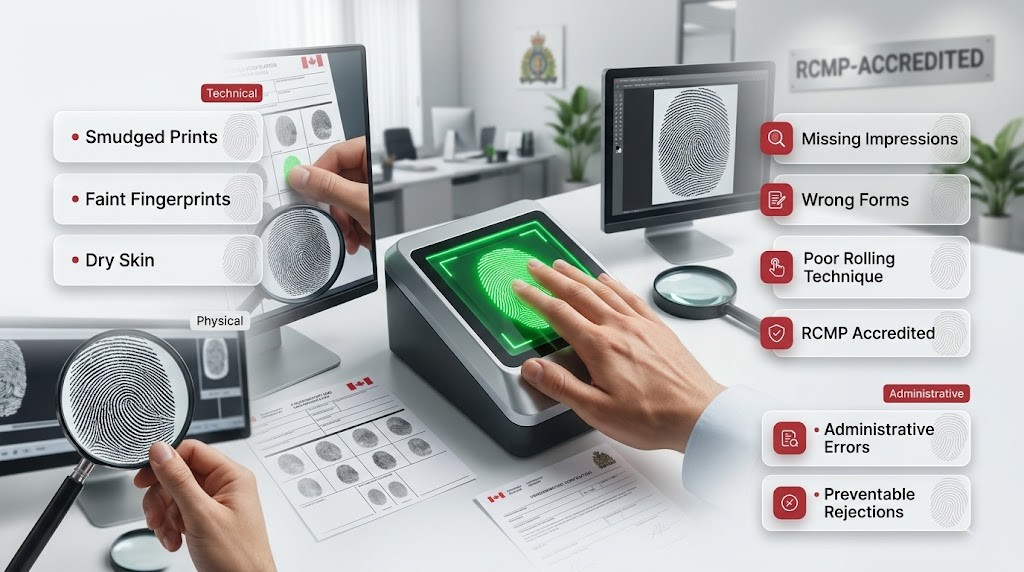
| # | Rejection Reason | Category | Prevention |
|---|---|---|---|
| 1 | Too much pressure — dark, smeared prints | Technical | Relax hand; let technician control |
| 2 | Too little pressure — faint, incomplete prints | Technical | Full contact; experienced technician |
| 3 | Smudging during or after printing | Technical | No movement during roll; don’t re-touch |
| 4 | Sweaty or moist hands | Physical | Wash & dry; cool hands before session |
| 5 | Dry or cracked skin | Physical | Moisturise 5–7 days before appointment |
| 6 | Worn ridges from occupational exposure | Physical | Intensive moisturising; sugar scrub; expert technician |
| 7 | Non-RCMP-accredited agency used | Administrative | Verify RCMP accreditation before booking |
| 8 | Incomplete impressions on card | Administrative | Professional technician checks completeness |
| 9 | Wrong form for application type | Administrative | Confirm form requirements before appointment |
| 10 | Core loop / delta points not legible | Technical | Full nail-to-nail roll; experienced technique |
What Should You Do If Your Fingerprints Are Rejected?
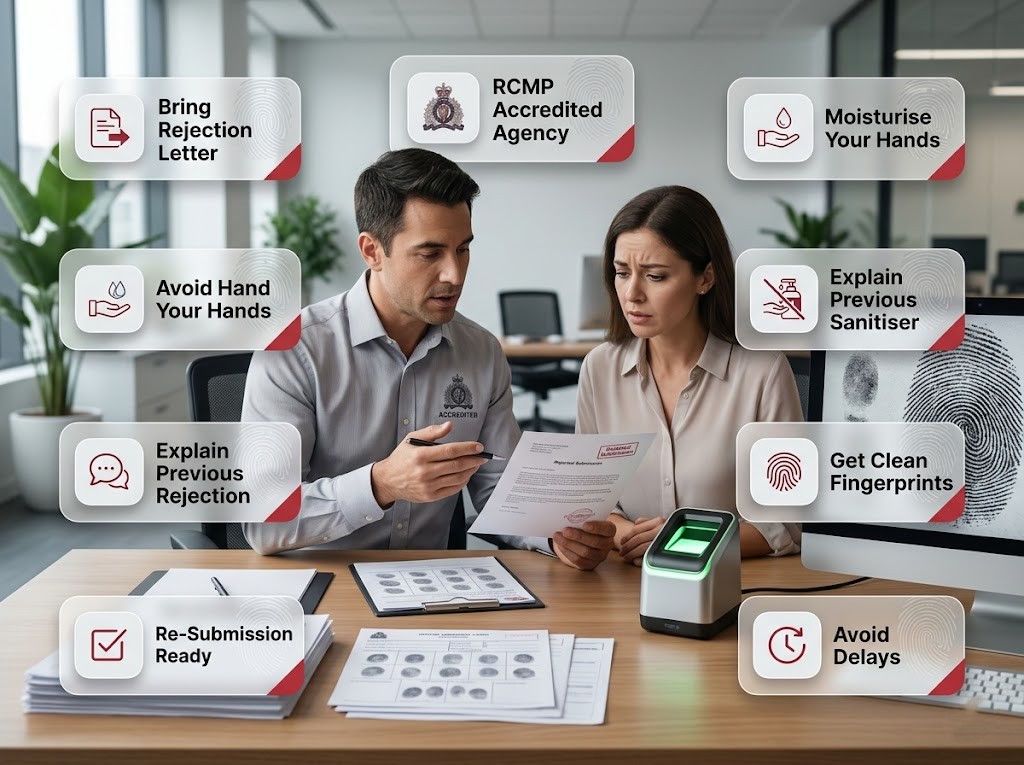
- Keep the rejection letter — bring it to your re-submission appointment. It will specify the reason for rejection, which helps your technician address the specific issue.
- Book with an RCMP-accredited agency if your previous submission was not — verify accreditation before booking.
- Prepare your hands — start moisturising immediately, avoid hand sanitiser, and protect your hands from wear until your appointment.
- Tell your technician what happened — a good technician will adjust their technique based on your previous rejection reason.
- Do not rush — if print quality is borderline, it is worth taking the time to get a clean set rather than submitting a marginal card that risks a second rejection.
Why Lotey Fingerprinting for Your Submission?
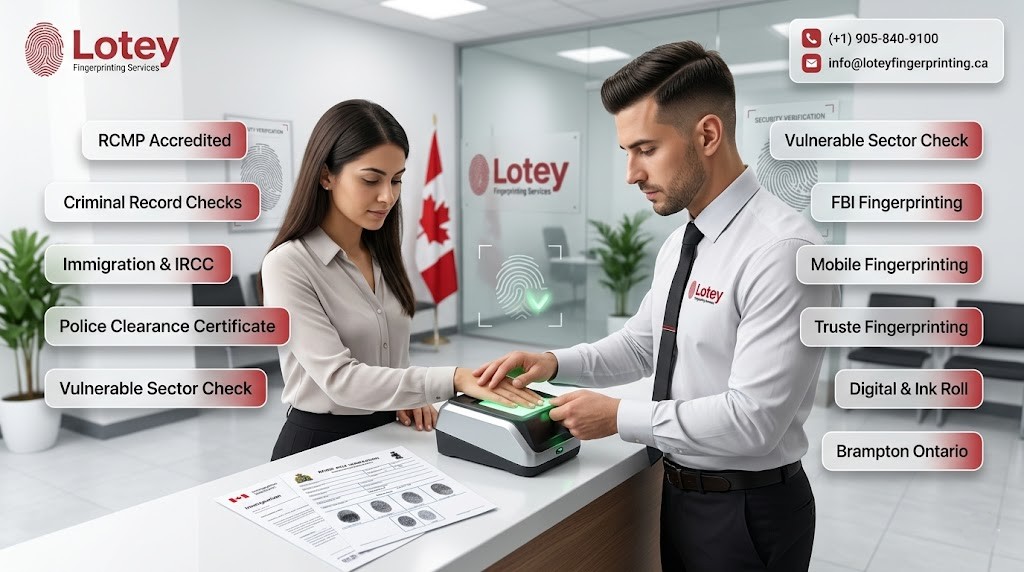
Lotey Fingerprinting Services in Brampton is RCMP accredited — our digital and ink roll fingerprinting submissions are accepted by the RCMP Canadian Criminal Real Time Identification Services. We provide fingerprinting for:
- Criminal Record Checks — employment, licensing, volunteering
- Immigration & IRCC applications — permanent residence, citizenship, sponsorship
- Police Clearance Certificates — international travel and foreign government submissions
- Vulnerable Sector Checks — work with children, seniors, and vulnerable individuals
- International submissions — FBI and other agency formats
- Mobile fingerprinting — we come to you when attending our Brampton office is not convenient
Our experienced technicians have worked with thousands of clients — including many who came to us after a rejection elsewhere. We know what the RCMP requires, we use the correct forms for every application type, and we take the time to get your prints right the first time.
FAQ: Your Questions Answered
What is the most common reason fingerprints are rejected by the RCMP in Canada?
The most common reasons are technical print quality issues — too much pressure (causing dark, smeared prints), too little pressure (faint prints), and poor hand condition (excessively dry or sweaty skin). These issues prevent the RCMP from clearly identifying the core loop patterns and delta points needed to classify and search fingerprints. The vast majority of rejections are preventable with proper preparation and an experienced, accredited technician.
Can I resubmit fingerprints after a rejection?
Yes — a rejection is not final. You will receive a rejection notice specifying the reason. Bring that notice to your re-submission appointment so your technician can address the specific issue. Depending on the reason for rejection, you may need to prepare differently — moisturising for dry skin, managing perspiration for sweaty hands, or simply using a more experienced technician if the rejection was technique-related.
Do my fingerprints need to be taken in Canada for IRCC or citizenship applications?
Yes — for citizenship applications specifically, IRCC requires that fingerprints be taken inside Canada by an RCMP-accredited agency. Fingerprints submitted from outside Canada for citizenship purposes will be rejected. For other immigration applications, requirements vary — check with your IRCC representative or immigration lawyer before booking.
How long does it take to get results after re-submitting fingerprints?
After re-submission to the RCMP, standard processing for a criminal record check typically takes a few weeks to a month. If a criminal record is found, processing can extend up to three months. IRCC deadlines for providing fingerprints are generally within 30 days of the request letter — if processing delays occurred, IRCC has indicated it will automatically extend deadlines by 30 days without requiring contact from the applicant.
Does moisturising really help improve fingerprint quality?
Yes — and this is officially recommended by police services including the Edmonton Police Service. Consistent moisturising for five to seven days before a fingerprinting appointment helps restore skin elasticity and ridge definition, particularly for people with dry or worn ridges. The most effective approach is applying high-quality lotion multiple times per day, sleeping with lotion and cotton gloves overnight, and avoiding alcohol-based hand sanitisers in the days before the appointment.
What is the RCMP Form C-216C?
Form C-216C is the official RCMP fingerprint card used for civil (non-criminal investigation) fingerprinting purposes — criminal record checks, police clearance certificates, and immigration submissions. It is the standard form used by RCMP-accredited agencies for civilian fingerprinting in Canada. Using a different or incorrect form is an administrative rejection reason regardless of print quality.
What is the difference between digital fingerprinting and ink fingerprinting?
Digital (livescan) fingerprinting captures prints electronically using a sensor — results are immediate and can be transmitted directly to the RCMP system. Ink fingerprinting uses traditional ink roll impressions on a physical fingerprint card, which is then submitted to the RCMP. Digital fingerprinting generally produces more consistent quality and lower rejection rates. Lotey Fingerprinting provides both digital and ink roll fingerprinting — our team advises on which method is appropriate for your specific application.
Can worn fingerprints from my job cause permanent rejection?
Not in most cases. Worn ridges from occupational exposure are a real challenge — but not an insurmountable one. Intensive moisturising, skin regeneration time, and a highly experienced technician who knows how to work with worn prints can often produce acceptable quality. In rare cases of significant physical damage, the RCMP has procedures for handling applicants whose prints are genuinely unclassifiable due to medical or physical reasons. If you work in a trade or profession that significantly wears the hands, start moisturising at least a week before your appointment and inform your Lotey technician at booking.
How do I know if a fingerprinting agency is RCMP accredited?
The RCMP maintains a publicly accessible list of all accredited private fingerprinting companies on their official website at rcmp.ca. Before booking any fingerprinting service, verify that the agency appears on this list. Lotey Fingerprinting Services is RCMP accredited — our accreditation is current and our submissions are accepted by the RCMP Canadian Criminal Real Time Identification Services (CCRTIS).
Can Lotey Fingerprinting come to me if I cannot attend your Brampton office?
Yes — Lotey Fingerprinting offers mobile fingerprinting services. Our technician comes to your location — home, office, care facility, or other site — with all required equipment and forms. Mobile fingerprinting is particularly useful for elderly clients, individuals with mobility limitations, or organisations needing multiple employees fingerprinted at one location. Book mobile fingerprinting at loteyfingerprinting.ca or call us to discuss your requirements.

Navneet Lotey
Navneet Lotey has over 5 years of experience in fingerprinting. He aims to deliver accurate, easy-to-understand fingerprinting solutions for individuals and businesses alike.