


Table of Contents
One of the most common questions we receive at Lotey Fingerprinting is simple: “Do I need digital or ink fingerprinting?”
It is a fair question — and the wrong answer can cost you weeks of processing time and the expense of starting over. Choosing the wrong fingerprinting method for your application type results in an immediate rejection, because the receiving agency cannot process fingerprints in the wrong format.
The good news: the decision is almost never about preference. It is determined entirely by who is asking for your fingerprints and where those prints are being sent. Once you know that, the right method becomes obvious.
This guide breaks down exactly when you need digital fingerprinting, when you need ink fingerprinting, and what happens in the cases where both or either could work — from Lotey Fingerprinting, Brampton’s RCMP-accredited fingerprinting experts.
What Is Digital Fingerprinting (Livescan)?
How Does Digital Fingerprinting Work in Canada?
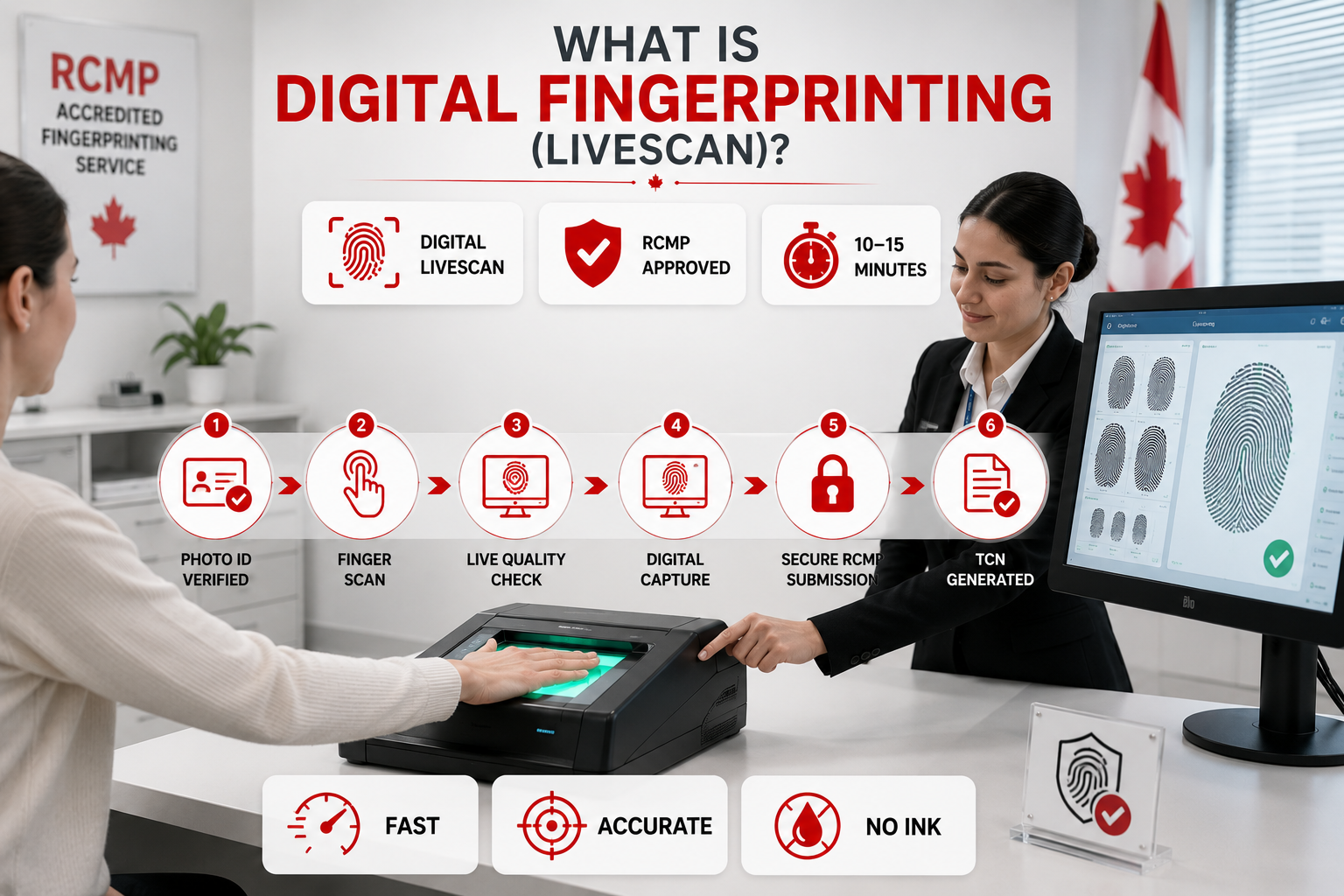
Digital fingerprinting — also called livescan — is the modern, electronic method of capturing fingerprints. Instead of using ink and pressing fingers onto paper, you place your fingers one at a time (and then in groups) on a glass scanning plate connected to a certified Electronic Fingerprint Capture Device (EFCD).
Here is what the process looks like
- You arrive at the fingerprinting agency and your identity is verified with government-issued photo ID
- Your fingers are placed on the glass plate of the EFCD scanner — one at a time for rolled impressions, then in groups of four for flat impressions
- The device captures a high-resolution digital image of your fingerprint in real time
- The technician can instantly see the quality of each impression on screen and retake any that are unclear — before you leave the office
- Once all impressions meet quality standards, the complete fingerprint transaction is transmitted electronically and securely to the RCMP CCRTIS RTID system
- A Transaction Control Number (TCN) is generated confirming your submission was received
The entire session typically takes 10–15 minutes. There is no ink, no mess, and no waiting for prints to dry.
Key Advantages of Digital Fingerprinting
| Advantage | Detail |
|---|---|
| Speed | Electronic submission reaches the RCMP RTID system instantly — no courier, no mail delay. |
| Quality Feedback | Technician sees print quality in real time — poor impressions are retaken on the spot. |
| Lower Rejection Rate | Automated quality checks reduce the chance of a submission being rejected for print quality. |
| No Mess | No ink on hands, no smudging, no drying time required. |
| Environmentally Cleaner | No paper cards and no ink waste per session. |
| RCMP Standard | Digital livescan is the RCMP’s primary and preferred submission method for civil fingerprinting in Canada. |
What Is Ink Fingerprinting (Ink & Roll)?
How Does Ink Fingerprinting Work?
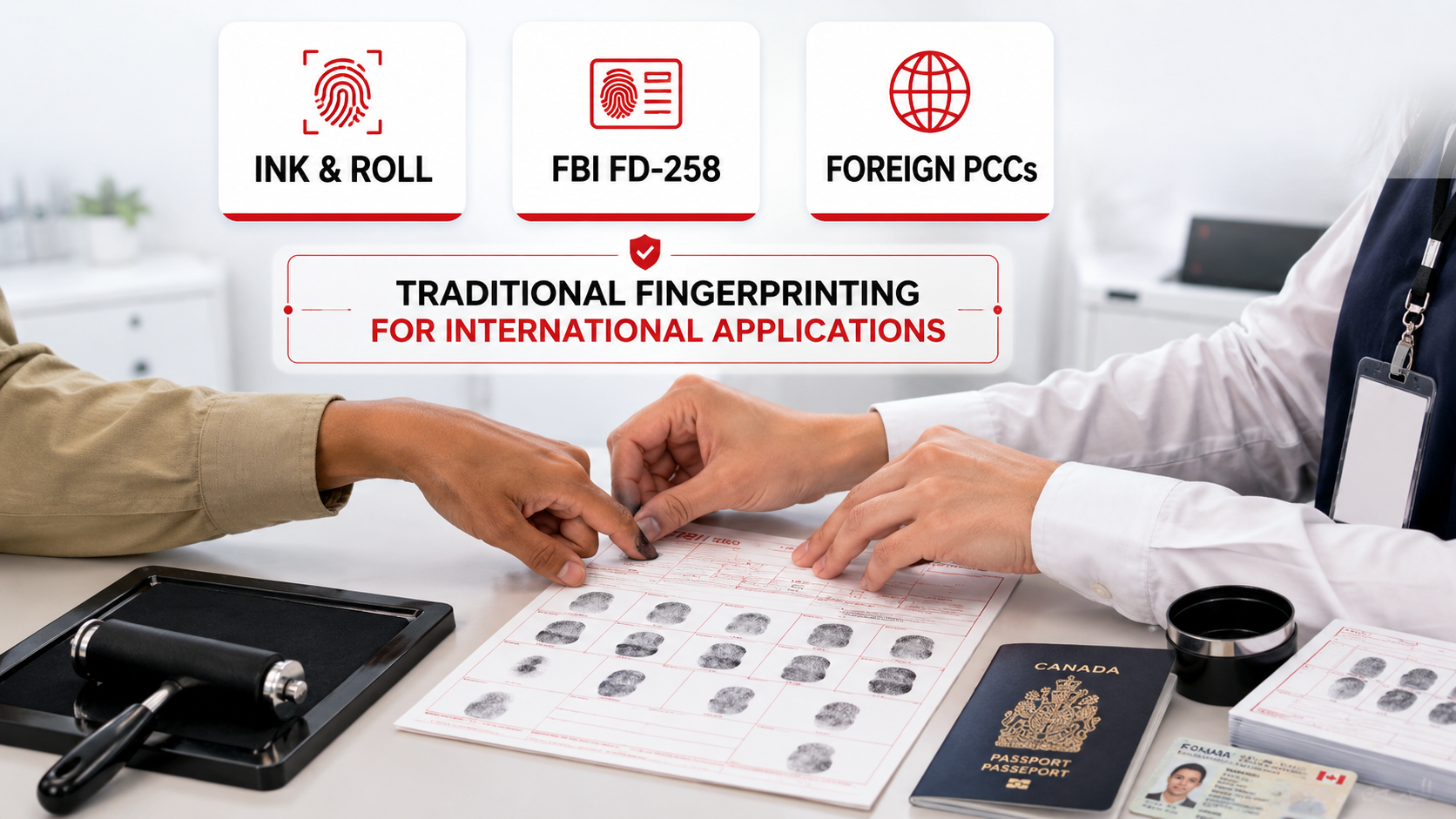
Ink fingerprinting — also called ink and roll — is the traditional method that has existed since the 19th century. It remains in active use for specific application types, particularly those submitted to foreign agencies that do not accept electronic submissions.
The process:
- Your identity is verified with government-issued photo ID
- A trained technician takes your hand and rolls each finger — starting with the thumb — across an ink pad to coat the fingertip
- Each inked finger is then rolled across the correct space on the fingerprint card with consistent, even pressure from nail to nail
- Four-finger simultaneous flat impressions and thumb impressions are taken in addition to the individual rolled prints
- The completed card is allowed to dry
- The physical card is given to you, or submitted on your behalf, to the requesting agency
The session takes 15–30 minutes, depending on the number of cards required and any need to retake impressions. Unlike digital, the technician cannot see the quality on a screen in real time — quality assessment requires trained visual inspection of the physical card.
Common Forms Used for Ink Fingerprinting
| Form | Used For |
|---|---|
| RCMP C-216C | RCMP civil criminal record checks where ink submission is required. |
| FBI FD-258 | US FBI Identity History Summary Checks (standard US criminal record check card). |
| Country-Specific Forms | Mexico, Iran, South Africa, Philippines, and other countries with unique fingerprint card layouts. |
The Core Rule: Who Is Asking Determines the Method
How Do I Know Whether I Need Digital or Ink Fingerprinting?
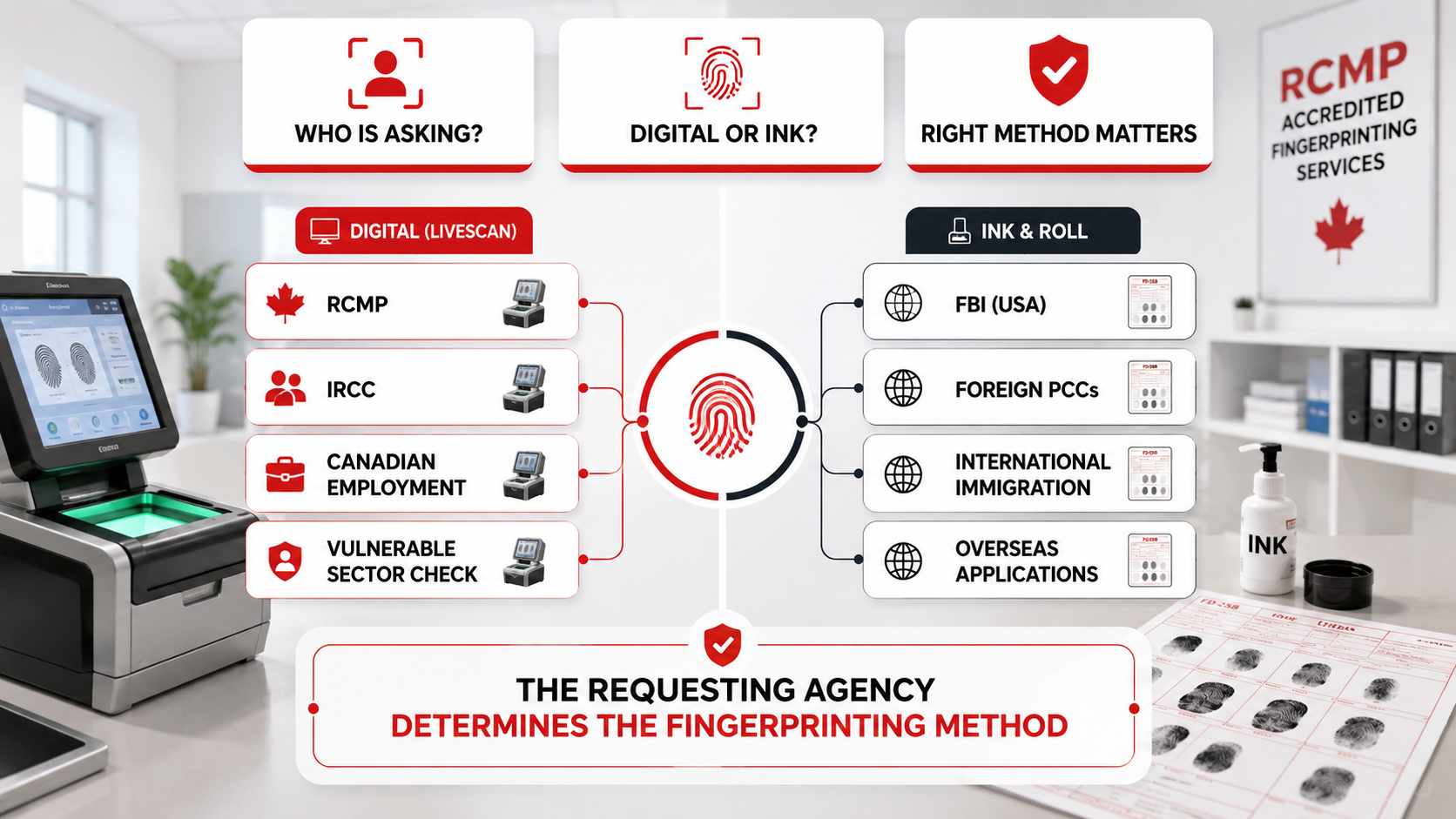
This is the single most important principle: the requesting agency determines the fingerprinting method. It is not a personal choice.
| Requesting Agency | Method Required |
|---|---|
| RCMP (Canadian Criminal Record Check) | Digital (Livescan) — RCMP’s standard submission method since 2014. |
| IRCC (Immigration, PR, Citizenship) | Digital (Livescan) — submitted electronically through CCRTIS. |
| Canadian Federal Employment | Digital (Livescan) — mandatory electronic fingerprint submission. |
| Vulnerable Sector Check (Canada) | Digital (Livescan) — electronically submitted to the RCMP. |
| Record Suspension / Pardon (Canada) | Digital (Livescan) — electronically processed through the RCMP. |
| FBI (USA) | Ink & Roll — completed on an FBI FD-258 card and physically submitted. |
| Foreign Police Certificates | Ink & Roll — country-specific forms for Mexico, Philippines, Iran, South Africa, and others. |
| RCMP Certificate (Applicants Outside Canada) | Ink & Roll — FBI FD-258 accepted and mailed to an accredited Canadian agency for digitisation. |
| US Entry Waiver | Digital or Ink — depends on the submission pathway and agency requirements. |
| International Immigration Applications | Ink & Roll — required according to the destination country’s rules. |
When Do You Need Digital Fingerprinting?
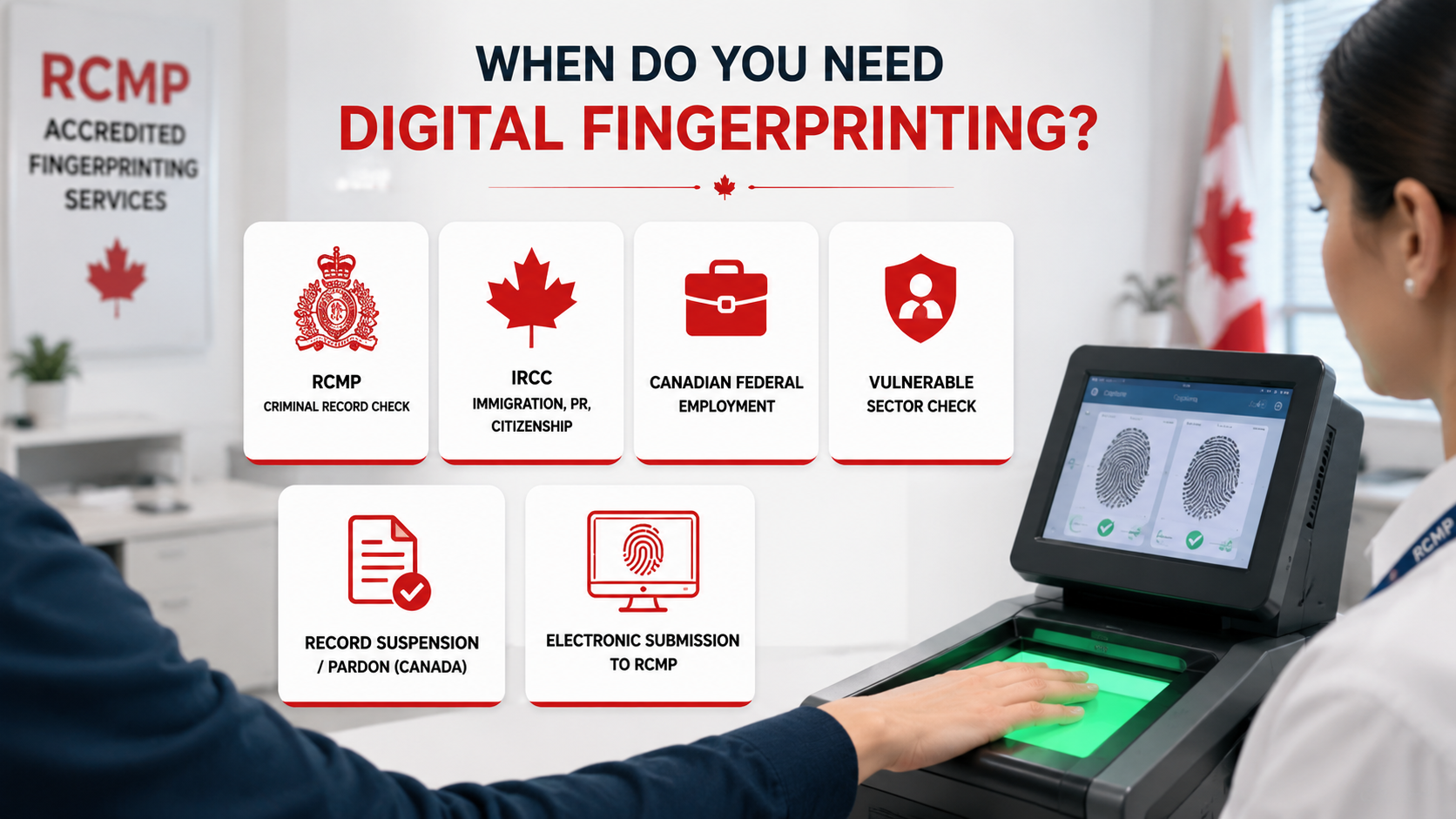
What Applications Require Digital Livescan Fingerprinting in Canada?
Digital livescan is the correct method for virtually all Canadian-destination fingerprint submissions:
- Criminal Record Check for employment — domestic employers, government positions, regulated industries
- Vulnerable Sector Check — working with children, seniors, or vulnerable individuals in Ontario and across Canada
- Immigration to Canada — IRCC fingerprints for permanent residence applications
- Canadian Citizenship — IRCC-requested fingerprints as part of citizenship processing
- Record Suspensions (Pardons) — submitted to the Parole Board of Canada via RCMP
- Government of Canada security clearance — mandatory electronic fingerprints under the federal personnel security screening programme
- NEXUS trusted traveller programme — fingerprint component for border trusted traveller enrolment
- Provincial licensing — many regulated professions in Ontario require fingerprint-based criminal record checks
The key test: If your fingerprints are staying in Canada and going to the RCMP or a Canadian government body, digital livescan is almost certainly what you need.
When Do You Need Ink Fingerprinting?
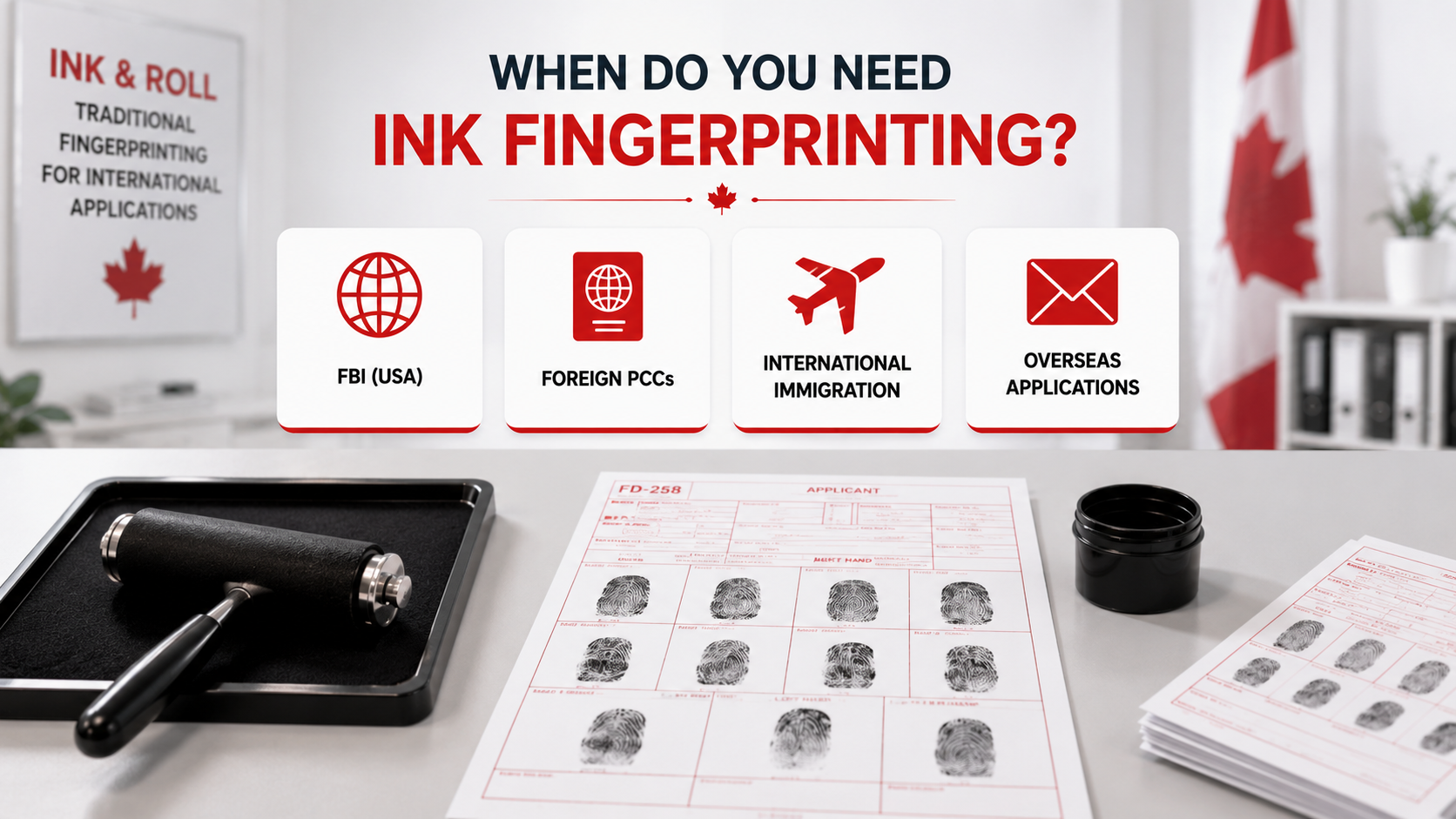
What Applications Require Ink & Roll Fingerprinting?
Ink fingerprinting is required when your prints are being submitted to a foreign agency — or to the RCMP from outside Canada:
- FBI Identity History Summary Check — the standard US criminal record check, required for US visas, NEXUS, US employment, and US immigration. Requires FBI FD-258 card, completed with ink and roll impressions.
- Foreign Police Certificates — countries including Mexico, the Philippines, Iran, South Africa, and many others require ink fingerprints on their own specific card formats.
- RCMP certificate for applicants outside Canada — if you are living abroad and need a Canadian criminal record check, you can submit ink fingerprints (on FBI FD-258 or C-216C) to an RCMP-accredited Canadian agency, which will digitise and submit them on your behalf.
- US Entry Waivers — some US Entry Waiver applications for Canadians with prior US inadmissibility require ink fingerprint cards submitted through a specific channel.
- Foreign work or study visas — destination countries that require their own criminal record check as part of a visa application typically specify ink fingerprints on their own form.
- International adoption — many countries’ adoption processes require ink fingerprinting on a specified card format.
The key test: If your fingerprints are leaving Canada — going to the FBI, a foreign government, or a foreign immigration authority — ink and roll on the correct card format is almost certainly what you need.
What Is the "Hybrid" Option?
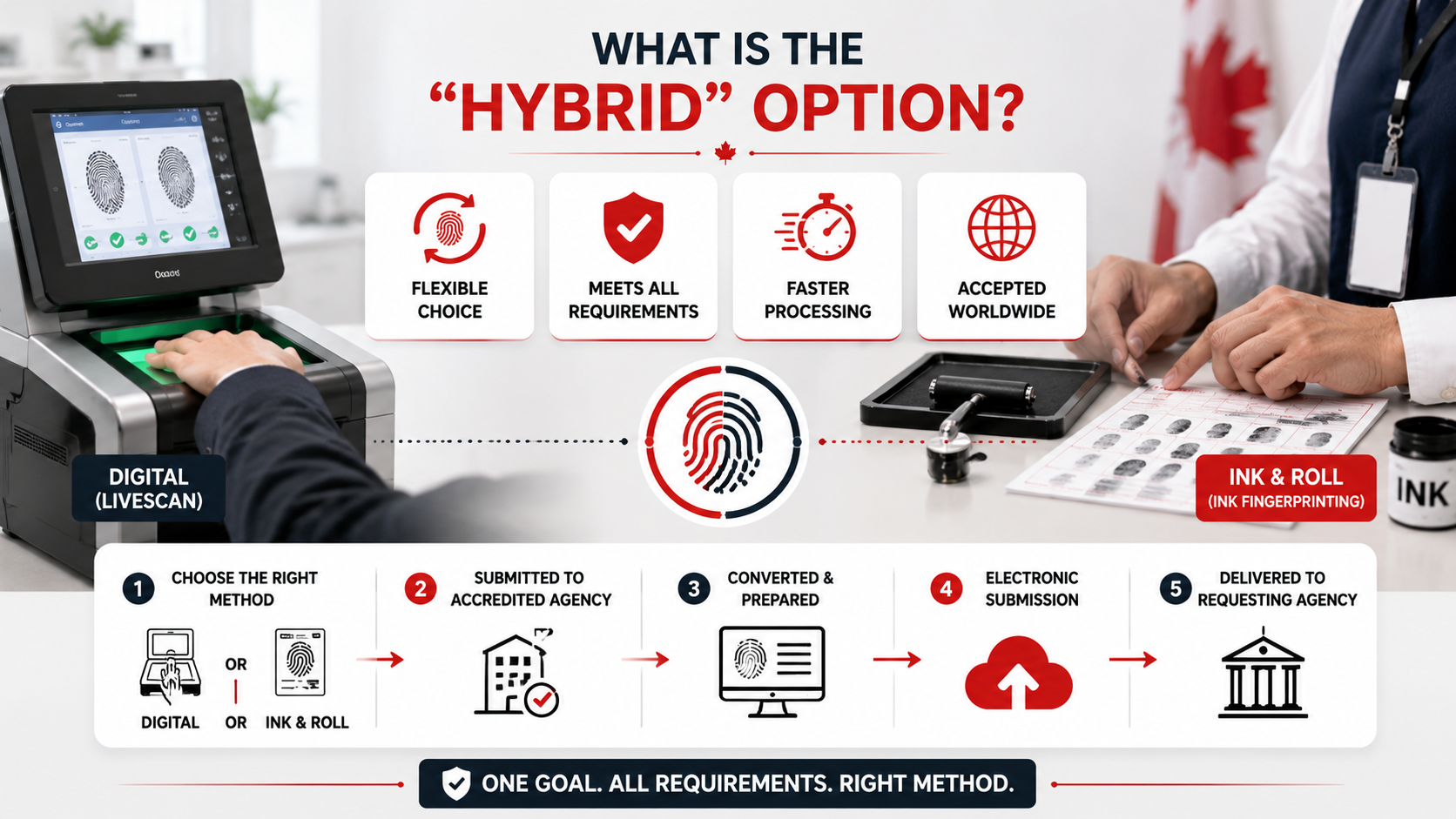
Can Ink Fingerprints Be Digitised for RCMP Submission?
Yes — and this is a frequently used pathway for applicants outside Canada who need an RCMP criminal record check.
The RCMP accepts FBI FD-258 fingerprint cards from applicants outside Canada, where ink and roll impressions are completed. The physical card is then couriered to an RCMP-accredited Canadian fingerprinting agency, which digitises the card using a cardscan device and submits the digital transaction electronically to RCMP CCRTIS on the applicant’s behalf.
This process:
- Adds time — the physical card must travel by courier before digitisation can occur
- Requires careful ink fingerprint quality — the card must meet RCMP standards after digitisation
- Is the standard pathway for Canadians living abroad, international applicants seeking Canadian PCCs, and others who cannot attend an accredited Canadian agency in person
At Lotey Fingerprinting, we work with clients on both sides of this process — taking ink fingerprints for foreign submissions in our Brampton office, and accepting couriered ink cards from abroad for digitisation and RCMP submission.
Side-by-Side Comparison
| Feature | Digital (Livescan) | Ink & Roll |
|---|---|---|
| Method | Glass plate scanner, no ink | Ink pad rolled onto paper card |
| Session Time | 10–15 minutes | 15–30 minutes |
| Messiness | Clean — no ink | Ink on hands; cleanup needed |
| Quality Feedback | Instant on-screen view; retakes on the spot | Visual inspection by technician; retakes require new card |
| Rejection Risk | Lower — automated quality checks | Higher — smudging and pressure errors may go unnoticed initially |
| Submission Method | Electronic, instant to RCMP RTID | Physical card mailed or couriered |
| Processing Start | Immediate upon electronic receipt | After physical card arrives at destination |
| Accepted by RCMP (Canada) | ✅ Primary method | ✅ Via digitisation at accredited agency |
| Accepted by FBI (USA) | ❌ Not accepted directly | ✅ Required (FD-258 card) |
| Accepted by Foreign Agencies | ❌ Generally not accepted | ✅ Required for most foreign submissions |
| Best For | All Canadian applications | FBI, foreign PCCs, international applications |
| Available at Lotey Fingerprinting | ✅ Yes | ✅ Yes |
Most Common Mistakes — Wrong Method for the Application
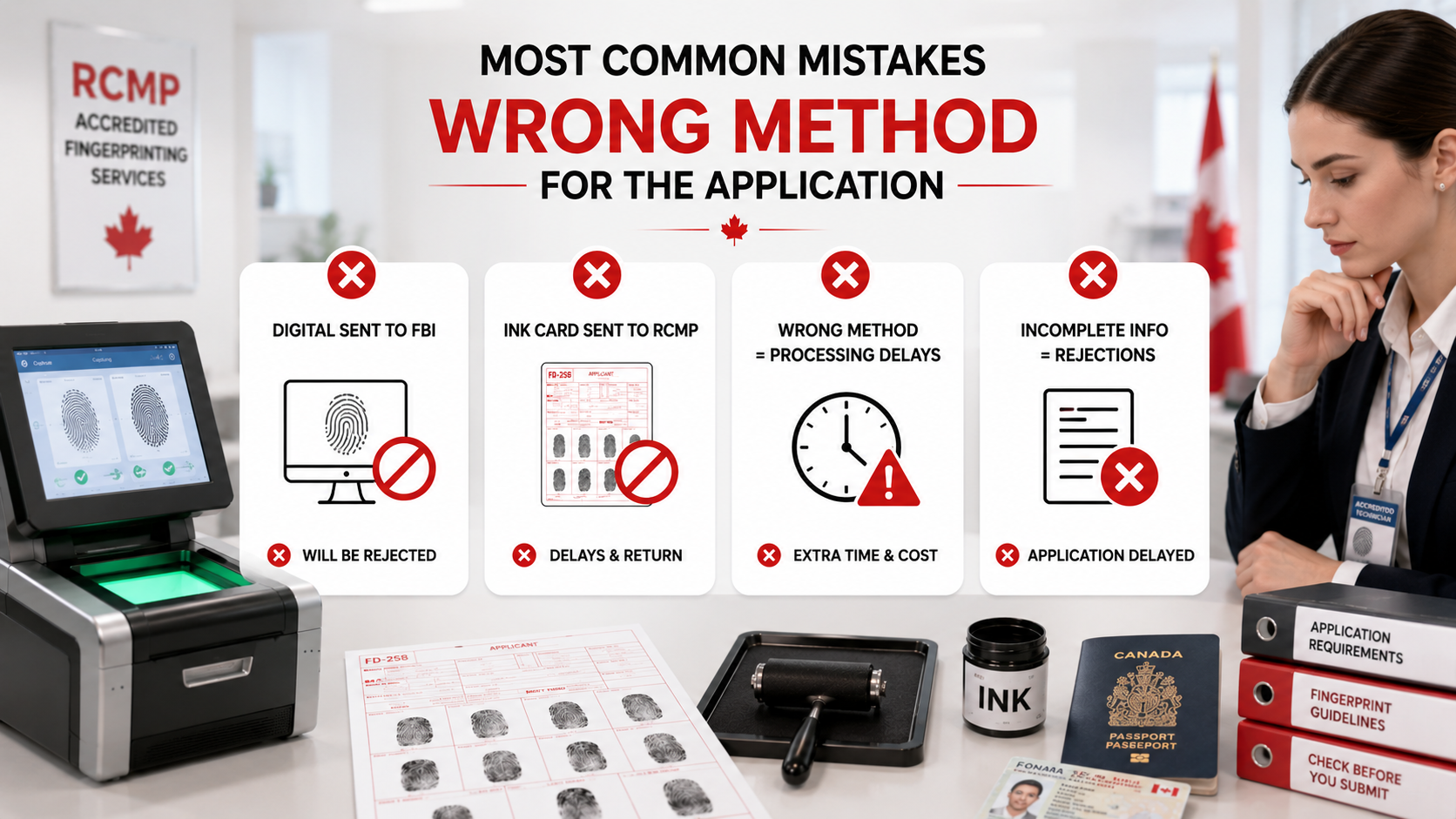
What Happens If You Choose the Wrong Fingerprinting Method?
Submitting the wrong fingerprint type is an immediate, administrative rejection — and one of the most avoidable errors in the fingerprinting process:
- Submitting ink cards to the RCMP when digital livescan was required — the RCMP’s RTID system requires electronic submission; undigitised ink cards submitted directly are not processed
- Submitting digital scans to the FBI — the FBI does not accept digital-only submissions from external agencies; the FD-258 ink card is mandatory
- Using the wrong card format for a foreign country — submitting an RCMP C-216C to an agency that requires its own national card format results in rejection regardless of print quality
- Getting ink fingerprinting in Canada for an IRCC application — IRCC requires electronic submission through the RCMP CCRTIS channel; paper-only ink submissions are not the correct pathway for immigration applications within Canada
The solution: Always confirm the required method with the requesting agency before booking your fingerprinting appointment. If you are unsure, our team at Lotey Fingerprinting will confirm the correct method at the time of booking — it is one of the first questions we ask.
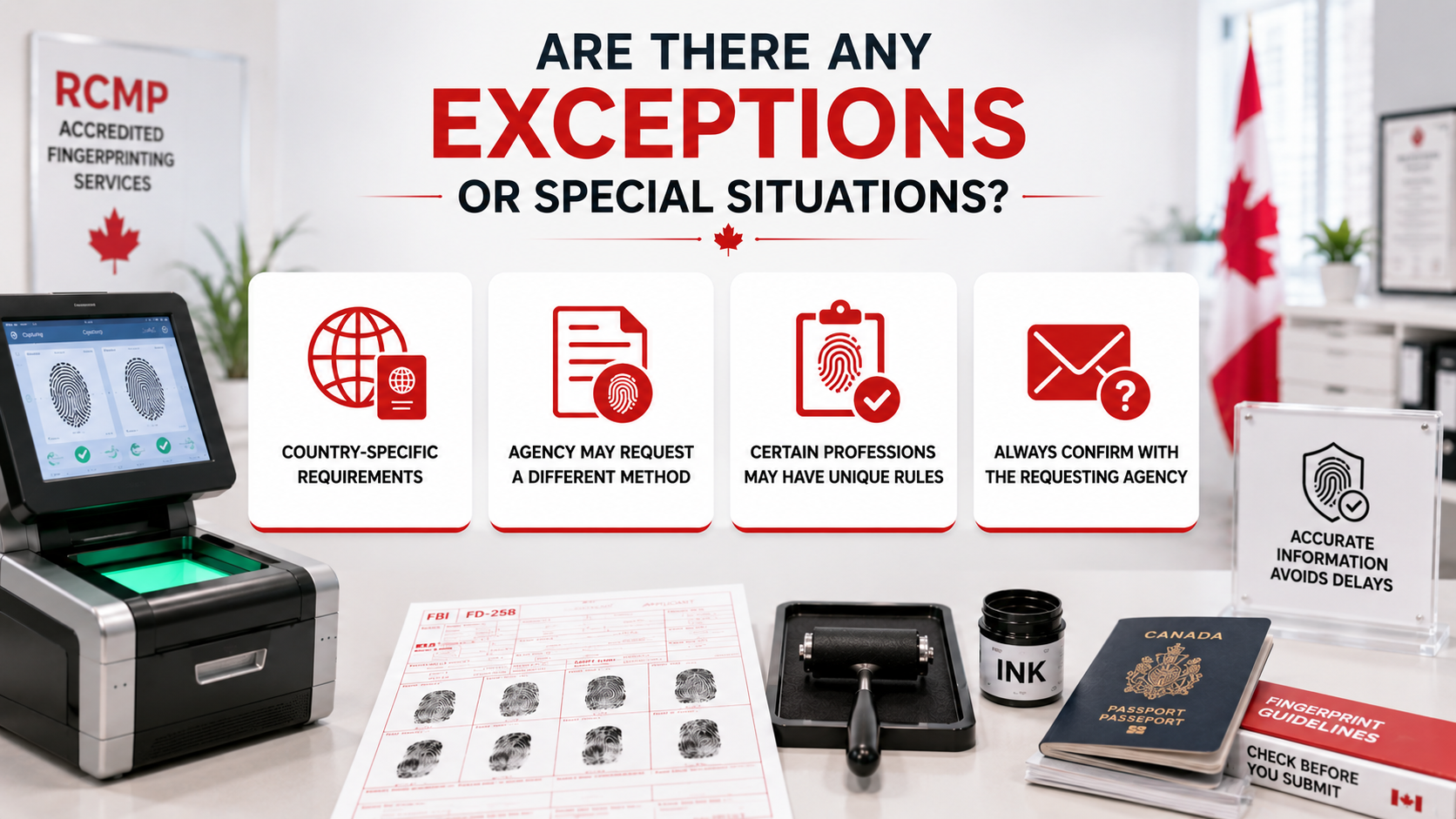
Are There Any Exceptions or Special Situations?
What if my fingertips are worn or damaged?
In rare cases where a client’s fingerprint quality is too low for reliable digital scanning — due to occupational wear, medical conditions, or physical damage — the RCMP has provisions for handling unclassifiable prints. The digital method still applies where possible; the exception is managed through the RCMP CCRTIS process. See our guide on fingerprint rejection reasons for more detail.
What if I need both an RCMP check and an FBI check?
This is common for people applying for immigration to the United States or for NEXUS. You will need two separate fingerprinting sessions: one digital session for the RCMP submission, and one ink session on an FBI FD-258 card for the FBI submission. Both can be completed at Lotey Fingerprinting in a single visit.
What if I am outside Canada and need an RCMP check?
You will need to complete ink fingerprints on an FBI FD-258 or RCMP C-216C card at a local police agency or fingerprinting service in your country, then courier the completed card to an RCMP-accredited agency in Canada for digitisation and submission. Lotey Fingerprinting accepts couriered ink cards — contact us to confirm the process and mailing address before sending.
Not Sure Which Method You Need? We Will Tell You Before You Book.
At Lotey Fingerprinting Services in Brampton, we confirm the correct fingerprinting method for your specific application at the time of booking — before you arrive. We provide both digital livescan and ink & roll fingerprinting, and our team has experience with Canadian, FBI, and international submissions across all major application types.
You do not need to know the answer before calling us. That is what we are here for.
FAQ: Your Questions Answered
Is digital fingerprinting accepted by the RCMP in Canada?
Yes — digital livescan fingerprinting is the RCMP’s primary and preferred method for all civil fingerprint submissions in Canada. Since 2014, the RCMP has required electronic submission of civil fingerprints through the CCRTIS RTID system. RCMP-accredited agencies equipped with certified Electronic Fingerprint Capture Devices (EFCDs) submit digital transactions directly to the RCMP in real time. Digital fingerprinting is used for criminal record checks, immigration, citizenship, vulnerable sector checks, and virtually all Canadian-destination applications.
Does the FBI accept digital fingerprinting from Canada?
No — the FBI does not accept digital-only livescan submissions from external Canadian agencies for Identity History Summary Checks (the standard US criminal record check). The FBI requires ink and roll fingerprints completed on an FBI FD-258 fingerprint card. This card is then mailed or submitted physically to the FBI. If you need both an RCMP check and an FBI check, you will need both a digital session and a separate ink session.
Can I use ink fingerprinting for a Canadian immigration application?
For immigration applications processed within Canada, IRCC requires fingerprints to be submitted electronically through the RCMP CCRTIS channel — which means digital livescan is the correct method. Ink-only cards are not the standard submission pathway for IRCC within Canada. However, if you are outside Canada and need an RCMP certificate, ink fingerprints on an FBI FD-258 or RCMP C-216C card can be couriered to an RCMP-accredited Canadian agency, which will digitise and submit them electronically on your behalf.
Which fingerprinting method has a lower rejection rate?
Digital livescan generally has a lower technical rejection rate than ink fingerprinting. The key reason is real-time quality feedback — the technician can see each impression on screen immediately and retake any that do not meet quality standards before you leave the office. With ink fingerprinting, quality is assessed visually after the fact, and errors like smudging or uneven pressure may only become apparent upon review. That said, both methods can produce high-quality prints when performed by an experienced, trained technician.
How long does each fingerprinting method take?
A digital livescan session at Lotey Fingerprinting typically takes 10–15 minutes from start to finish, including identity verification, all required impressions, and quality review. An ink and roll session takes 15–30 minutes depending on the number of cards required and any necessary retakes. The more significant time difference is in submission: digital submissions reach the RCMP RTID system instantly, while ink card submissions require physical mailing and manual processing after arrival.
What fingerprinting method do I need for a Vulnerable Sector Check in Ontario?
Digital livescan is required for Vulnerable Sector Check fingerprinting in Ontario and across Canada. The fingerprints are submitted electronically to the RCMP CCRTIS, which cross-references against the National Repository including sealed records that would otherwise not appear in a standard name-based check. Vulnerable Sector Checks are required for anyone working or volunteering with children, seniors, or other vulnerable populations. Lotey Fingerprinting provides Vulnerable Sector Check fingerprinting at our Brampton office.
Can I get both digital and ink fingerprinting done at Lotey Fingerprinting in the same visit?
Yes — if you need both an RCMP criminal record check (digital) and an FBI or foreign agency submission (ink), both can be completed at Lotey Fingerprinting in a single appointment. This is common for clients applying for US immigration, NEXUS, or international positions that require both Canadian and US criminal record checks simultaneously. Contact us when booking to let us know you need both methods so we can allocate sufficient appointment time.
What is the FBI FD-258 fingerprint card?
The FBI FD-258 is the standard fingerprint card used for US FBI Identity History Summary Checks — the equivalent of a Canadian criminal record check, but for US purposes. It is a physical card completed using ink and roll technique, with ten individual rolled fingerprint impressions plus flat impressions. It is required for US visa applications, US employment in regulated sectors, NEXUS enrolment, US immigration, and many other US-related background check purposes. The RCMP also accepts FBI FD-258 cards from applicants outside Canada for RCMP criminal record checks, as an alternative to the RCMP C-216C card.
Do I need ink fingerprinting for a South Africa, Mexico, or Philippines police certificate?
Yes — South Africa, Mexico, the Philippines, and many other countries require ink fingerprinting on their own specific card formats as part of their police certificate application process. Each country has its own fingerprint card layout and submission requirements. At Lotey Fingerprinting, we work with clients on country-specific ink fingerprint submissions — contact us with your destination country so we can confirm the correct card format and any additional requirements before your appointment.
Is mobile fingerprinting available for both digital and ink methods?
Mobile fingerprinting availability for both methods depends on the equipment carried to the mobile session. Contact Lotey Fingerprinting directly to discuss which methods are available for mobile appointments in your area. Our standard Brampton office provides both digital livescan and ink and roll fingerprinting for all application types.

Navneet Lotey
Navneet Lotey has over 5 years of experience in fingerprinting. He aims to deliver accurate, easy-to-understand fingerprinting solutions for individuals and businesses alike.