



Table of Contents
If you are applying for immigration — to Canada, from Canada, or to a third country — there is a high probability you will be asked to provide a Police Clearance Certificate (PCC). It may also be called a police certificate, a criminal clearance certificate, or simply a background check, depending on the requesting authority.
Whatever it is called, the underlying document is the same: an official record confirming whether you have a criminal history in the country that issued it. For Canada, a Police Clearance Certificate is issued by the Royal Canadian Mounted Police (RCMP) through their Canadian Criminal Real Time Identification Services (CCRTIS) — and it is the fingerprint-based RCMP Certified Criminal Record Check that most immigration authorities require.
This guide explains exactly what a Canadian PCC is, who needs one and why, how to apply whether you are inside or outside Canada, how long it takes, how long it stays valid, and what to do if you cannot get one.
What Is a Police Clearance Certificate from Canada?
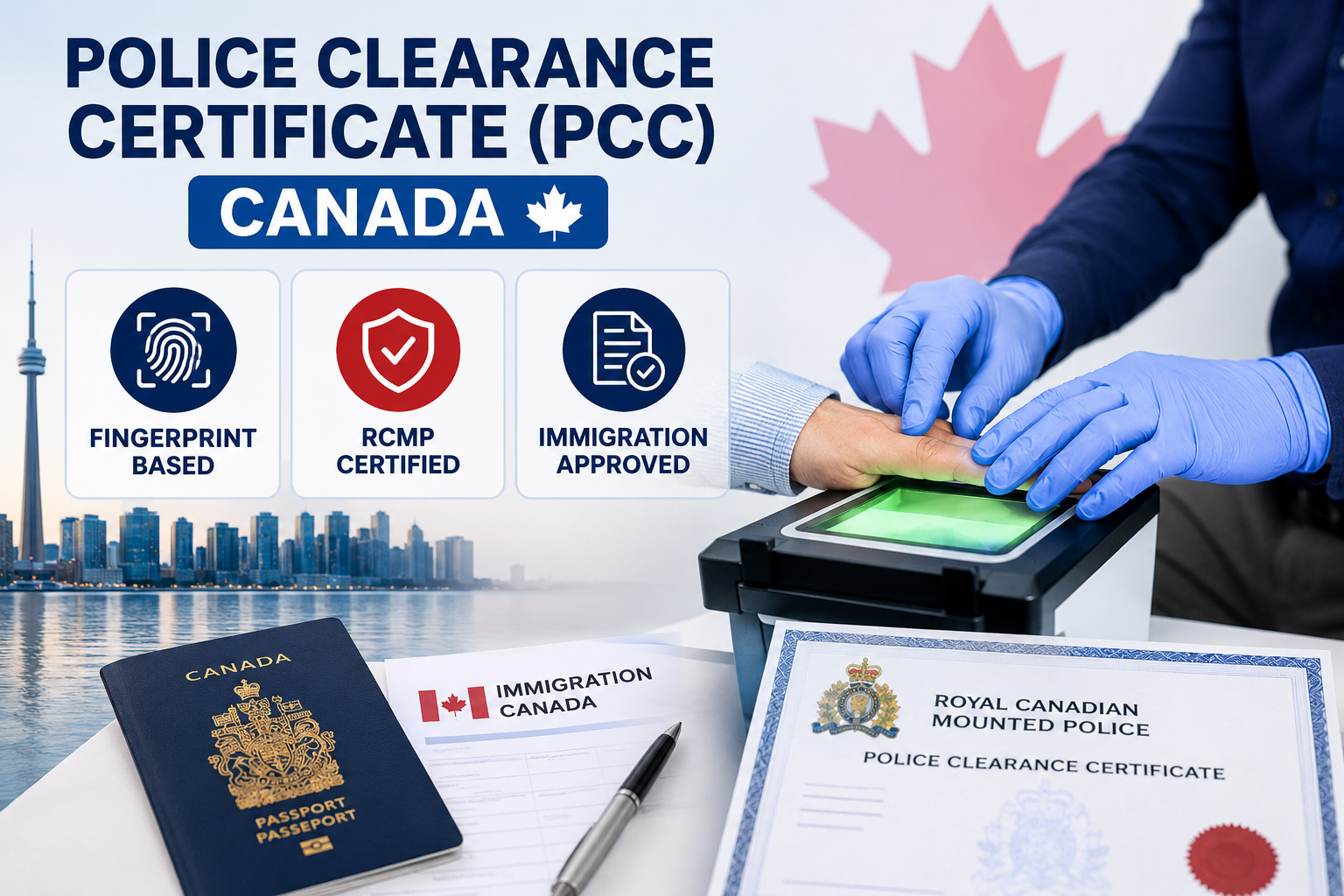
What Does a Canadian Police Clearance Certificate Show?
A Canadian Police Clearance Certificate is a formal document issued by the RCMP that states whether you have a criminal record in Canada’s National Repository of Criminal Records — the database maintained by RCMP CCRTIS.
- If you have no criminal record: the certificate confirms this, and serves as proof to the requesting authority that you have no criminal history in Canada
- If you have a criminal record: the certificate includes a copy of your criminal record, showing offences and convictions recorded in Canada
The PCC reflects your Canadian criminal record for the entire period you have been in Canada — not just recent years. It does not cover criminal records from other countries.
There are two types of Canadian police clearance certificates:
| Type | How Conducted | Notes |
|---|---|---|
| Name-based PCC | Search conducted using name and date of birth only | Less reliable — name matches can miss records or return false positives; not accepted by all immigration authorities |
| Fingerprint-based PCC (RCMP Certified) | Search conducted using digitally submitted fingerprints against the National Repository | The gold standard — most immigration authorities, foreign governments, and regulated industries require this type |
For immigration purposes — including IRCC applications, foreign PR applications, and most visa requirements — a fingerprint-based RCMP Certified Criminal Record Check is required. This is the same document as an RCMP criminal record check, issued in the format of a Police Clearance Certificate.
Why Is a Canadian PCC Required?
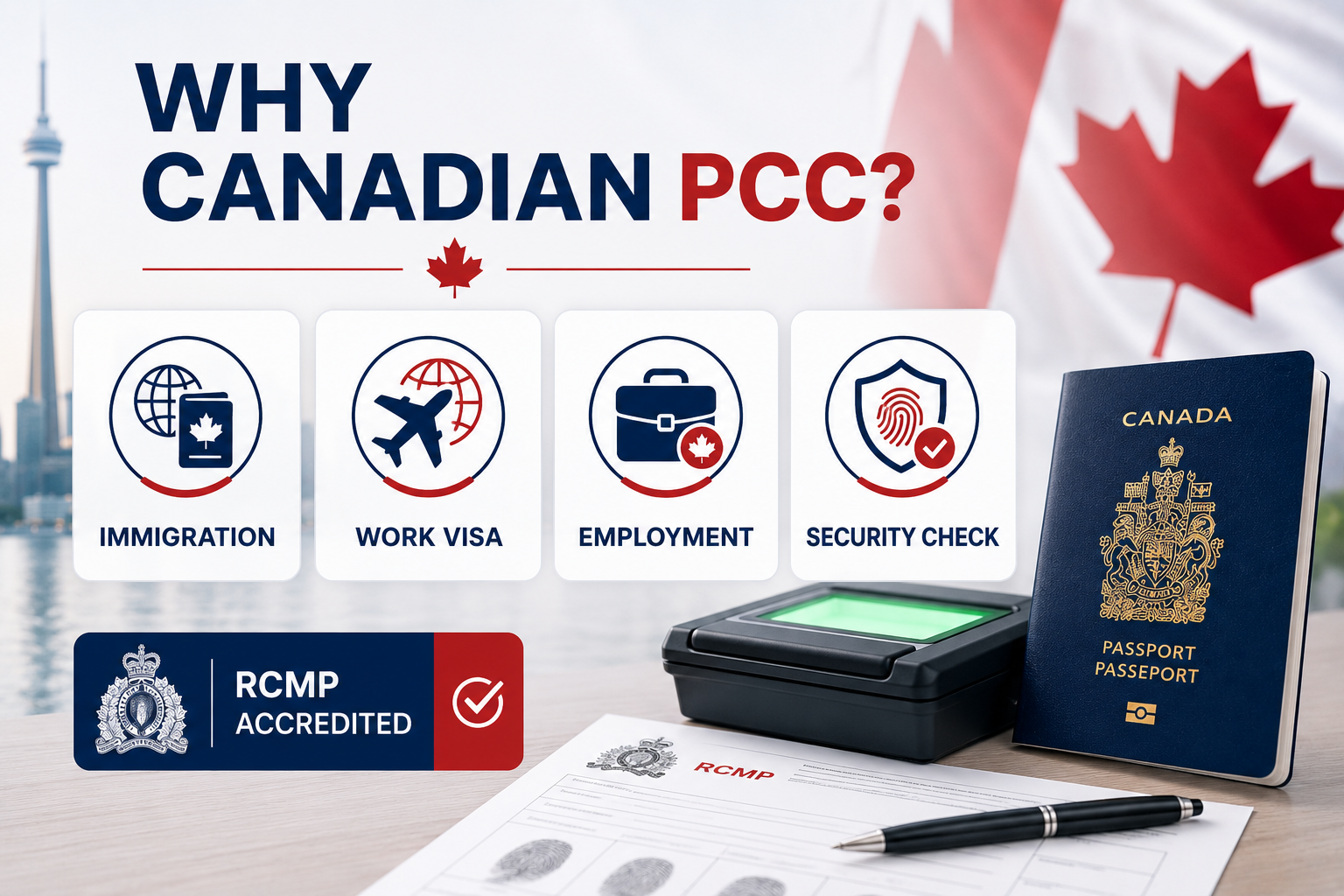
Who Asks for a Police Clearance Certificate from Canada and Why?
A Canadian PCC is required in a wide range of situations. The common thread: an authority needs to verify your Canadian criminal record history before granting you a visa, permit, status, licence, or position.
Immigration to Canada:
- Applicants for Canadian Permanent Residence via Express Entry, family sponsorship, Provincial Nominee Programme, or other pathways are required to provide police certificates from every country where they have lived for 6 months or more consecutively in the past 10 years
- Applicants for Canadian Citizenship require a fingerprint-based criminal record check
- IRCC uses the PCC to assess admissibility — whether there are reasons that would make the applicant inadmissible to Canada
Canadians and former Canadian residents applying abroad:
- Many countries require a police certificate from each country where you have previously lived as part of immigration, visa, or residency applications
- Common scenarios: Canadians applying for a work visa in the UK, Australia, UAE, USA, or Europe; former Canadian residents applying for PR in a third country
Employment and licensing:
- International employment in regulated sectors (finance, healthcare, aviation, government, security)
- Professional licensing in countries that require background clearance from all previous countries of residence
Other purposes:
- International adoption processes
- US Entry Waivers (for Canadians inadmissible to the United States)
- NEXUS trusted traveller programme
- Sponsoring a family member to immigrate to Canada
PCC vs Criminal Record Check: What's the Difference?
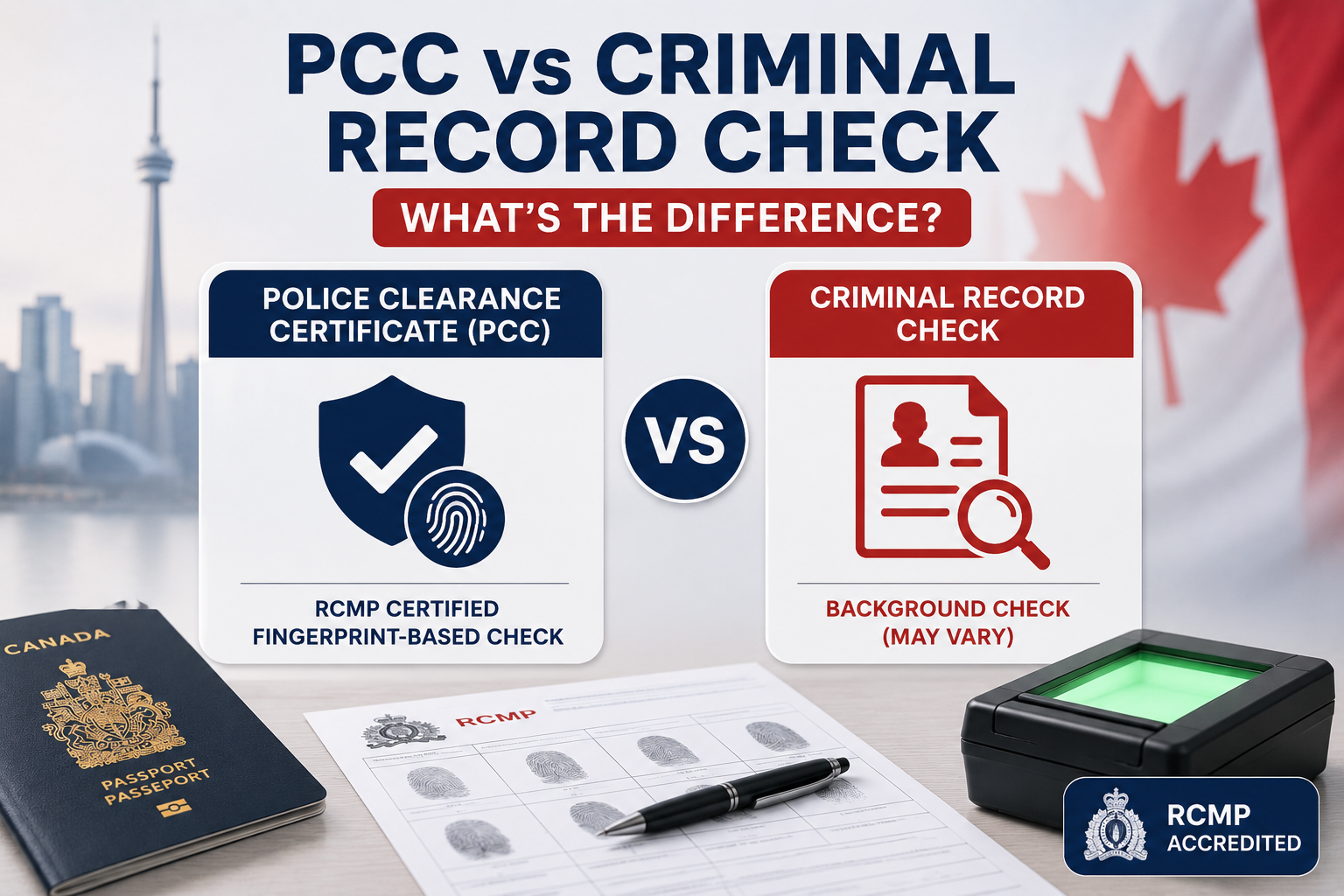
Is a Police Clearance Certificate the Same as a Criminal Record Check?
The terms “Police Clearance Certificate” and “RCMP Criminal Record Check” refer to the same underlying document — an RCMP-certified fingerprint-based search of the National Repository of Criminal Records. The distinction is largely terminological:
| Term | Used By | Meaning |
|---|---|---|
| RCMP Certified Criminal Record Check | Canadian employers, domestic use, accredited agencies | Standard term used within Canada for fingerprint-based criminal record verification |
| Police Clearance Certificate (PCC) | IRCC, foreign immigration authorities, embassies | Same RCMP-certified document, commonly requested for immigration and visa applications |
| Canadian Police Certificate | Foreign government visa requirements, third-country immigration | Country-specific terminology referring to the official Canadian criminal record certificate |
| Criminal Background Check | Employers, informal term | Often refers to the same RCMP fingerprint check; always confirm the required format |
The key point: when a foreign government, IRCC, or immigration authority asks for a “police clearance certificate” from Canada, they are asking for the RCMP Certified Criminal Record Check — fingerprint-based, submitted through an RCMP-accredited agency, and certified by RCMP CCRTIS. A name-based municipal police check from your local police service is generally not accepted as a substitute.
Who Needs a Canadian Police Clearance Certificate?
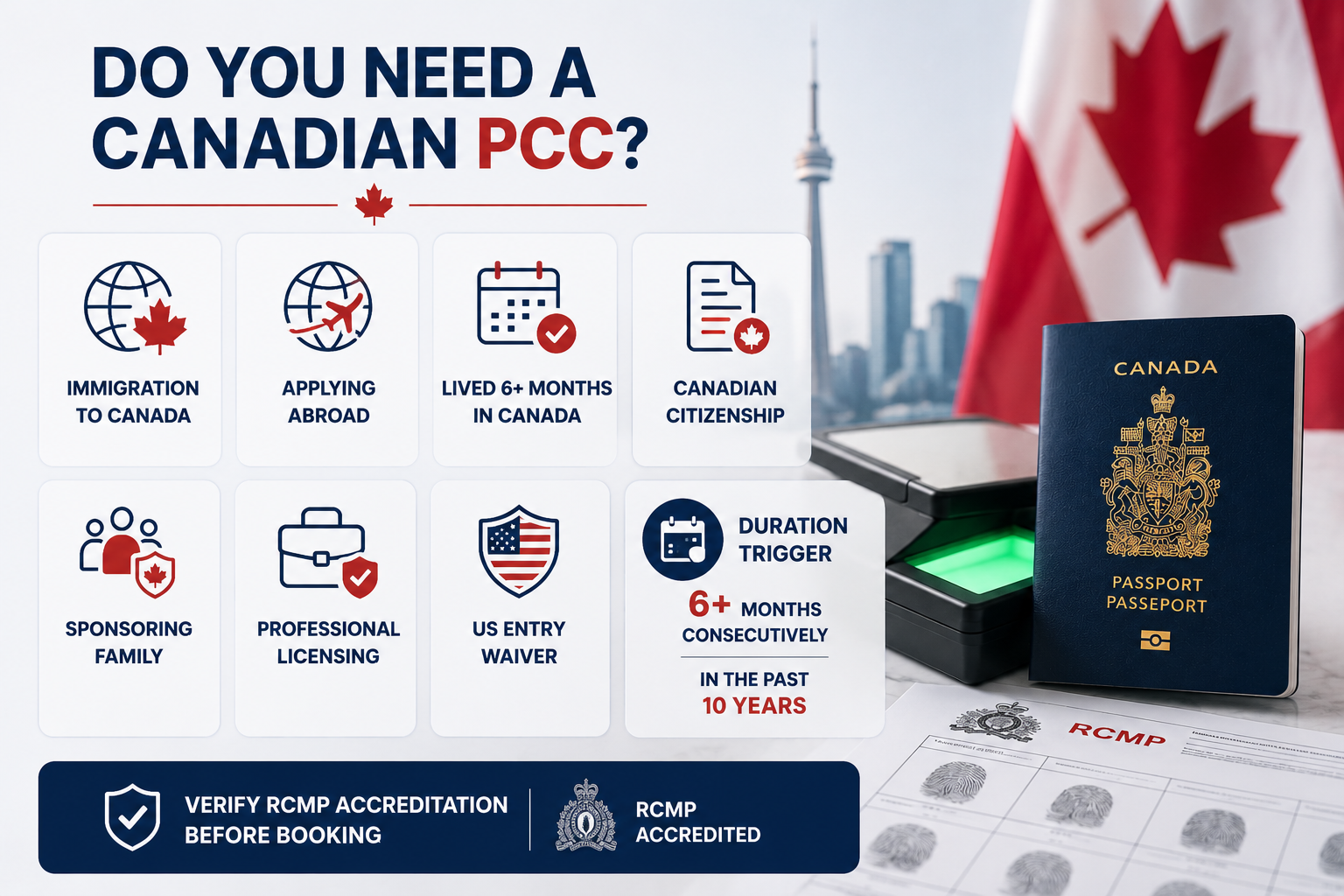
Do I Need a Canadian PCC for My Application?
You need a Canadian PCC if:
- You are applying for immigration to Canada (IRCC will request police certificates from countries where you have lived)
- You are a Canadian or former Canadian resident applying for a visa, PR status, or work permit in another country that requires a police certificate from Canada
- You lived in Canada for 6 months or more consecutively at any point in the past 10 years and are now applying for immigration elsewhere
- You are applying for Canadian citizenship
- You are sponsoring a family member to come to Canada (certain sponsorship applications require the sponsor’s criminal record check)
- You are a regulated professional applying for international licensing that requires background clearance from all countries of prior residence
- You are applying for a US Entry Waiver as a Canadian with prior US inadmissibility
Duration trigger — when is a Canadian PCC required for foreign immigration?
Most immigration authorities, including IRCC, use a trigger of 6 months or more consecutively in a country to require a police certificate from that country. If you lived in Canada for 6+ consecutive months in the past 10 years, you will generally be required to provide a Canadian PCC for any immigration application.
How to Get a Police Clearance Certificate in Canada (Inside Canada)
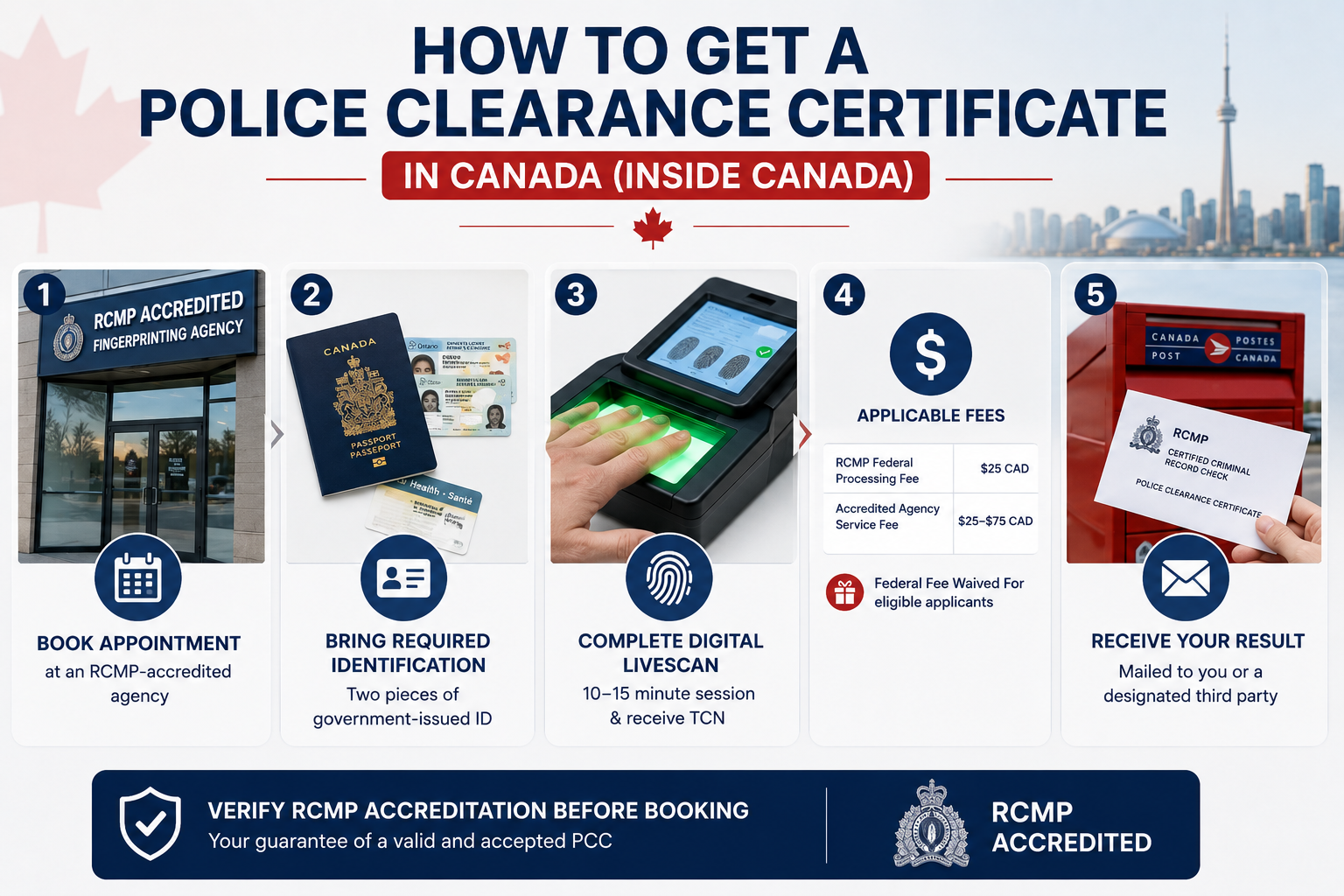
What Is the Process to Get a Canadian PCC If You Are Inside Canada?
If you are currently inside Canada, the process is straightforward:
Step 1 — Book an appointment at an RCMP-accredited fingerprinting agency
You do not go to a police station for a PCC inside Canada. You attend an RCMP-accredited private fingerprinting agency — such as Lotey Fingerprinting Services in Brampton — that is authorised by RCMP CCRTIS to take digital livescan fingerprints and submit them electronically.
The RCMP maintains a public list of all accredited agencies: → rcmp.ca/en/criminal-records/criminal-record-checks/private-fingerprinting-companies-accredited-rcmp
Step 2 — Bring required identification
Bring two pieces of government-issued ID:
- Primary ID (photo ID): Passport, Canadian driver’s licence, PR card, NEXUS card, Ontario Photo Card
- Secondary ID: SIN card, birth certificate, student card, immigration document, health card
Step 3 — Complete digital livescan fingerprinting
Your technician will capture all ten fingerprints using an RCMP-certified Electronic Fingerprint Capture Device (EFCD) and review quality in real time. The session takes 10–15 minutes. A consent form is signed, and you will receive your Transaction Control Number (TCN) — confirmation that your fingerprints have been submitted to RCMP CCRTIS.
Step 4 — Pay the applicable fees
| Fee Type | Amount |
|---|---|
| RCMP Federal Processing Fee | $25 CAD |
| Accredited Agency Service Fee | Set by agency — typically $25–$75 CAD |
| Federal Fee Waived For | Canadian immigration applicants, Canadian citizenship applicants, volunteer work, federal government employment, joining a Canadian police force, and Privacy Act requests |
Step 5 — Receive your result
The RCMP mails the result — your certified criminal record check / police clearance certificate — directly to you or to a third party you designate. Standard delivery is non-trackable mail. If you need it sent internationally, confirm the mailing address at the time of fingerprinting.
How to Get a Canadian PCC from Outside Canada
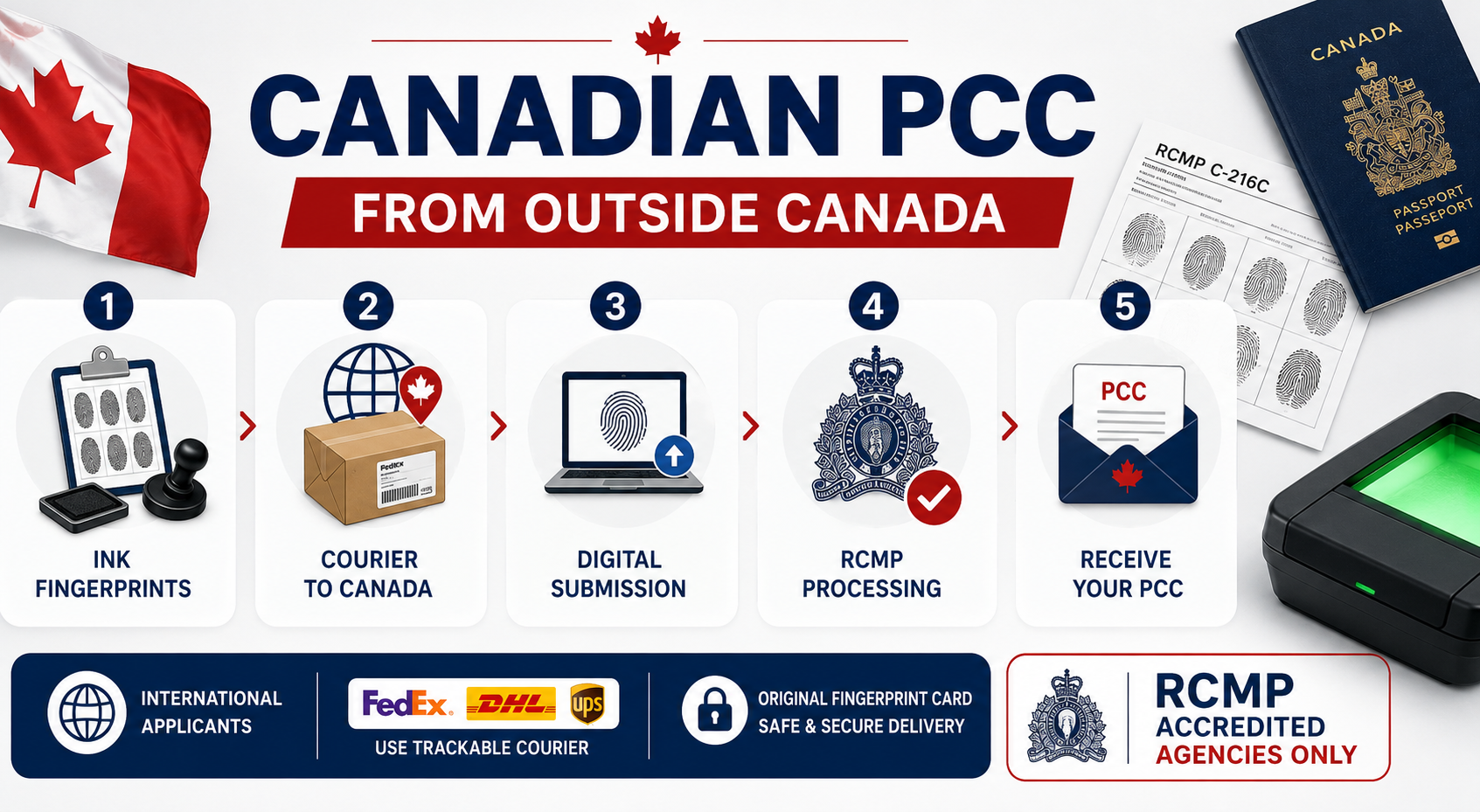
Can I Get a Canadian Police Clearance Certificate If I Live Outside Canada?
Yes — and this is one of the most common requests from former Canadian residents, Canadians working abroad, and international immigration applicants.
The process from outside Canada:
- Get ink fingerprints taken by an authorised local agency in your country (police station, notary, government office) on an RCMP C-216C or FBI FD-258 fingerprint card
- Mail or courier the physical fingerprint card to an RCMP-accredited Canadian fingerprinting agency (such as Lotey Fingerprinting in Brampton)
- The Canadian agency digitises your card and submits it electronically to RCMP CCRTIS
- The RCMP processes the check and issues your PCC, which is mailed to you internationally
Key points for outside-Canada applicants:
- You cannot submit fingerprints directly to the RCMP — all submissions must go through an accredited Canadian agency
- Use a trackable international courier (FedEx, DHL, UPS) for your fingerprint card — it is an original, irreplaceable document
- In countries where VFS Global operates the RCMP criminal record check service (USA, UAE, China, and others), you can use their end-to-end service
- Contact the Canadian accredited agency before mailing to confirm their address, accepted card formats, and what supporting documents to include
For the full step-by-step guide: → How to Get an RCMP Criminal Record Check from Outside Canada →
How Long Does a Canadian PCC Take?
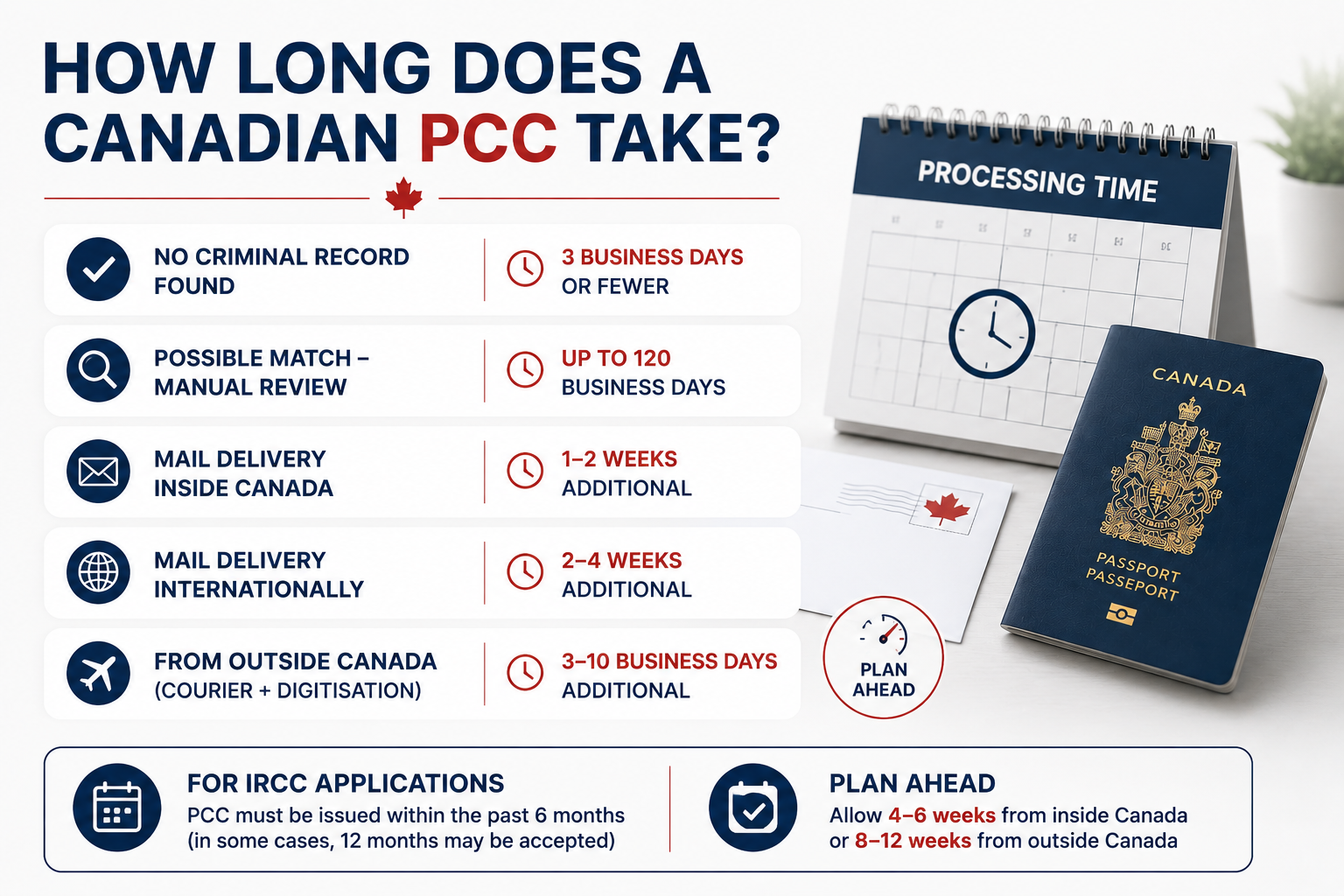
What Are the Processing Times for a Canadian Police Clearance Certificate in 2026?
| Scenario | RCMP Processing Time |
|---|---|
| No Criminal Record Found | 3 business days or fewer after electronic submission |
| Possible Criminal Record Match — Manual Review | Up to 120 business days |
| Mail Delivery Inside Canada | Add 1–2 weeks for standard Canada Post delivery |
| Mail Delivery Internationally | Add 2–4 weeks for standard international mail |
| From Outside Canada (Courier + Digitisation) | Add 3–10 business days for international courier + 1–2 days for digitisation and submission |
For IRCC immigration applications: PCC results must be recent. IRCC typically requires that your PCC was issued within the past 6 months for most applications. Check your specific application requirements — some IRCC programmes allow PCCs issued within 12 months for certain applicant categories.
Plan ahead: If you are applying for immigration with a deadline, allow a minimum of 4–6 weeks from inside Canada and a minimum of 8–12 weeks from outside Canada to ensure you have your PCC in time.
How Long Is a Canadian Police Clearance Certificate Valid?
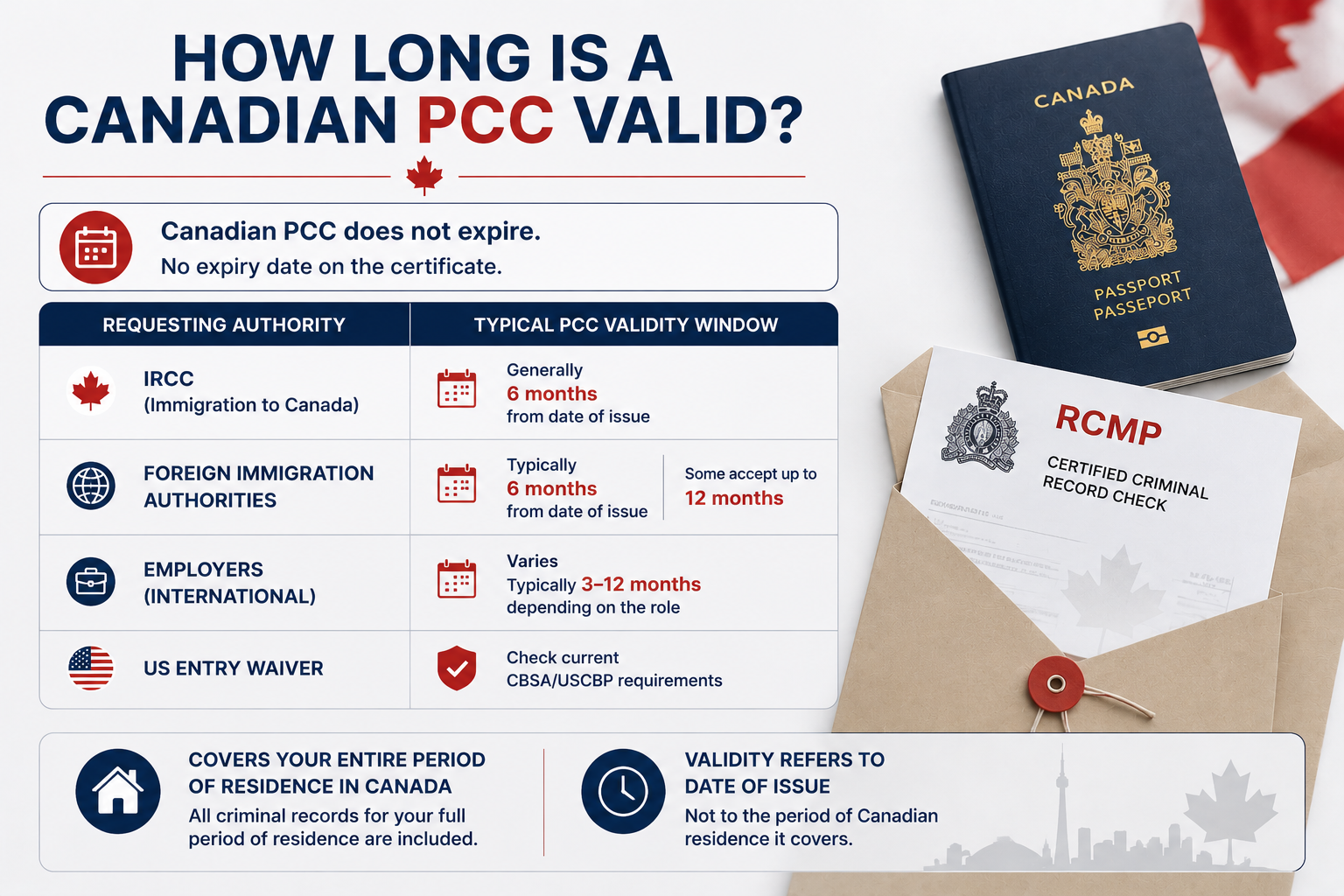
Does a Canadian PCC Expire?
A Canadian Police Clearance Certificate does not expire in an absolute sense — the RCMP certificate does not have a printed expiry date. However, for immigration and application purposes, most requesting authorities set their own validity windows:
| Requesting Authority | Typical PCC Validity Window |
|---|---|
| IRCC (Immigration to Canada) | Generally 6 months from date of issue |
| Foreign Immigration Authorities | Typically 6 months from date of issue; some accept up to 12 months |
| Employers (International) | Varies — typically 3–12 months depending on the role and jurisdiction |
| US Entry Waiver | Check current CBSA/USCBP requirements |
The certificate covers your entire period of residence in Canada — there is no specific historical window. Whether you lived in Canada for 1 year or 20, all criminal records for that full period are reflected. The validity window refers to how recently the certificate was issued, not to the period of Canadian residence it covers.
What If You Cannot Get a Canadian PCC?
What Happens If I Cannot Obtain a Canadian Police Certificate?
In rare cases, applicants may face difficulties obtaining a Canadian PCC — for example, if records are unavailable, processing is significantly delayed, or there are administrative complications. If you cannot provide a Canadian PCC for an IRCC immigration application, you must:
- Show proof that you requested a police certificate from the correct authorities (your TCN from the fingerprinting submission, or written confirmation of your application)
- Write a letter explaining all steps you have taken to obtain the certificate and the reasons it has not been received
IRCC acknowledges that in some cases, obtaining a police certificate from a particular country or in a particular situation may not be possible. However, submitting both the proof of request and the explanatory letter does not guarantee IRCC will accept your application without the certificate — it is assessed case by case.
What If Your Certificate Is Not in English or French?
Do I Need to Translate My Foreign Police Clearance Certificate?
For IRCC immigration applications, if you are submitting a police certificate from a country other than Canada, and that certificate is not in English or French, you must include:
- The original police certificate in its original language
- A certified translation into English or French by a certified translator
A Canadian PCC issued by the RCMP is in English or French and does not require translation.
Need a Canadian PCC in Brampton or GTA? Book with Lotey Fingerprinting Today.
At Lotey Fingerprinting Services in Brampton, we provide fast, RCMP-accredited Digital vs Ink Fingerprinting: — whether you need a PCC for immigration to Canada, IRCC processing, or a visa application abroad.
We also accept couriered ink fingerprint cards from outside Canada for digitisation and RCMP CCRTIS submission. Contact us before sending to confirm our address, accepted formats, and fees.
FAQ: Your Questions Answered
What is a Police Clearance Certificate from Canada?
A Canadian Police Clearance Certificate (PCC) is an official document issued by the Royal Canadian Mounted Police (RCMP) confirming whether you have a criminal record in Canada’s National Repository of Criminal Records. It is the same document as an RCMP Certified Criminal Record Check — the term “Police Clearance Certificate” is used in immigration and international contexts. The certificate confirms whether you have no criminal record, or includes a copy of your criminal record if one exists. For most immigration and visa purposes, a fingerprint-based RCMP PCC is required — not a name-based municipal police check.
Is a Canadian PCC the same as an RCMP criminal record check?
Yes — a Canadian Police Clearance Certificate and an RCMP Certified Criminal Record Check are the same document, referred to by different names in different contexts. When IRCC, a foreign embassy, or a visa authority asks for a “police clearance certificate” or “police certificate” from Canada, they are asking for the RCMP fingerprint-based criminal record check. The document is submitted through an RCMP-accredited fingerprinting agency, processed by RCMP CCRTIS, and issued as a certified result. A name-based check from a local police department is typically not accepted as an equivalent.
How long is a Canadian Police Clearance Certificate valid?
The RCMP certificate does not carry a printed expiry date, but immigration authorities set their own validity windows. IRCC typically requires a PCC issued within the past 6 months. Most foreign immigration authorities also use a 6-month validity window, though some accept certificates up to 12 months old. The certificate covers your entire period of Canadian residence — there is no historical cut-off on what records it reflects. Apply for your PCC as close to your application submission as possible to ensure it meets your authority’s validity requirement.
How much does a Canadian Police Clearance Certificate cost?
The RCMP federal processing fee is $25 CAD per criminal record check. This fee is waived for certain categories including immigration applicants to Canada, Canadian citizenship applicants, volunteer work, and federal government employment applications. In addition to the federal fee, the RCMP-accredited fingerprinting agency charges a service fee for conducting the fingerprinting and submission — fees vary by agency. If applying from outside Canada, you will also incur local fingerprinting fees in your country and international courier costs for sending your fingerprint card to Canada.
How long does it take to get a Canadian Police Clearance Certificate?
RCMP processing is 3 business days or fewer if no criminal record is found, and up to 120 business days if a criminal record match triggers manual review. Delivery of the result by standard mail adds 1–2 weeks inside Canada and 2–4 weeks internationally. From outside Canada, add the time for local fingerprinting, international courier delivery to Canada (3–10 business days), and digitisation by the Canadian agency (1–2 business days). Total time from outside Canada in a straightforward case is typically 3–5 weeks. Apply at least 3 months before any deadline to allow for potential complications.
Do I need a Canadian PCC for a permanent residence application to another country?
If you lived in Canada for 6 months or more consecutively at any point in the past 10 years, most immigration authorities will require you to provide a Canadian Police Clearance Certificate as part of your PR or visa application. This includes immigration to Australia, the UK, UAE, New Zealand, USA, and many other countries. The required timeframe (6+ months, last 10 years) is the most common trigger, though individual countries may have different specific requirements. Always check the police certificate requirements for the country you are applying to before applying.
Can I get a Canadian PCC if I am outside Canada?
Yes — the RCMP accepts applications from outside Canada. You must get ink fingerprints taken on an RCMP C-216C or FBI FD-258 card at a local authorised agency (police station, notary, government office), then courier the physical card to an RCMP-accredited Canadian fingerprinting agency for digitisation and submission. You cannot submit directly to the RCMP from abroad — all submissions must go through an accredited Canadian agency. See our complete guide: How to Get an RCMP Criminal Record Check from Outside Canada.
What does an RCMP Police Clearance Certificate look like?
The RCMP PCC is an official printed document on RCMP letterhead, bearing RCMP certification and the result of the criminal record check. If no criminal record is found, the document states this clearly. If a criminal record exists, the document includes the record details. The certificate includes the applicant’s name and date of birth as confirmed during the fingerprint submission. Some immigration authorities require the PCC to be apostilled — an additional official certification step — if it is being used in countries that are part of the Hague Apostille Convention. Confirm with the requesting authority whether an apostille is required for your specific application.
Do I need to have my Canadian PCC translated?
If you are submitting your Canadian PCC to a Canadian authority (IRCC), no translation is required — the RCMP issues certificates in English or French. If you are submitting it to a foreign immigration authority or embassy, and that authority requires documents in their national language, you may need to have the PCC translated by a certified translator. Confirm translation requirements directly with the requesting authority.
What if my Canadian PCC shows a criminal record?
If your RCMP PCC shows a criminal record, this does not automatically disqualify you from immigration or other applications — but it will require your application to be assessed for admissibility. Different offences carry different admissibility implications under IRCA (Immigration and Refugee Protection Act) for Canadian applications, and similar legislation in other countries. For immigration purposes, you should consult an immigration lawyer or regulated consultant who can advise you on the specific admissibility implications of your record for your specific application. Committing an offence abroad may also require additional police certificates from those countries.
Does Lotey Fingerprinting provide PCC fingerprinting in Brampton?
Yes — Lotey Fingerprinting provides digital livescan fingerprinting for PCC applications at our Brampton location. We are RCMP accredited, our EFCD devices are certified by the RCMP, and your fingerprint submission is transmitted electronically to RCMP CCRTIS the same day as your appointment. We serve clients throughout Brampton, Mississauga, Oakville, Toronto, and the Greater Toronto Area — and mobile fingerprinting is available where in-office attendance is not possible. We also accept couriered ink fingerprint cards from international applicants for digitisation and RCMP CCRTIS submission. Book at loteyfingerprinting.ca.

Navneet Lotey
Navneet Lotey has over 5 years of experience in fingerprinting. He aims to deliver accurate, easy-to-understand fingerprinting solutions for individuals and businesses alike.